|
T of C
Home |
My Work |
Hand- books |
Qin as Object |
Qin in Art |
Poetry / Song |
Hear, Watch |
Play Qin |
Analysis | History |
Ideo- logy |
Miscel- lanea |
More Info |
Personal | email me search me |
| Qin Tunings, Some Theoretical Concepts / Problems with just intontation tuning / 1-, 5- & 9-string qin tuning | 首頁 |
|
Tuning a Qin
1
Determining pitch/frequency2 and deciding what pitch standard to use3 |
古琴定弦法 |
1. Introduction
The traditional Chinese pentatonic scale has the relative pitches do re mi sol la (1 2 3 5 6 in modern Chinese number notation) rather than fixed pitches such as C D E G A where, according to the current Western standard, the A above middle C on a piano has a pitch of A=440hz (vib/sec).4 Thus the open first string on a qin is commonly tuned to 65 Hz. (As the 440Hz chart shows, because of this the pitch of a harmonic played at the 10th position on the fifth string also yields 440Hz.)5
However, because qin music in pre-modern times always used silk strings and relative tuning, and because tuning to A=440 often causes problems when playing with silk strings, on my own recordings the open first string is usually tuned lower. For example, the open first string will often be 60Hz (as in this 405Hz chart rather than 65Hz. In modern Western terms this makes the "C" closer to Bb, but for music of the Baroque period it is close to what they commonly played as "C".6
Having established that the notes in qin music do not have fixed pitch, the actual tuning of a qin requires first determining what standard relative tuning to use on a particular instrument and/or for a particular piece then, if necessary, modifying that tuning to achieve any of the non-standard tunings. In this regard, since ancient times standard tuning has been achieved by following instructions such as those given below under General tuning. Then, as shown there, this standard tuning can be considered either as 1 2 4 5 6 1 2, or 5 6 1 2 3 5 6, depending on what the tonal centers are for the melody to be played. The actual relative pitches resulting from those two tunings are shown in this chart (given there using solfeggio).
Today almost all qin pieces use standard tuning, the main exceptions being two melodies that use ruibin tuning, in which one string is altered: the fifth string is raised a half tone. In constrast, early qin music used a great variety of different tunings, some requiring re-tuning as many as four of the strings. The most common non-standard tunings are given in the chart at the top of the page on mode.
To recap what was just written, it is important to remember that traditionally there was no absolute pitch standard in qin tuning. Standard modern Western concert tuning puts the pitch we call "A" at about 440 Hz, and Western influence in Chinese conservatories has led to pervasive claims nowadays that qin strings should follow that standard and be tuned so that the lowest qin string in standard tuning is tuned to an octave below the Western concert C. Traditionally, however, the relative tuning accorded with such factors as individual taste, the size of the instrument, the weather and other factors. On my silk string qin the first string is usually tuned to between the modern Western pitches of B and Bb, but there are old recordings of silk string qins with the bottom string tuned as low as G or as high as C sharp.
When my teacher Sun Yuqin first taught me to tune my guqin there was no discussion of absolute pitch any more than there was of mathematics. On this site mathematical calculations are discussed either elsewhere or in the appendices below.
- For calculations based on relative pitch see Qin Tunings, Some Theoretical Concepts.
- For finger positions generally used see Appendix I, Representational Finger Position Charts.7
- For the resulting harmonics with do = 60 Hz, see Appendix II, Pitches available in harmonics.
- For considering actual pitch see Appendix III, Absolute pitch.
For actual tuning of the qin the general principle for pitch seemed to be to tighten the strings as much as possible without them breaking easily. As for the actual process, my teacher first showed his students how to do a general tuning using open strings and stopped sounds, then a fine tuning using harmonics. As with teaching in general the students simply mimicked him. The sequence was not always the same, but this did not affect the result. Here is a discussion of the process.
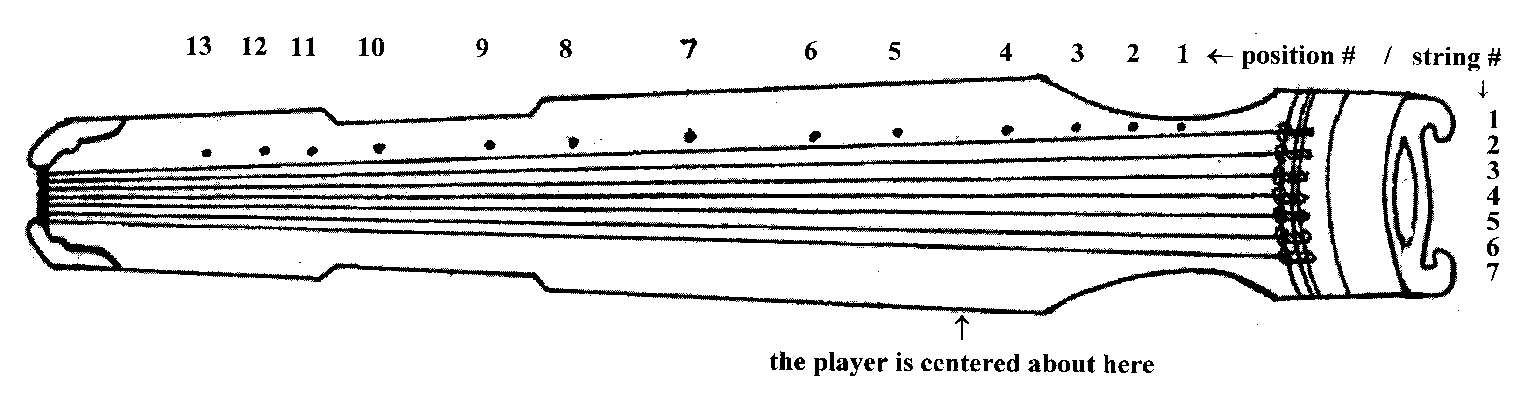
On the accompanying illustration note that qins have seven strings, numbered from the far side of the player, and 13 markers (hui) indicating harmonic nodes, but also used to indicate stopped-sound finger positions.
 |
Standard Tuning:8
General Tuning
As a typical example for standard tuning, once the pitch of either the fourth string or the seventh string seems to be about right, you can start with the following six steps.
Fine Tuning: Standard Tuning
Now use the following harmonic positions to make the tuning more precise. This tuning is more precise because with the stopped sounds it is almost impossible to put the left finger down in precisely the correct position, while the harmonic position must be precise or the note will not ring clearly.
(A footnote below describes how to set the fifth string to 202.5 Hz [the A one octave below 405 Hz on the chart below, that considers the open first string as having the pitch 60 Hz, between a modern concert B flat and B natural]. The following process can easily be adjusted so as to begin by setting the pitch for this fifth string, then adjusting the other strings accordingly.)
The same results come from testing the harmonic positions at the player's right end of the qin, as follows.
During the above process, if one of the strings is found to be out of tune, you make the necessary adjustments then go through either the entire sequence again or, more commonly, only the harmonic sequence. In fact many people do their tuning using only the harmonic sequences, unless the qin has gone very badly out of tune.
Almost all melodies in the active repertoire (i.e., excluding melodies reconstructed from early tablature) use this standard tuning. With different tunings, the relationships are always given in terms of how they deviate from this standard tuning. For example the raised 5th string tuning (usually called ruibin diao in old handbooks but today other names may be used) is usually indicated as follows.
Non-standard tuning (example)
General Tuning (Ruibin)
To achieve this tuning, first do the standard tuning, as above. Then from standard tuning raise (tighten) the 5th string so that the open 7th string has the same sound as the 5th string stopped in the 11th position (newer handbooks may try to be more precise by saying position 10.8).
Fine Tuning (Ruibin)
The harmonic equivalents have now changed, as follows.
Similar sequences are followed to adjust for and check the accuracy of the various other tunings used for the qin. For further information on this see
Qin Tunings, Some Theoretical Concepts or
Modality in Early Ming Qin Tablature.
1-, 5- & 9-string qin tuning
Melodies in the 1618 handbook use all nine strings to form single melodies. However, as can be seen in the previous two lines, using a nine-string qin one could also play two seven-string melodies using different tunings without have actually to stop and re-tune.
Here reference may be made to the first chart shown on the page
Modality in early Ming qin tablature. Looking at that chart one can see that with the nine string tuning considered as having its lower seven strings using standard tuning, i.e., 5 6 1 2 3 5 6 1 2 one could play, without re-tuning, any melody using the following tunings:
If, instead, the nine string tuning remains pentatonic but with the upper seven strings tuned to standard tuning 5 6 1 2 3 5 6, making the nine strings 2 3 5 6 1 2 3 5 6, one could play, without re-tuning, any melody using the following tunings:
Such possibilities do not seem to have been discussed in any traditional handbooks. However, might such a nine string qin be useful for a performer who wants to play two or three melodies in different tunings without having to stop and re-tune?
Standard tuning (正調 zheng diao, two versions)
10
(Note: A harmonic on the 9th position of the 5th string will not have the same sound as a harmonic played on the 10th position of the 3rd string.)
(Note: A harmonic on the 5th position of the 5th string will not have the same sound as a harmonic played on the 4th position of the 3rd string.
(Note: A harmonic on the 7th position of the 5th string no longer has the same sound as a harmonic played on the 9th position of the 2nd string.)
(Note: A harmonic on the 9th position of the 7th string no longer has the same sound as a harmonic played on the 10th position of the 5th string.
These are qin types that are mentioned in ancient history but with no ancient tablature. Tablature was developed for them during the Ming dynasty, but the model seems always to be the standard 7-string qin, perhaps modified in some way.
As can be seen from this image
(compare here) the one string qin seems to be considered as a standard qin with only one string, placed perhaps in the center. The numbers along the top of any of the charts below show the positions that would have been used for tablature playing notes with the common Chinese musical scale and intonation.
Likewise, the five string qin as seen from
this image (also
here), during the period from which we have tablature seems to have been considered the same as the standard qin but with only five strings. Again the positions used on any of the five strings would be the positions that would have been used for tablature playing notes with the common Chinese musical scale and intonation. Most likely it would be the first five or the last five of the seven positions.
As for the nine string qin, for which melodies were only included in one handbook (Li Xing Yuan Ya [1618], which had five such melodies), the tuning seems to have been largely pentatonic, again with hui positions as in the charts below. The image on that page showing a
sample of 9-string qinpu describes the tuning method. As for the melodies included in that handbook, the nine strings used seem to be tuned either to what are the first nine strings in the first chart below, which shows the two standard tunings (5 6 1 2 3 5 6 and 1 2 4 5 6 1 2). Adjusting for octaves this makes the nine string tuning either
or
1 2 4 5 6 1 2 4 5
6 1 2 3 5 6 1 (middle 7 strings); e.g., any guxian mode melodies
1 2 3 5 6 1 2 (upper 7 strings); e.g., any manjue mode (a.k.a., biyu mode) melodies.
3 5 6 1 2 3 5 (middle 7 strings); e.g., any
mangong mode melodies
5 6 1 2 3 5 6 (upper 7 strings); e.g., any gong mode melodies (actually any standard tuning melodies)
Appendix I: Representational finger position charts
9
When doing dapu I use charts such as these to quickly know the pitches indicated in tablature. In the charts the words in capitals are the relative pitches of the open strings, letters in capitals show the harmonics, small letters show stopped sounds. The stopped positions are "representational" because they name the notes but for
various reasons cannot consistently indicate the precise position where the note is played.
(Top)
In standard tuning the open first string is usually considered either as do or as so (traditionally there was no absolute pitch,
discussed below).


 |
Non-Standard tunings (外調 wai diao, many variants)
There are further variants; most include non-pentatonic notes. The two most common examples are as follows:
In non-standard tuning one or more of the strings is lowered or raised from standard tuning. Any string might be considered as do. There are five qin tunings set to the standard Chinese pentatonic scale of 1 2 3 5 6 (do re mi so la). One of them is the standard tuning treated as 5 6 1 2 3 4 5, shown at the top of the chart directly above. There are five of these in all, as follows (links are to charts below):
2 3 5 6 1 2 3 ruibin (raise 5th string)
3 5 6 1 2 3 5 mangong (lower 1st, 3rd and 6th strings )
5 6 1 2 3 5 6 zhengdiao (standard)
6 1 2 3 5 6 1
guxian (tighten 2nd, 5th and 7th )
2 4 5 6 1 2 3 qiliang (raise 2nd and 5th strings)
Manjue tuning (慢角調 manjue diao)
From standard tuning lower the third string a half pitch. In this tuning the open first and sixth strings are do.
 |
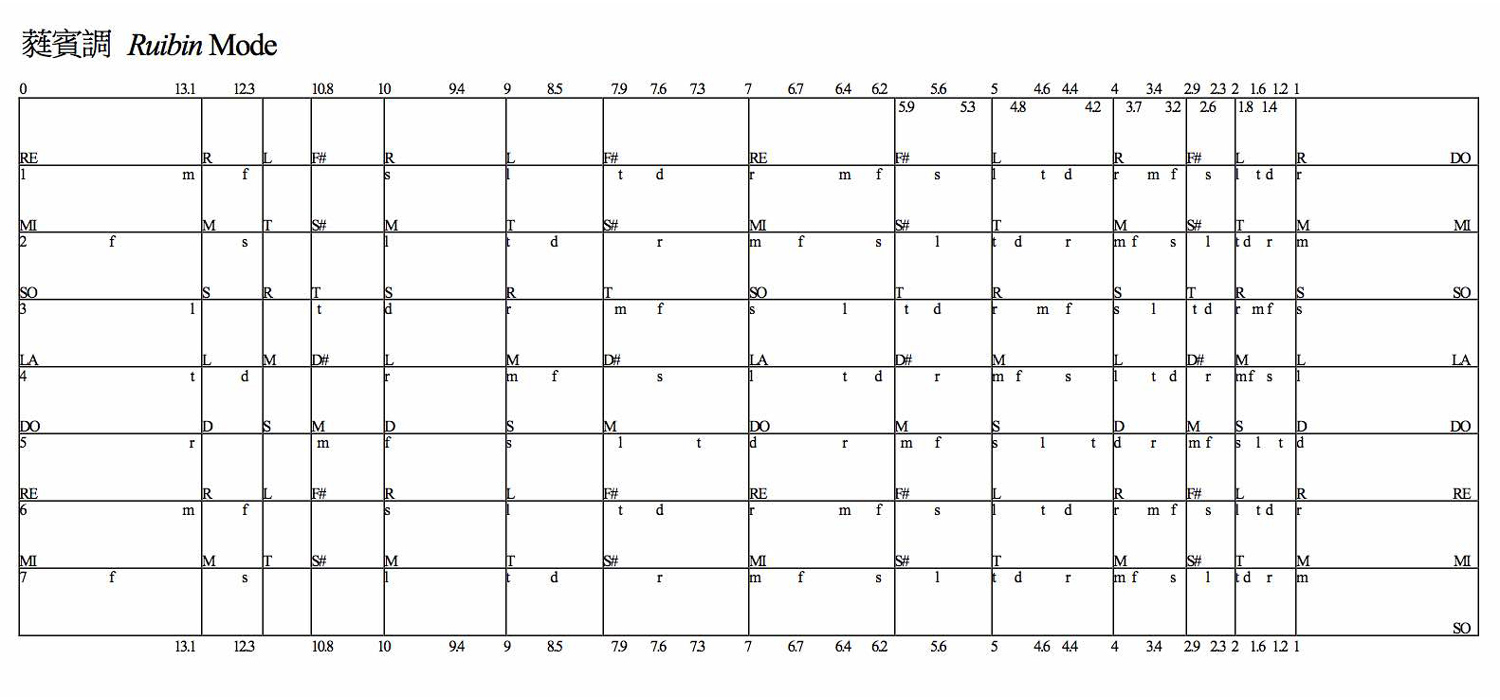
Ruibin tuning (蕤賓調 ruibin diao)
From standard tuning raise the fifth string a half pitch. In this tuning the open fifth string is do.
 |
Mangong tuning (慢宮調 man gong diao)
From standard tuning lower the first, third and sixth strings (or raise the second, fourth, fifth and seventh strings) a half pitch. In this tuning the open fourth string is do.
(Compare this alternate, in which the second string is do and so (as with the 1 2 4 5 6 1 2 version of zheng diao) one string is tuned to fa.

 |
Guxian tuning (姑洗調 guxian diao)
From standard tuning raise the second, fifth and seventh strings (or lower the first, third, fourth and sixth) a half pitch. In this tuning the open second string is do.
 |
Huangzhong tuning (黃鐘調 huangzhong diao)
From standard tuning lower the first string a whole pitch and raise the fifth string a half pitch. In this tuning the open fifth string is do.
 |
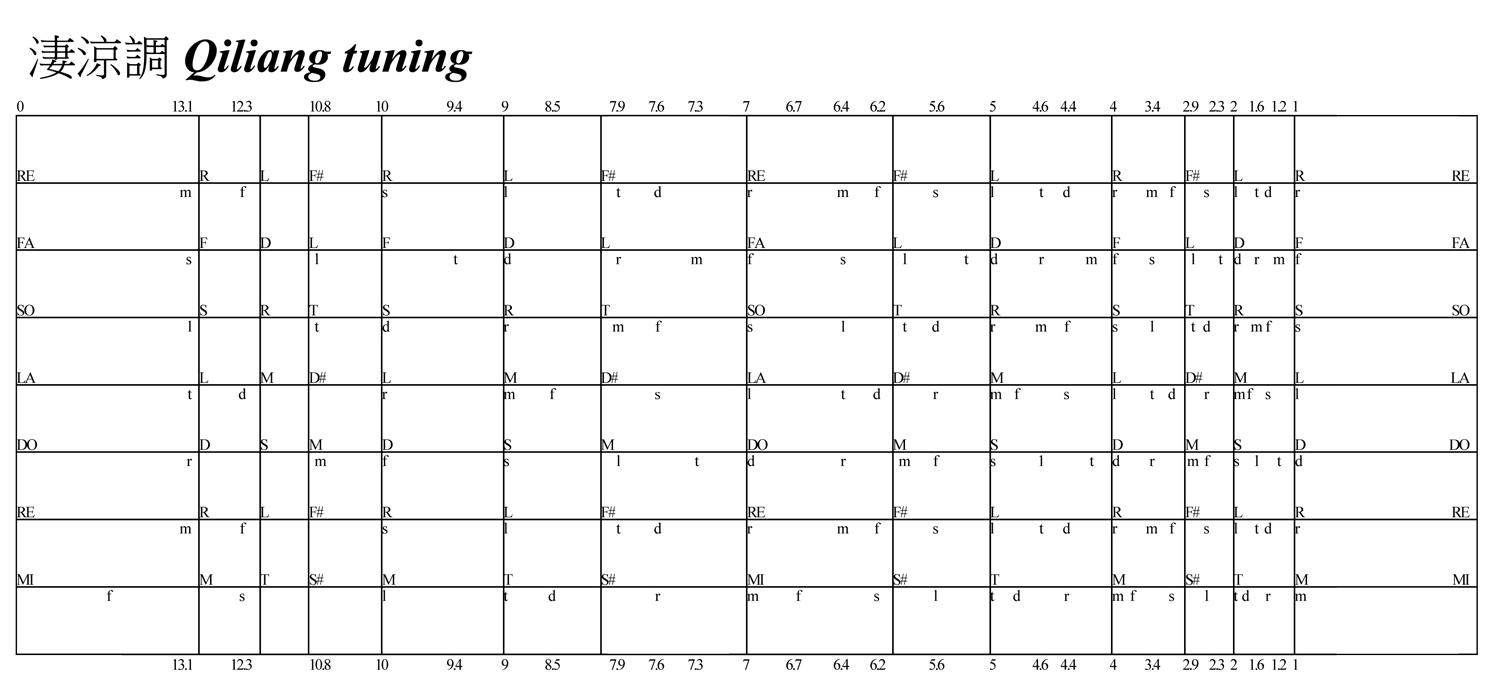
Qiliang tuning (凄凉調 qiliang diao)
From standard tuning raise the fifth string a half pitch. In this tuning the open fifth string is do.
 |
Similar charts are available for most other tunings.
For the harmonics in the above illustrations it is mathematically convenient to consider the open first string to be tuned to 60 vib/sec (Hertz, Hz).11 Although, based on a modern concert pitch of A=440 Hz, this 60 Hz first string is a slightly flat B, for baroque music C is often based on A=415, making this 60 Hz open first string a slightly flat C (in this system C is about 62 Hz). On my qin this is close to the pitch I generally use for the open first string. Listed below are possible measurements (in Hertz) based on the open first string being tuned to 60 Hz. Note that the 13 hui form a mirror image from the middle (#7). Thus, a harmonic played at hui #1 on the first string has the same pitch as at #13 on the same string, etc. (The "just intonation" pitches at positions 2, 6, 8 and 11 on each string also have identical pitch.)
Open string and harmonic pitches on a qin tuned to A=405 hz
(compare A=440Hz)
Appendix II: Pitches available in harmonics
This uses standard tuning, with the open first string (considered as do) = 60 Hz
Note that with stopped sounds any pitch is available
| String/rel. pitch/fraction of do \ hui: | ||||||||||||||
| 1. (Do [1]) = 3/4 (48/64) | ||||||||||||||
| 2. (Re [2]) = 27/32 (54/64) | ||||||||||||||
| 3. (Fa [4]) = 1 (64/64) | ||||||||||||||
| 4. (sol [5]) = 9/8 (72/64) | ||||||||||||||
| 5. (la [6]) = 81/64 (81/64) | ||||||||||||||
| 6. (do [1]) = 3/2 (96/64) | ||||||||||||||
| 7. (re [2]) = 27/16 (108/64) |
The open string and harmonic pitches on the above chart can be grouped as follows (the range of a qin is four octaves plus a whole tone; the open first string is considered as do):
| Name | Pitch (Hz) | |
| do | = 60, 120, 240, 480, 960 | |
| do# "just" | = 506 | |
| re | = 67.5, 135, 270, 540, 1080 | |
| mi | = 300 , 600 | |
| mi "just" | = 304, 608 | |
| fa | = 80, 160, 320, 480 | |
| fa# "just" | = 337.5, 675 | |
| sol | = 90, 180, 360, 720 | |
| la | = 101, 202.5, 405, 910 | |
| la "just" | = 400 | |
| ti "just" | = 450 |
As for the justified intonation ("just") notes, do# and fa# almost never occur (ti may occur slightly more often). In early tablature the justified mi and la do sometimes occur in the same pieces as the Pythagorean mi and la. This has led some people to try to retune the qin to avoid these "dissonances". I believe that qin players of antiquity appreciated the special colors brought by the occasional justaposition of such pitches. My argument is presented in Qin Tunings, Some Theoretical Concepts and Problems with Just Intonation Tuning.
| Name | A | A# | B | C | C# | D | D# | E | F | F# | G | G# | A | |
| Pitch (Hz) | 220 | 233 | 247 | 262 | 277 | 294 | 311 | 330 | 349 | 370 | 392 | 415 | 440 |
Today the guqin is commonly tuned based on the Western standard of the A above middle C being 440Hz and the open first string being tuned two octaves below middle C (approximately the lowest note on a cello): 65/66H. Here, then, instead of the pitches above, are the pitches available in harmonics if the qin is tuned to the modern Western standard are as follows:
Open string and harmonic pitches on a qin tuned to A=440 hz (compare A=405Hz)
| String/rel. pitch/fraction of do \ hui: | ||||||||||||||
| 1. (Do [1]) = 3/4 (48/64) | ||||||||||||||
| 2. (Re [2]) = 27/32 (54/64) | ||||||||||||||
| 3. (Fa [4]) = 1 (64/64) | ||||||||||||||
| 4. (sol [5]) = 9/8 (72/64) | ||||||||||||||
| 5. (la [6]) = 81/64 (81/64) | ||||||||||||||
| 6. (do [1]) = 3/2 (96/64) | ||||||||||||||
| 7. (re [2]) = 27/16 (108/64) |
As explained here, instead of following Western pitch standard I am more likely to using a lower tuning with, as outlined here, my first string tuned to about 60 hz, putting it between the 58.27 Hz A#/Bb and the 61.735 Hz B♮ two octaves below middle C. (If the first string is tuned up to the modern concert C [ca. 65 hz] it breaks too often; if tuned exactly to a "baroque C" [modern B: ca. 62 hz] breakage is usually not a problem. In a place with constant humidity change I may tune even lower.)
The problem with following this tradition is that it causes problems when trying to play the qin with instruments inflexibly tuned to modern concert pitch. With stopped sounds any note can in theory be played on a qin, but harmonics and open strings are very important, and without retuning the qin these are inflexible. Plus, I know of no one who can take a qin melody and simply transpose it up or down without retuning.
Thus, unless one wishes to risk breaking strings, there seem to be two most likely strategies to use for playing together with instruments using modern Western pitch.
| Tuning \ String | 1 | 2 | 3 | 4 | 5 | 6 | 7 | ||
| Standard | B | C# | E | F# | G# | b | c# | ||
| Huangzhong | A | C# | E | F# | a | b | c# | ||
| Guxian | A | C | D | E | G | a | c | ||
| Mangong | A | C | D | F | G | a | c |
Unfortunately there are not many melodies that use guxian and mangong tunings (follow the links above to see listing).
Footnotes (Shorthand references are explained on a
separate page)
1.
Tuning a qin
To understand why the tuning methods (定弦法子) described on this page result in the desired relative tunings (相對定音) please study the mathematical relationships between positions on the seven qin strings as described under Qin tunings: some theoretical concepts.
(Return)
2.
Pitch
Musical pitch is measured scientifically in terms of vibrations per second (Hertz/Hz). The higher number of vibrations per second, the higher the pitch. The precise mathematical relationships (e.g., doubling the number of vibrations per second makes the pitch go up an octave). In the Western during earlier periods the "standard" pitch was generally either lower or there was no absolute standard. In fact, although it is not certain when people first realized that pitch was related to the number of vibrations, it was not until the 1830s that we began to be able to measure these vibrations (proaudioencyclopedia.com).
(Return)
3.
What pitch standard to use: absolute? relative? (compare "perfect pitch")
"Absolute pitch", discussed further above as well as in the next footnote, is sometimes used with the same meaning as "perfect pitch: the ability to determine simply by hearing whether a note is a C or a D, etc. Here "absolute pitch" is used to mean "standard pitch". For more on this see these Wikipedia articles:
These suggest that "absolute pitch" is usually used to mean the ability to identify a precise pitch (in Hz?) simply by listening.
(Return)
5.
Absolute pitch?
The idea that qin should be tuned based on the modern Western concert standard of A=440 clearly has no foundation in Chinese tradition. The fact is that Chinese music conservatories are so imbued with Western aesthetic (or more specifically the aesthetic of Russian conservatories in the Soviet period) that even today in China "music" means "Western music" while "Chinese music" is considered "ethnic". From a practical standpoint, then, the main reason for tuning a qin to Western concert pitch is that this allows the qin to play together with other instruments that use the same standard, in particular the piano. The higher tuning also allows the qin to be played louder, and the emphasis in the conservatories is performance, not self-cultivation.
This attitude is also completely bound up with the development of nylon metal strings during the Cultural Revolution, usggesting that it was, at least in part, another result of this Western influence; it is thus not surprising that this standard has been applied to the metal qin strings. It is more difficult to apply these pitch standards to silk strings, as such a high tuning on a standard size instrument leads to more string breakage. Unfortunately, instead of accepting this as an essential part of the qin tradition the conservatories try to use this as evidence that there is something wrong with the qin tradition.
(Return)
6.
Actual pitches on a qin
The actual pitches of qin strings were determined by such factors as individual taste (the higher the pitch the clearer and louder the sound, the lower the pitch the mellower the sound), the quality and size of the instrument, the weather (changing humidity requires lower pitch to keep the strings from breaking). My own tendency is to tune the strings up as high as they can go without causing them to break very often. What is "often" is, of course, subjective.
From my experience the string most likely to break is the highest (and thinnest) one (#7); hence most sets include an extra 7th string. Second most likely to break is the fourth string (#4), which is the thinnest of the wrapped strings; for this reason some sets have also included an extra fourth string. Next most likely to break is the sixth string; other strings hardly every break.
In a climate controlled room with regular play I expect the 7th string to go at least six months without breaking - often longer, certainly longer if tuned lower, shorter if not climate controlled.
(Return)
7.
Representational Finger Position Charts
These are of particular use when reconstructing early music directly from tablature.
(Return)
8.
Standard Tuning (正調 zhengdiao)
In Chinese this tuning literally means "correct" or correctly regulated. Non-standard tunings (外調 wai diao, literally "outside tunings") are described by how standard tuning must be changed to achieve them. There was no standard pitch (designated absolute pitch) in early qin tunings, so they are best described not by Western pitch names (A B C, etc.) but by relative pitch names (do re mi... or, in the Chinese number system, 1 2 3...).
Traditional tunings all emphasize the fact the qin music was basically pentatonic though, especially with the earlier surviving repertoire, there are many non-pentatonic notes. This led to an idiom which makes it difficult to play diatonic music on the qin using any of the traditional tunings.
There was a traditional disagreement in Chinese writing about whether the main pitch in standard tuning should be on the first or the third string. The choices are:
Standard tuning, third string as 1 (do): 5 6 1 2 3 5 6
Once again, in pitch these two tunings are identical: the difference has to do with which pitch is (or should be) the most important one.
It is somewhat puzzling, especially given the fact the the lower five strings are named gong shang jue zhi yu, i.e., do re me sol la, why 1 2 3 5 6 1 2 did not become the main tuning. Instead it is generally called "lowered third" (manjue) tuning, and at least since the Ming dynasty it has never been very popular. The answer to this probably concerns practical use of the tuning; there is some mention of this in the following arguments.
The arguments on the topic of standard tuning generally seem to concern music theory as opposed to practical use.
- Arguments in favor of considering the tuning as 1 2 4 5 6 1 2, i.e., naming the first string "do" ("gong" in Chinese), begin with the fact that the first string is called "gong". The argument may add that since "do" is the most important string the fundamental string should be tuned to that string.
The most obvious problem with considering the tuning as 1 2 4 5 6 1 2 is that for purely pentatonic music the open third string must be avoided. Although this could be solved by making the third string 3 instead of 4, one then can no longer tune the qin using only harmonics in the seventh and ninth (or fifth) positions (see above as well as the following comment, which helps explain why this 1 2 4 5 6 1 2 tuning did in fact become the most popular one by far).
- Arguments in favor of considering the tuning as 5 6 1 2 3 5 6, i.e. naming the third string "do" thus center on a negative: the fact that if the first string is do then in this tuning the third string does not fit into the standard Chinese pentatonic scale, do re mi so la (1 2 3 5 6).
The problems with considering 5 6 1 2 3 5 6 as standard tuning may be less obvious, but from my experience they are related to the fact that most qin music is in a do - sol mode (details under modal characteristics). Qin melodies with do as the main note like to play octaves or techniques such as da yuan on do; these are awkward when the only open string tuned to do is the third string. This also helps explain why "yu mode" (la - mi mode) pieces use this tuning: here the open second and seventh strings are both yu (6; la).
Although my transcriptions are all written in Western staff notation, this is treated like the Chinese number system, so that "A" has nothing to do with the modern A=440 Hz; instead it means la (further details).
The next footnote has an example of setting the actual pitch when tuning a qin.
(Return)
| 9. Hui marker positions: source of information for the above | Finger position guidelines chart copied from 1911 (expand) |
 The charts above give 徽位 finger positions following the decimal system as used in charts such as the one on the right
(expand; see also the
original layout, from
QQJC XXX/352). Many such charts were included in earlier handbooks, but this seems to be the most precise of the ones that I have seen within the handbooks included within the Qinqu Jicheng collection. Examining those charts suggests that even after the development of the modern decimal system (the earliest evidence for which seems to date from around 1600) it was quite likely that the charts were generally based on observations of an actual qin rather than on theoretically correct positions.
The charts above give 徽位 finger positions following the decimal system as used in charts such as the one on the right
(expand; see also the
original layout, from
QQJC XXX/352). Many such charts were included in earlier handbooks, but this seems to be the most precise of the ones that I have seen within the handbooks included within the Qinqu Jicheng collection. Examining those charts suggests that even after the development of the modern decimal system (the earliest evidence for which seems to date from around 1600) it was quite likely that the charts were generally based on observations of an actual qin rather than on theoretically correct positions.

Since the actual positions used can vary depending on such factors as the height of the bridge relative to the top surface of the qin, the thickness and tension of the string, an individual player's ideas about intonation, and so forth, it is my assumption that these positions were intended not as exact prescriptions for where to put the fingers, but as guidelines whose main function was to identify the relative note, not its precise relative pitch. This is why I think the method for old Ming dynasty hui positions could be just as useful as that for modern decimal ones.
Whether the writers of these charts were trying to determine positions by empirical observation or theoretical calculation is something that needs further research. For theoretical calculation the most likely candidates (and their drawbacks) are:
- Equal temperament
The chart in the attached equal temperament footnote shows the first problem: should you tune the strings themselves to equal temperament (never known to have been done) or, having tuned the strings to the Pythagorean system, tune the stopped sounds on the string to equal temperament? In any case, the result would unavoidably make many stopped sounds different from harmonics sounds; it thus seems an unlikely choice. - Pythagorean (sanfen sunyi)
This system is based on the cycle of fifths whereby pitches are raised by fifths (multiples of 3/2) then kept within the same octave by dividing by 2. However, if carried out through all 12 semitones to the higher octave the result is not the desired 2/1 octave but a note that is higher by about 23 cents (Wiki). This difference is called the "Pythagorean comma"; making a finger position chart then requires deciding where to put the Pythagorean comma. - Just intonation
(problems?)
Mention is made elsewhere about potential problems with using just intonation tuning, whether for stopped sounds or for harmonics. To sum up the conclusion regarding stopped sounds, although this system seems to be the one mostly readily usable for a theoretical position chart, in many cases it cannot be used consistently throughout: too many pitches may not be played exactly the same each time. Thus within even one melody multiple figures may be needed for some of the individual hui position.
On this basis, my assumption is that however the figures used with the chart copied from 1911 were determined (theoretical or observed positions), they were intended as a sort of code telling the names of the pitches rather than as a prescription saying what the precise frequencies should be. And the pitches of each note do not exist in a vacuum but are influenced by the notes that come before and after them.
The conclusion that neither a theoretical chart nor one based simpy on observation would work in isolation was reached after trying to figure out how one could actually make a theoretical chart for any of the above intonations, giving figures in terms of the relative string length (i.e. "10 units", for example, rather than "45 inches"). Such an undertaking seems far too complex and with far too many variables.
On the other hand it is certainly useful to have this somewhat less ambitious chart as long as it identifies itself as giving the hui positions according to an identifiable standard, preferably published. For this the 1911 positions would be a logical choice and so these are the ones I have used on the represtational charts above. I do not know whether they were also published prior to 1911, but I have seen the same figures given in some later publications such as on the attached .pdf file (from 趙璞,中國樂器學,古琴篇,民國?年 ["1991"; p.271, second line from bottom "__正徽分"], which also adds some extra figures that are not clear), so they are arguably the most useful. This is not to say that charts with differing figures cannot be just as useful as long as their sources and/or rationale are clear.
With such a chart to compare with finger positions as indicated on specific melodies one might then better understand arguments such as that by Tse Chun Yan, who says that by analyzing the finger positions given in certain handbooks one can see that sometimes a deliberate attempt seems to have been made to change the intonation (further detail).
See also Origin of the modern decimal system for indicating finger positions.
(Return)
10.
Alternate standard tunings
Several pieces in zhi use standard tuning but seem to have tonal centers not on the note equivalent to the open 1st string, but to the open fourth string (the "zhi string"). As outlined under
Celestial Air Defining Zhi Mode, there are at least two such alternatives. As outlined
here there are:
- Fourth string as do: 4 5 7b 1 2 4 5
- No string as do!: 2 3 5 6 7 2 3
Charts not yet made for these.
(Return)
11.
Tuning a qin so that the open first string is 60 Hz
To do this I used a Korg Orchestral Tuner OT-120. I calibrated "A" to be 405 Hz (compare "la" on the chart above), then plucked the open fifth string, tuning it so that when the meter centered it read "A 2". Then, by going through the tuning process described in detail
above, I brought the other strings in tune with this. Having done this, when I play a harmonic on the 7th node of the first string (the open first string, one octave lower, seems to be a problem for the Korg) the meter should center and read "C 3".
(Return)
Return to Top, to Analysis or go to the Guqin ToC.