|
T of C
Home |
My Work |
Hand- books |
Qin as Object |
Qin in Art |
Poetry / Song |
Hear, Watch |
Play Qin |
Analysis | History |
Ideo- logy |
Miscel- lanea |
More Info |
Personal | email me search me |
| Qin body Spectral analysis Ancient techniques 19th century account Lost tradition? Wong Shu-Chee In other cultures Availability | 首頁 |
|
Silk Strings
And qin strings in general 2 |
絲絃
1
(古琴絃) Suxin advertisement; Marusan Hashimoto strings 3 |
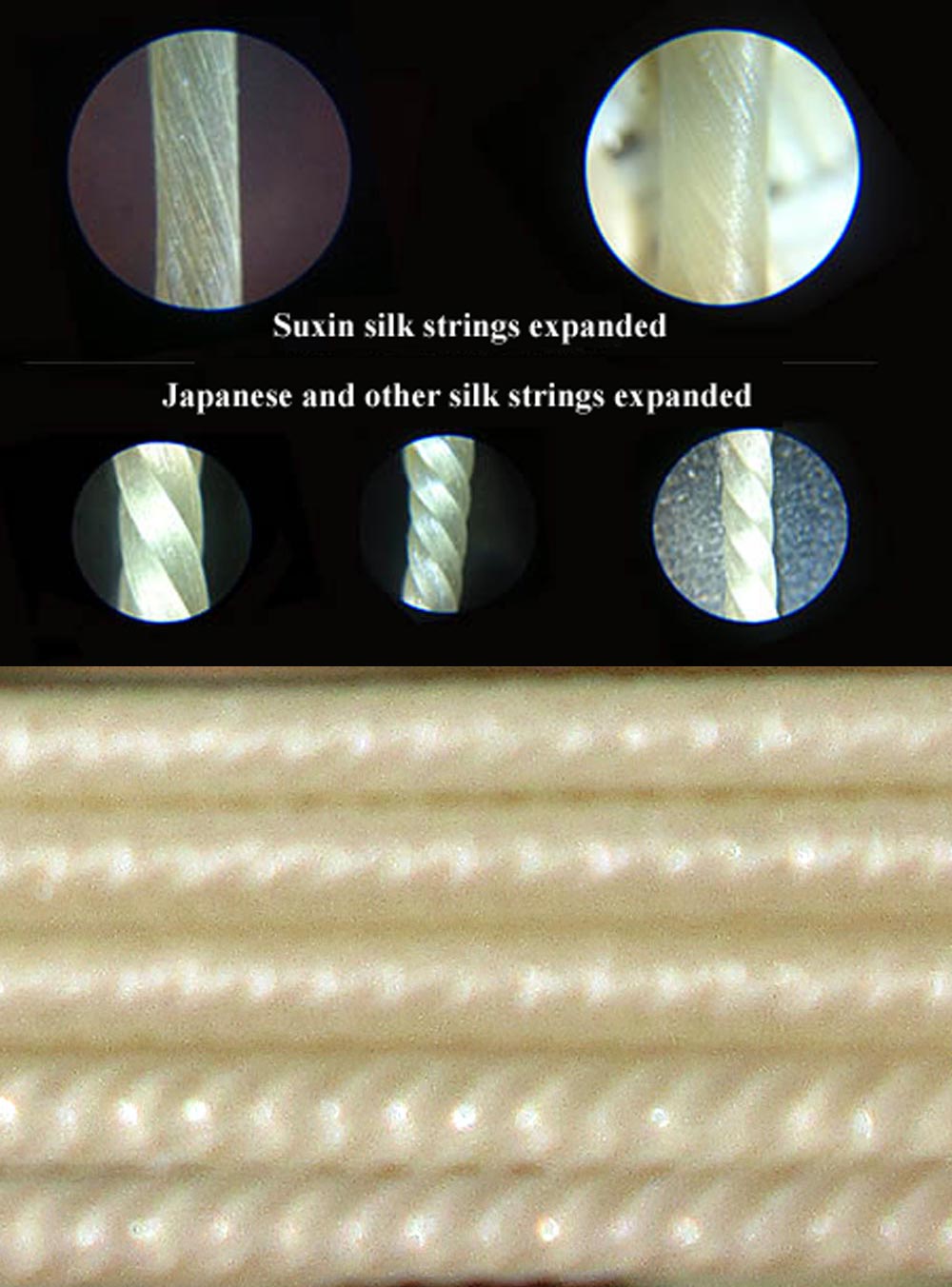 No characteristic of the traditional qin music sound was more basic than the rich timbre of sounds produced by the qin's silk strings; indeed, no other type of string can produce this essential element required by the musical aesthetics of its original listeners.4 Nevertheless, although a common term for qin was "silk-wood" (sitong),5 the expression "sixian qin" (silk-string zither) is not to be found, as yet, in any dictionary. Originally it would not have been meaningful, since all Chinese stringed instruments were categorized as having silk strings.6 However, by the mid-20th century the qin (now usually called guqin, i.e., "old qin") was one of the few Chinese instruments still strung with silk.7
Then during the Cultural Revolution (1966-76) this last bastion of the traditional string instrument sound fell with the enforced use of metal strings (also called nylon strings, or nylon-metal strings, since they are nylon with a metal core) that had been developed specifically for qin.8 Experiments had begun on metal strings at least as early as the 1950s, but apparently no one wanted to use them until during the Cultural Revolution (1966-76) their use was mandated in Chinese conservatories. After this silk strings became much less available and nylon metal became the common standard for qin strings.9 Although these new strings produce a much less rich sound, they are smoother and louder and thus easier for performance. As a result, by the 1990s it was rare to find anyone in China playing with silk strings;10 they had gained a reputation as "too much trouble".11 This has also had an effect on the basic construction of guqins.
Since then there has been a gradual revival of interest in silk, first in Hong Kong,Taiwan and elsewhere overseas,12 then eventually in mainland China, though largely outside the conservatories.13 Still, though, almost all players use metal strings (or perhaps other synthetic strings). Articles by Wong Shu-Chee, who since the 1990s has been working to revive the art of silk-string making, have further details on these issues.
As a result of this abandonment of the silk string tradition, most available CDs of silk-string qin recordings are re-issues of recordings from before 1965 (see the silk string qin discography). It is partly because of this that on this website I consciously use the term "silk-string zither". It is important for people to keep in mind that there is a distinctive silk-string style of play to go along with the silk-string sound. In fact, one of the strengths of the qin is that it can accommodate both a silk-string style and a metal-string style.
My qin teacher Sun Yü-ch'in once told me that the sliding sound of fingers on silk strings was the qi (breath or life force) of qin music.14 Literati often used the term "silk-wood" (sitong) to refer to the qin and its sounds. Indeed, silk strings can be said to epitomize the qin's traditional role as an instrument of self-cultivation. Metal strings clearly damage the lacquer on a qin top, and there is also strong evidence that metal strings can cause structural damage to instruments.15 So why would a player interested in the qin tradition try to eliminate the sliding sounds?16 And why would so many of them completely abandon silk strings?
Basics of qin strings
For at least 2,000 years, until the Cultural Revolution, qin strings were always made of silk filaments that had been twisted into strands, the strands then combined into strings by twisting them together in various numbers depending on the thickness required (see Ancient techniques); the silk was also cooked in glues made of various natural and chemical subtances.17
At some stage the lower three or four qin strings came to have in addition a mesh ("wrapping gauze") around the twisted core.18 These lower strings are wrapped in sequence around one of the legs; the upper strings go in sequence around the other leg. With four strings wrapped, as is common today, the strings that break most often are the fourth and the seventh; these are the last to be wound around each leg, so when they do break none of the others needs to be re-wound around the leg. In addition, many sets contain an extra seventh string - it generally breaks more often than the fourth. (See also mesh tearing.)
Relevant measurements for silk qin string length include the following:
These dimensions allow the string to extend under the qin, at the player's left end, about 40 cm (15-16") beyond the nut (where the vibrating part of the string meets the body) before being wound a number of times around one of the two legs under the qin.
The strings have graded diameters (gauges), the first (lowest) string ranging from about 1.4 to 1.75 cm, the seventh from about 0.70 to .9 cm.20 In theory the tension of the strings could all be the same, the pitch then being determined be the relative string gauges.
Silk strings usually break right where they rub against the bridge. The string is then trimmed neatly near the break and several more inches are required to tie a new knot before the string is reconnected to the tassel at the bridge end, then re-wound around the leg under the qin. In this way a string may be able to break as many as 10 times before it has to be replaced.21
Another issue is tearage in the mesh. This mesh is wrapped around the lower strings in order to make them denser. However, sharp fingernails striking the string in the area near the bridge eventually causes the mesh to tear. To a certain extent one can try to prevent this with the regular application of a very thin layer of glue in that area, preferable the same kind of glue as that glue in which the strings were boiled. However this glue, not having been boiled into the string, may become sticky in very humid weather.
Silk strings become more mellow with use.22 According to my teacher, Sun Yü-ch'in, strings should last for about seven years of normal use, and be at their best during the period of about two to five years.23 But he thought none of the strings then available (they had to be brought to Taiwan from the mainland) could compare with the good strings of former days.
Problems with Silk Strings?
The traditional sound of the qin as developed over the millennia is characterized by rich colors produced through overtones possible only with silk strings. The richness and subtlety of these overtones generally makes playing with other instruments seem superfluous, while the quiet nature of the tones means that qin music cannot compete with other sounds.
This is primarily a problem because the qin is so often presented in an inappropriate environment. In a perfectly quiet concert hall with superior acoustics one can play without amplification for rather large audiences; here silk strings can be appreciated. Unfortunately, it is more often presented in a venue that has bad acoustics, extraneous sounds, and a low quality amplification system: here of course the traditional musical qualities are totally lost and one may be better off using metal strings. In the past the scholar would take a qin to the mountains, then in an appropriate landscape pause to imagine its music. When invited to play at court, of course such a person would refuse: how could anyone appreciate a delicate representation of nature in such a noisy or otherwise acoustically poor environment?24
The tradition that qin music either represents or complements natural sounds is related to what can perhaps be called the
"beyond-sound" aspect of qin music. Going further, a common theme in paintings shows a scholar in the countryside with a stringless qin. I have a fan with such a scene, accompanied by an inscription to the effect that there is no need to play if one can already hear the sounds of nature.
One can debate whether the qin was intentionally designed to be quiet. In any case, it would seem that currently there are few people willing to wait for (or confident of finding) the proper environment for the silk string style of qin play. Instead people have developed a taste for the strong and smooth sound of nylon-metal strings instead of the delicate rich sound of silk.
Another perceived problem with silk strings, in addition to their quieter nature, is the belief that they break more easily than nylon metal. This tends to be overemphasized: silk strings are in fact very strong. The problem is the desire today to tune them too high.25 Tightening the strings too much is the main reason why they seem to break more often; this also makes the tuning less stable.26
This modern inclination to raise the relative pitch is very much encouraged by Chinese conservatories and the flashy style of play they often promote in emulation of 19th century Western aesthetic. Thus, they consider the modern Western concert pitch of A=440 vib/sec to be the appropriate standard for virtually all Chinese music, including that of the qin.27 There is no actual historical evidence to support this standard. Until the introduction of nylon metal strings, qin players took a more subjective approach based on their own aesthetic and philosophical inclinations. Some may have used higher pitches, but it is likely more often they would tune the strings to a lower pitch than what is used today. I often use A=415, common in early Western music, perhaps tuning down even further when the climate (humidity in particular) is variable: climate changes do make silk strings more likely to break.
The other main problem attributed to silk strings is the belief that, besides having a more delicate sound, the sound from the silk strings may be rather scratchy; people say that they would play with silk strings if only we still had the famous "ice strings" of the past.28
Although it is true that new nylon-metal strings are immediately ready to play, while silk strings may sound scratchy until they are broken in, it is not correct simply to blame this scratchiness on the quality of the strings now available. Once again the main problem is with the players. Players used to nylon-metal generally have little understanding of how to play with silk: of course when they first try to do so it will not sound good, as the technique for playing them is quite different from that used on nylon-metal. Another factor is that with silk strings if the fingers are not completely clean and dry the sound will be scratchy even with an experienced player. In performance this problem may be particularly critical: if the player gets at all nervous and/or if the room is too warm, the hands may become clammy; with clammy hands, playing on silk strings becomes impossible.
Because of the low sound output of the qin, amplification is often necessary for performance. Amplification may put disproportionate emphasis on the sound of the fingers sliding on the strings; in addition, standard microphones often fail to pick up the rich overtones which give the silk string qin its distincitve color. A noisy performance environment can have the same effect, and this is why the best performance space is a concert hall with good acoustics and no extraneous sounds. Otherwise the difference between the rich tones of silk strings and the plain tones of nylon-metal are not so apparent.29
Recording with silk strings also requires paying particular attention to certain factors, and the problems are accentuated if one does not want to put the microphones close to the qin. Since the silk-string qin cannot compete with other sounds, the required additional amplification means an exceptionally quiet recording environment is required. Thus beside using metal-string qins, almost all other modern qin recordings have had the microphone right next to, or even under, the instrument. As of around 2010 the main exceptions that I knew of were a few recordings made in Europe. (Artificial reverberation is also the rule).
When listening to a qin in a natural environment -- a perfectly quiet studio, for example -- the original delicate sound is much quieter than the sound one usually hears in a concert hall. Because in a performing environment the size of the venue as well as the inevitable room noise usually make amplification essential, I feel that a recording often has more potential for conveying the traditional qin spirit than a concert performance does. However, when most people listen to qin recordings almost invariably, in my experience, they set the volume control so that the sound level is much higher than what one would hear in a non-amplified performance. Again, the amplification proportionately increases the sound of the fingers sliding on the strings.
Related to this is the problem that most modern silk strings do seem to be more coarse than the good quality silk strings of the past. As mentioned above, the sound of the fingers sliding on silk can be considered as the qi: the breath or life force, of the music. But if the strings are too coarse the breath becomes raspy and, if the player does not know how to play with silk, the breath is like gasping. So how does one manage this qi?
The first attempt I heard of to solve the "problem" of sliding sounds came from Lui Tsun-yuen.30 During the 1970s he switched from silk to nylon wire, thus anticipating the nylon metal strings that were developed for the guqin during the Cultural Revolution. With such strings clammy hands are no problem -- one can simply put a bit of oil on the fingers and go on playing.
The problem with these substitutes for silk strings (and here one should also discuss silk strings intended to be
"smooth as ice") is that one might then lose the original qi of the qin. Silk strings can be made smoother with the application of wax or glue, but the best solution with modern silk strings is to have the patience to break them in,31 learn how to play with them properly, and find appropriate venues in which to play.
The development of metal strings
Metal qin strings today are almost always wrapped with nylon. To summarize the situation prior to their introduction, the basic materials for music strings were gut, hair, fiber (in Asia, mainly silk), metal and, more recently, synthetics.32 As for metal, although there is evidence it was used for strings in ancient Persia (along with gut and silk, which had longer histories there), more substantial records seem to begin around the 10th century. The New Grove Dictionary mentions them in Europe at that time, and Laurence Picken has written that they may have been used on the huqin two-string fiddle in the Tang dynasty and were definitely used there on a harp (sic) in the 14th century.33 Metal strings on the Middle Eastern qanun zither are mentioned as early as the 13th century, so presumably the closely related santur hammered dulcimer had them when it was introduced into China, where it became the yangqin, about two centuries later. By the end of the 19th century the Chaozhou guzheng zither commonly had metal strings.
This sketch is sufficient to show that, although in China all string instruments were once put in the "silk" category, other materials have also long been in use. In this context it is noteworthy that, although there are classical writings on the "problem" of the low volume output of the qin, any suggested solutions were always in terms of the environment (quiet; solid table; play over a water vat; etc.) or qin design. To my knowledge, not until the 1950s was any serious work done to develop metal strings (for pure nylon strings see below). If anything was published about this before the 1960s I have not seen it.
All this changed during the Cultural Revolution when, as mentioned above, official efforts were made to "improve" the sound of the qin so as to make it more accessible to the masses (further comment). This largely meant increasing the volume of sound, and modernizing the strings was an important part of this effort. One reason given for the introduction of metal strings during that period is the poor quality and lack of availability of silk strings.34 However, another factor in the switch from silk to metal strings was certainly political: silk strings were thought to emphasize the inward and meditative nature of qin music, while with metal strings it could become a performance instrument, an instrument performed for ordinary people.
Apparently the first metal strings for qin were very smooth. However, much research was focused on trying to re-capture the sound of silk while still taking advantage of the durability of metal. This led to experimenting with different coiling effects: today the inner metal core is usually covered with very smooth nylon, but experiments were also done making the nylon somewhat rough, as silk would be. Apparently attempts were also made to wrap nylon around a silk core, to avoid the roughness of silk. Strings have also been made with metal coiled around silk or nylon. As a result of the research, today some of the metal strings are much more mellow than others, but still the metal sound is quite distinctive.
As mentioned above, by the year 2000 virtually all qin players in China were exclusively using metal strings wrapped in nylon. Metal strings obviously expand the potential scope of the instrument in some ways but, in my opinion, the scope would be even broader if, instead of talking about whether silk is better or metal is better, there was more effort made to distinguish the developing metal-string styles from silk-string styles. We could then consciously develop each style in a manner natural to their different properties.
For a while, around 1990, I also used nylon-wrapped metal strings alongside the silk ones -- switching back and forth. It is not making a value judgment but simply stating a fact to say that using metal strings has a definite effect on the way one plays. For reconstructing old music I feel most comfortable using silk strings, and so today about the only time I play with metal strings is when required to do so: while visiting other players who only have metal strings, perhaps when playing together with other instruments, or perhaps when playing in certain environments, particularly noisy or humid (causing clammy hands).
I must emphasize that I don't object to metal strings per se. As with close miking, the sound can be quite interesting, and indeed I hope one day to have an electric qin with metal strings and magnetic pickups (as it is I do have a qin with piezo pickups.35 It particularly concerns me, though, that in China today virtually no one uses silk strings, almost all recordings use close miking plus reverberation, and there is little debate about this. If the Western guitar is broad enough to embrace classical, folk, popular and so forth styles, so too is qin, and the place to begin is by developing distinctive silk-string and metal-string sounds. With the qin this might naturally result in classical styles (reconstructing, preserving and developing the past) and modern styles (re-interpreting the past and encouraging new development).
An interesting characteristic affecting the ability of metal strings to reinterpret the past is their longer resonance. This may facilitate a meditative style of play, and one might even argue that, in spite of their lack of color, the cleaner and longer lasting sounds that metal strings produce during slides makes them just as capable of evoking meditative qualities as even the best quality silk strings of the past. And because they lack the color of silk, metal strings compensate by encouraging the development of new forms of slides, vibrato and other ornamentation. For new music the longer resonance is already used in some meditative (or New Age) styles of music. Meanwhile, the increased tension of metal strings also allows faster play (as can be heard in the conservatory styles that now seem to dominate). Their less complex sound allows more precision and may make blending the qin with other instruments easier. When playing with other instruments metal strings also have a particular advantage in that they are much more easily amplified. There are today experiments with electric qins; these of course require metal (or metal core) strings.
Balanced against this is the fact that metal strings can cause severe damage to a qin. For this reason, metal strings should be used exclusively on the new instruments now available, some of which are very good. Unfortunately, many people use them on lovely antique instruments, perhaps causing them permanent damage.
Scientific analyses comparing the non-silk and silk string sounds 36
In addition to being gentler on the instrument and less likely to cause permanent damage, silk strings on a qin produce a very rich sound that is quite distinctive from that of the nylon/metal strings commonly used in China since the Cultural Revolution. The sound is also distinctively different from that of the
pure nylon strings I have occasionally heard and even that of the still newer composite strings. This is something that can be measured scientifically.
One set of scientific measurements has suggested that the sound of silk strings on a qin is characterized by weak fundamental (1st harmonic) tones combined with extremely rich overtones that fade very slowly. Other stringed instruments can also produce quite rich overtones, but so far research seems to indicate that they die very quickly (within one second on a guitar, for example), whereas on the qin the overtones can remain strong for five seconds or more; as the overtones fade, they merge in such a way as to make the overall sound somewhat unstable, perhaps even seeming to raise and fall in pitch.37
The colors thus created help explain the appeal of certain characteristics of the traditional repertoire, such as repeating the same note on different strings; nylon-metal strings do not seem not capable of producing such varied color from repeating one note. And now, in addition to such anecdotal evidence from people who can hear that the sound of non-silk strings on a qin is much less rich, there is also growing scientific evidence supporting these opinions.38
Reviving silk strings
The above may suggest that metal strings are more appropriate than silk strings for modern music that silk strings. It would be more accurate, however, to say that metal strings are more appropriate than silk for certain types of modern music. Much of the perceived problems with silk strings concern their small volume of sound. With technology this problem can be overcome. This means that that the rich overtones that often make the silk string sound somewhat unstable can be naturally or digitally manipulated in interesting new ways. If color is important to a music composition, the silk string sound has a big advantage.
If the aim is "historically informed performance", then the advantages of metal strings generally become disadvanges. If metal strings allow the development of methods of ornamentation that were not possible with silk strings, that is wonderful: as long as one remembers that this was not part of the original music. People who hear silk strings in an appropriate environment often agree readily that their basic sound is more beautiful than the metal string sound. The problem is that it is rare to hear high quality performances of silk string qin in an appropriate environment.
This problem is often directly connected to the venues commonly used for qin performance. Because the qin was more likely to be played in a studio or garden than on a stage, such venues are often used for qin performances. The problem with this is that such places are usually noisy and the sound system inadequate. It is much easier to appreciate qin music in a quiet concert hall with good acoustics and, if necessary, a good sound system, than to appreciate it in a beautiful but noisy traditional environment. Unfortunately, in China these modern venues seem generally to be reserved for concerts of Western music or modernized Chinese music.
Recent problems in silk string production
By the end of the Cultural Revolution top quality silk strings were not even in production. Most silk strings were either too coarse, giving a rough sound, or too thin, giving a somewhat thin sound, or both. In addition, they broke or frayed too easily, perhaps due to the quality of silk and glue as much as to the skill of the string makers: they also have to be wrapped just right, or they may unravel.
Since then the quality of silk strings has gone up and down, but there are also things which can be done with even the lower quality strings. Regarding the coarseness, for example, my teacher simply advised me to play with them regularly for some months and they would eventually become smoother. Preserving them is also influenced by how they are treated, e.g., not tuning them too tight, especially in places where the temperature and humidity changed rapidly. However, other methods of preserving and smoothing them have also been suggested.39
According to a 1955 article by Zha Fuxi (see pp. 384ff of his Collected Writings), for about 800 years the best silk strings were said to come from Hangzhou, in particular using silk made in the Tangqi district near Hangzhou.40 However, disruptions in China from the end of the Qing dynasty eventually led to that industry closing down. During the 1930s some qin players, in particular Wu Jinglue and Zhuang Jiancheng, got together with Fang Yuting, a qin string maker in Suzhou, and helped Fang start a company which then produced the best strings. After 1949 Fang's company dominated the industry and the Hangzhou companies never revived. Some have suggested that Fang might in some ways be considered the last traditional maker of silk strings for qins.41
| 1976: Special sets show the potential | Top: ordinary strings from 1970s
-- ;
bottom: special sets from 1976/7 |
 The production of silk strings stopped during the Cultural Revolution. When in 1975 the young qin player Gong Yi came to Hong Kong to perform (with metal strings), Tong Kin-Woon had an interview with him where he asked about the situation with silk strings in China. Gong said he was not sure if Fang Yuting was still alive, but he thought perhaps Fang's son could still make strings. Tong asked Gong if he could order some sets of good ones to be especially made. This was said to be unlikely because, as mentioned, individuals were not supposed to tell factories what to do. Nevertheless, about a year later about 100 sets of good silk strings suddenly arrived in Hong Kong from Suzhou. Another year or so later perhaps another 100 sets were also sent, but some of these were not of such good quality (the best are tied together in purple thread; the next best in red thread).
At that time the strings I used, and had been using since I began studying in Taiwan in 1974, were all rather thick and coarse. Since these were the only strings I had seen, when my teacher Sun Yuqin had told me it took two years to break in qin strings I assumed this had always been the case. To break them in I not only played them but would also rub them with a cotton cloth and used other techniques as outlined in this footnote.
Although Tong Kin-Woon gave me several sets of these new purple- and red- marked special strings, I continued to use (and break in) the ordinary strings for daily use. Very few people then used silk strings, and so I had no confidence that the good quality strings would continue to be available.
Of course, when it came to doing the recording for my CD Music Beyond Sound I used strings from a purple-wrapped set which I had used about one year.
To my ears the sound of those strings is excellent and is the perfect challenge to people who at the time were saying that they did not use silk strings because the quality was not up to what it had been in the past. In fact, there was apparently little general demand for these strings as by then qin teachers all used nylon/metal and encouraged or demanded that their students do likewise. Thus there was little market for silk strings.42
| Silk strings in the 1980s and 1990s | Packaging for Suzhou silk strings in the 1980s and '90s |
 Nevertheless, the quality of ordinary silk qin strings available in the 1980s and 1990s was better than what I had played on when I began in 1974. These ordinary new strings, wrapped as shown at right and easily available in Hong Kong music stores that specialized in mainland products, cost the equivalent of about $US 20 to 30 a set (after being in a store for several years without being sold they might go on sale). The quality was also uneven: some sets were quite good, not as rough as the strings I originally played but still requiring quite a bit of time to break in. Others were of clearly inferior quality, with an uneven surface and more likely to come unraveled.
Meanwhile, Tong Kin-Woon had made the new high quality special sets available to a wide market, but to my knowledge most of the people interested in them were outside of mainland China. The same was to happen when the Taigu Qin Strings described next first became available.
Nevertheless, a revival of silk string production began in the mid-1990s. Meanwhile, I continued to play on the ordinary Suzhou strings for daily use. Supply was not an issue. What was needed most was an improvement in the quality.
| Taigu and the improvement of silk strings | Packaging for 太古琴弦 Taigu silk strings 1999-2002 |
 Fortunately this began to happen in the late 1990s. Most notably, in 1998 沈興順 Benny Shum Hing Shun of Hong Kong contacted traditional string makers in China and organized the production of some sets of silk strings, calling them Taigu ("most ancient") Qin Strings. Whereas for my
recordings, specifically the
Music Beyond Sound CD and
Folios I and II of my Shen Qi Mi Pu CD set, I had used strings from the special sets described above, in recordings for the Shen Qi Mi Pu CD of Folio III I used these new strings, which were had by then become available in two gauges.
Fortunately this began to happen in the late 1990s. Most notably, in 1998 沈興順 Benny Shum Hing Shun of Hong Kong contacted traditional string makers in China and organized the production of some sets of silk strings, calling them Taigu ("most ancient") Qin Strings. Whereas for my
recordings, specifically the
Music Beyond Sound CD and
Folios I and II of my Shen Qi Mi Pu CD set, I had used strings from the special sets described above, in recordings for the Shen Qi Mi Pu CD of Folio III I used these new strings, which were had by then become available in two gauges.
Subsequently, Wong Shu-Chee, by then living in Vancouver, took over Shum's work, and in early 2000 he produced some very high quality silk strings, also called Taigu strings, in three different gauges. After this Shu-Chee produced several more sets. He sent free sets of these to many qin players in China, but then in 2004 said he could not continue to do all of this.
As of 2014 some of these were still available online. And Shu-Chee did continue for some time to make individual sets on special order. But by then the only place they were generally available seems to have been the gift shop of the Chilin Nunnery in Hong Kong. And apparent these sets were mostly ones that had been returned by or gathered from players to whom Wong Shu-Chee had sent free sets, but had never been used.43
Fortunately, although there is little available in English, old Chinese books have a lot of information about most aspects of sericulture44 and silk string making.45 See in particular Taiyin Daquanji (15th c. or earlier) and Yuguzhai Qinpu (1857).
One spinoff from that project may be the strings made by Pan Guohui, who had been involved with Shu-Chee's project.46 As of 2012 it was possible to find online strings attributed to him under the name Jinyu Qin Strings.47 Another brand available online in 2012 was Tiger Hill.48
However, as of 2020 my own information on this is rather out of date. The situation is actually quite complex, with new companies selling strings for which the make various claims for authenticity and quality, but little way to substantiate these claims without actually seeing the strings.49
Silk strings from the West
Meanwhile, another interesting (and promising) sign has been the interest of some early Western instrument players in Chinese silk strings. Some strong arguments have been made that silk strings were used on medieval Western instruments.50 (Another not-so-well-known fact is that silk strings have continued in use in on certain Western instruments, albeit rarely.51) The argument for their historical use is based on references in texts (references to silk are mostly indirect) as well as descriptions of sound (silk is much more resonant than gut). As of 2015 Alexander Raykov in upstate New York was also making good quality silk strings for early Western instruments. He also made a set for me to use on qins; they were very good (upper strings only). His website had further information, but as 2009 it was not functioning (see Raykov on silk) and he was expressing interest in passing on this skill to others.
LP Kaster (Lawrence Kaster) in Texas, who has also been making silk strings for use on Western instruments, is one person who has learned from Alex Raykov and is now himself making good quality silk strings for guqin. As of 2015 (as with the Tobaya strings) the lower strings were not wrapped, but since 2017 he has been making complete sets that include wrappings for the lower strings. These are available individually as well as in complete sets (details below).52
More recent revival of silk string manufacture
Although by around 2010 it seemed that people had given up on making good silk strings in China. I had even heard that because of the air pollution there one would never get good enough Chinese silk for silk strings. However, since then the situation seems to have changed once again. This is largely related to the explosion of interest in the guqin since 2000.
This interest is partly fueled by the performers and performances coming from Chinese conservatories, but it also includes people whose interest in Chinese traditions makes them more eager to hear the guqin as it sounded in the past. This has led first to a dramatic increase in the price of qins, especially those by certain makers. Nevertheless, some of the least expensive qins have proven to be quite useable when strung with silk. In my experience, for these cheap instruments the best result usually comes from lighter ones.
More relevant to this page, this has also led to a greater availability of the silk strings already in production, and also to considerable work being done again to revive good quality silk string production.
Regarding distribution, when I last wrote about this (2013), online ordering had improved the situation considerably. With most teachers in China still demanding use of nylon metal strings the market for silk strings remained relatively small. However, the silk string supply does seem to be increasing, and as people are increasingly able to buy strings online, as well as in shops, demand seems likely to increase further. This has also led to an increase in the variety of silk strings now available, in shops as well as online. This now includes strings from Japan53 as well as China.54 Some of these strings have become very expensive.
Regarding improving the strings one might divide this into the work being done in Japan and in China.
China
Silk strings are best served by good quality instruments, and since today there are again some very good qin makers it should not be surprising that good silk strings seem not to be very far behind. It is also not surprising that with the cost of qins by well-known makers skyrocketing there will also be strings that similarly expensive. In my opinion, however, just as one can still find qin through careful searching, the older and less expensive silk strings are still quite adequate for enjoyable playing.
Conclusion
Summing up, to take account of the differences between a qin with silk, nylon-metal or composite strings perhaps one should revert to the old term "seven-string qin" (qixian qin) when referring to all three versions. Although one could make a good argument that the nylon-metal string qin is sufficiently different that it should have its own name, and that with the addition of nylon-metal strings the "old qin" (guqin) has become a "new qin", such a radical change should not really be necessary; in addition the term "new qin" is already in common use to refer to any newly made stringed instrument. (Unfortunately, the romanization of "qixianqin" makes it unlikely to catch on in English.)
To compare the situation with that of the Western guitar, there are major differences between the guitars used for classical music, folk music and rock music. Guitars can be described as electric guitars, steel-string guitars, nylon-string guitars and so forth, but they are still guitars. The important thing here is being aware of the differences caused by strings and by the subsequent related changes both to the structure of the instruments and to the playing methods. When this happens people will naturally wish to know whether the seven-string qin about to be heard or discussed has nylon-metal strings ("gangsixian qin"), composite strings ("fuhexian qin"), or silk strings (sixian guqin: the "real" guqin).57
Preserving the old helps give a more solid base to the new. It also allows more variety: the more the better.
1.
Silk strings 絲絃 or 絲弦
My dictionaries have no specific references to "silk string qins" per se. 28058 絲 has no 絲絃琴 (or 絲弦琴) sixianqin; what it has is simply 28058.53 絲絃 si xian, which it defines as a string for music instruments, giving 紅樓夢 Hong Lou Meng as a reference.
On the other hand 4. (七) has both 4.231 七絃 qixian and 4.232 七絃琴 qixianqin. The former is said to be short for the latter, with a reference given to 嵇康,酒會詩 Poem of a Wine Gathering by Xi Kang. The latter names the seven strings as on a guqin, though only using the word "qin" rather than "guqin". "Seven-string qin" may in fact be the best term to use today when referring to a "guqin" regardless of what type of strings it uses (further comment above and below).
It must be noted that nowadays use of the word "silk string" does not guarantee strings made of silk. One example is the ensemble formed in England in 2006 calling itself "Silk String Quartet". It consists of pipa, zheng, erhu and yangqin, but none of the players actually uses silk strings. When it comes to the qin world, the prevalent conservative ideology contrasts starkly with most players' ignorance of silk strings. Dealing with silk strings is sometimes inconvenient, largely due to the fact that most current teachers do not present them as an alternative. But the basic conundrum is that, while there are no real problems with silk strings if you follow the tradition of playing for self-cultivation, even people who want to think they are following the tradition are in fact more focused on performing, usually for people who do not know the traditional aesthetic. There is further comment on this in the footnote Misuse of the words "silk strings".
Unauthorized versions of these articles, often abridged and with mistakes, can be found in various places online. Some time ago I give a link to one as an example, only to be told later that someone had apparently taken over that Chinese site so the link was quite embarrassing! (It is gone now, but I wonder how often that happens.)
Gut strings
2.
Qin strings 琴絃 or 琴弦
1/586 琴弦 gives as its earliest reference 北周庾信,詠畫屏風 Yong Hua Pingfeng, a poem by Yu Xin (513-581):
This is the seventh in a set of 25 poems/stanzas, three of which mention qin
Sexual connotations of "qin strings"
As for qin strings, number of old Chinese texts on sexual practices refer to a part of the female sexual organs as "qin strings". A good discussion of this is in Douglas Wile, The Chinese Sexual Yoga Classics Including Women's Solo Meditation Texts (Albany, State University of New York Press, 1992). For example, this book has the following explanation of the word "zither strings" (琴絃 qin xian) in a note on p.236 (referring back to a passage p.87, that quotes The Classic of
Su Nü [素女經 Su Nü Jing, perhaps a Sui or Tang text but apparently preserved from the Ming dynasty] as having said, "Withdrawing to a shallow depth, stab her 'zither strings,' and then penetrate three and a half inches."). Wile's comment says,
Wile seems to suggest that earlier works located the "qin strings" at the labia while later texts have the location perhaps an inch inside. Meanwhile, the same text also refers to a "zither without strings" (沒絃琴 mei xian qin, not to be confused with the 無絃琴 wuxian qin, which really is a qin without strings), understood by Wile (pp. 172 and 268) as referring to the vulva. Having thus established that strings represent the female sex organs, sword, as in the expression qin and sword (琴鍵 qinjian), is a obvious reference to the male.
3.
Image:
Suxin advertisement;
Marusan Hashimoto strings
4.
Silk string aesthetics
One of the reasons I began reconstructing and playing melodies from Ming dynasty tablature was that, in addition to finding the melodies beautiful, I could imagine myself communicating with the people who had created the music by playing their music. This led to my trying to establish principles of historically informed guqin performance. And, knowing that (until the Cultural Revolution) for centuries if not millennia qin players had rejected the opportunities presented by metal strings, even as they were adopted on other instruments, and that to my knowledge listeners had never asked for them, how could I imagine having such communication while making sounds that would clearly have been rejected?
One of the essential characteristics of guqin music is the fact that different colors can be achieved when playing the same pitch in different ways. Thus, any particular pitch will sound different when played as an open string, as a harmonic, or as a stopped sound on differing strings. This variety of color was an essential part of the traditional aesthetic of guqin music - quite likely on a par with the melody itself. To my ears the variety of color brought out by these techniques is much diminished without silk strings. Indeed, this distinction becomes even sharper when simply playing a single note. This became most clear the first time I played a high quality qin with silk strings: I would play a single note, and it would be so beautiful I was hesitant to play the next note. The subtle beauty of the notes also gave an indication as to why the guqin was seldom combined with other instruments, except in a ritual context.
Thus, although nylon metal strings have their own advantages, the lack of this type of color leads players to a different style of play, one that emphasizes other melodic possibilities on the guqin, including playing with cheaper instruments and playing together with other instruments (also important is desire to perform combined with the fact that the distinctive sound of silk strings usually gets lost with the recording and amplification systems that are in common use). Stated simply, since one note on the new strings is not as aurally complex as one played on a good instrument with silk strings, players naturally seek new ways to combine the sounds when using the new strings.
Fortunately, it is now possible to gain some scientific understanding of the sounds which created the traditional guqin aethetic, as well as how they are different from the sounds on the modern strings. This is because musical colors can best be defined in terms of the musical overtones of the pitches being played, and these can be measured through scientific experiments. As has been shown by experiments such as the one discussed further in the main text, especially in related footnotes, nylon metal strings do not produce the variety of overtones created on silk strings. Thus the instrument becomes fundamentally different.
5.
絲桐﹕silkwood, silk-wood, silk and wood
6.
Silk string category 絲絃類
Noticeably missing from this list is gut, in particular gut strings (腸絃 chang xian). Trying to get details on the compostion of strings is in general very difficult because writings on musical instruments seem very happy to ignore this issue. There is historical evidence that use of gut strings dates back thousands of years but as yet I have not seen evidence in classical Chinese writings of commentary on how gut might fit into the 8 Sounds.
In short, all stringed instruments were categorized ib China under the silk category, and perhaps at one time all Chinese stringed instuments did use silk. However, most Chinese instruments played today were introduced into China from outside after the Han dynasty, and presumably many of these came with strings made of other materials, such as 馬尾絃 horse-hair strings (mostly for bows), 腸絃 gut strings, or 鋼絲絃 metal strings. Once again, both Western and Chinese language sources seem to be lacking commentary on this. As yet I have not done serious research on this in Chinese, but so far I have not yet found research on the introduction of non-silk materials for use as strings on musical instruments.
7.
Abandonment of silk strings on other Chinese instruments
8.
Required use of Metal strings (鋼絲絃 gangsi xian)
Compare: Silk strings with steel filament core (絲和鋼絃)
9.
Abandonment of silk strings for the qin during the Cultural Revolution (1966-76)
According to my own understanding, modern experiments aimed at increasing the volume of sound from the guqin were begun in the late 1950s. Part of this was focused on the qin body; part of it was on the qin strings. Regarding the latter, various types of metal and/or metal-nylon combinations were used in this effort. Some leading players were involved with this work including Wu Jinglue. In February 1959 Wu published an article called, "Improving the Guqin" (republished as 古琴的改良; 音乐出版社 1961年12月版). According to a more detailed 2012 article by 林晨 (20 世纪上半叶的古琴改良), Wu began experimenting with aluminum alloy-wrapped metal strings in 1958; in 1959 he made a recording, but this work was never popularized. Then in 1964 he experimented again, this time with nylon-wrapped metal strings, his inspiration being violin strings. However, this work was interrupted during the outbreak of the Cultural Revolution and it was not until 1974 that he actually succeeded in developing metal strings and they only came to dominate the scene in the late 1970s.
It is not yet clear what might the early recordings with this new material. According to my understanding most players resisted the introduction of metal strings until a point during or after the Cultural Revolution when anyone associated with programs at Chinese music conservatories was required to use them.
Here one might argue that nylon-metal strings quite likely would eventually have been introduced anyway, in particular to fit the demands of modern music as well as to provide a cheap alternative to silk (though see also Problems with Silk Strings?). Clearly, however, this introduction during the Cultural Revolution, as well as the continued enforced use of metal strings in Chinese conservatories, brings up some important questions about the significance of this change. To what extent should one encourage qin play as a form of self-cultivation? How important is it that it appeal to the masses? Looking at it another way, what was the role of politics in the general unavailability of silk strings (see story)? To what extent did the change become a matter of preference (see another story)? Whatever the impetus, as the qin became largely taught in conservatories, the traditional attitude of playing the qin for self-cultivation was replaced by the belief that to preserve the qin it had to be turned into a performance instrument.
For comparison one could also look to the treatment of opera during the Cultural Revolution. When revolutionary operas were introduced during the Cultural Revolution there was such overwhelming resistance from traditional performers that eventually the government said, either perform revolutionary opera or don't perform at all: for some years only revolutionary opera could be performed.
10.
Current attitudes in China to silk strings
11.
Silk strings: too much trouble (太麻煩 tai mafan)? (also see previous footnote)
Part of the essence of the qin tradition is to take you out of ordinary society. Here one might also point to other Chinese traditions that seem to survive in spite of the extra work involved:
Nylon-metal strings also have their own mafan, but as Wong Shu-Chee tells students who complain about silk strings being troublesome, if you don't want this kind of mafan you shouldn't be playing qin.
12.
Return to silk strings outside mainland China
13.
Return to silk strings within mainland China
14.
Sliding sounds as 氣 qi
I also do not know how this fit in with the fact that at that time he had to play with strings rougher than he had been used to. In any case, it may be more precise to say that what he was trying to convey was that when sliding on the strings any resultant noise should be smooth, like healthy breathing, not harsh like rasping: he wasn't advocating any accentuation of that sound. Indeed, in later years, in spite of these comments about qi, he followed the trend to metal strings.
Related to this, Liang Mingyue wrote the following in
The Chinese Ch'in, Its History and Music, p.296:
Liang's "an lin jou mu" should be "an ling ru mu", i.e., "按令入木: when pressing down cause (the finger) to enter the wood"
(source). As for "scratching sounds", around this time Liang made a recording in Germany called Liang Mingyue, Yangguan Sandie, where his sliding sounds are indeed very scratchy. However, I believe this was mainly as a result of his using a rather average instrument with new silk strings that had not been broken in properly. Later recordings by Liang use nylon metal strings. Nevertheless, if one substitutes "sliding" (or perhaps "gliding", or even "caressing") for "scratching", the above is a good statement of the traditional attitude towards the sound made by fingers moving on the strings.
Here one might cite the following couplet for an analogy between playing a qin with the silk strings for which it was designed and playing one with metal strings, invented only during the Cultural Revolution:
Playing a silk-string qin is like caressing a silk dress;
Following on this are two more analogies. The first perhaps echoes Tao Yuanming's search for the 趣 true existential path of the qin.
Metal strings struck, fine sounds please, briefly charming the ear; but
This other couplet concerns only the silk strings:
Playing silk strings, when calmly done, slides are qin’s life force; but
Are these general truths or just personal feelings? Perhaps both?
As mentioned, part of the interest in Japanese silk strings comes from a belief that the quality of silk there may be better. Whether or not that is the primary impetus, some Chinese and Japanese qin players have been working with Japanese companies to make or improve strings intended for the qin; these efforts clearly have the China market in mind. Here there are basically two types of Japanese silk strings, those already being made (e.g., Tobaya for the Japanese market, which do not use mesh on the lower strings); and new-style Japanese silk strings made more directly in the style of Chinese silk strings (Marusan Hashimoto.)
55
The revival of interest in the guqin in China has led to at least half a dozen groups working on improving the quality of silk strings there. As of 2020 the most successful of these seems to have been the project in Beijing led by Fang Suxin that in 2014 produced Suxin Silk Strings, but then seems either to have gone out of business or to have temporarily stopped production.56 Suxin strings are now discussed further on a separate page.
Footnotes (Shorthand references are explained on a
separate page)
Although the unique richness of tones produced by a qin with silk strings is something that can be measured scientifically, and this page presents an argument for the value of the these distinctive qualities, it is not intended to suggest that this makes them "better" in any abstract philosophical or aesthetic sense. Likewise this is not even an argument that the silk string aesthetic was unique to the qin or even that this aesthetic is confined to the silk string qin. Specifically, some old writings tell of literati playing the 箏 zheng zither with the same lofty aims as are more commonly connected to the qin
(example). There are even Western compositions, such as John Cage's I Ching, that have claimed to be inspired by this sense. So although one can argue that the sounds or the appearances are different (whether the strings are of silk or metal), who can speak with certainty of differences in the mind of the player, or of the listener?
Articles on silk strings by Wong Shu-Chee (黃樹志 Huang Shuzhi)
Wong Shu-Chee, who since the 1990s has been involved in projects to produce higher quality silk strings, has written several interesting articles in Chinese on the subject. He has given me permission to post them on this website:
Translated as "Through Qin Strings, Inquiring about the Guqin's Past, Present and Future Path of Development."
Gut strings were used on some Chinese instruments, but apparently never on the guqin. Nevertheless, since the present article discusses the importantce of gut strings on early Western instruments in several places, it is interesting to compare the making of strings from with the making of them from gut. A good article on the latter can be found at gamutmusic.com. The basics are that the gut is cleaned and processed into long tubes. Strings may be made from these tubes, but more commonly the tubes are split into ribbons and the strings are made from ribbons in various numbers. The linked website says that gut strings for the violin family typically range from 3 ribbons on the highest violin string to 64 ribbons on the lowest bass string.
(Return)
21570.46 琴絃 gives as its earliest reference 靜女吟 Jing Nü Yin, a poem by 孟郊 Meng Jiao (751–814):
任禮恥任妝,嫁德不嫁容。
君子易求聘,小人難自從。
此志誰與諒,琴琴絃幽韻重。
歌聲上扇月,舞影入琴弦。
澗水纔窗外,山花即眼前。
但願長歡樂,從今盡百年。
Before discussing strings, see also
these references to historical attitudes towards sex in China as well as
these comments on erotic aspects of the qin
(Return)
More details about this image are on the links given above. The Suxin image presumably shows the strings when new (see also Fang Suxin and silk string research in China). The Marusan Hashimoto image shows their strings after some use (see also Japanese silk strings for guqin).
(Return)
This statement is not intended to suggest that one cannot express their own understanding of the essential "Dao" (Way) of the qin when using metal strings - or when playing any instrument, for that matter (see further comment on this above). The mention below of "silk wood", however, does suggest that the creators of the instrument considered the strings just as important as the body (further comment).
(Return)
28058.45 絲桐 sitong says this is another name for the qin, with numerous references beginning with 史記 Shi Ji Chapter 46, 田敬仲完世家
Hereditary House of Tian Jingzhong Wan (more under
Zou Ji).
(Return)
At least by the Han dynasty the Chinese had categorized music instruments according to eight materials into "8 sounds" (1475.217 八音 ba yin):
(Return)
There is some further comment under "The development of metal strings", but in general it is difficult to get specific information about this, as strings seem rarely to be mentioned in historical documents.
(Return)
Technically the term "metal-nylon" or "nylon-metal" would be more accurate, but generally the term used seems to be "鋼絃 gang xian: "metal strings" (or occasionally "尼龍弦 nylon strings"). The next footnote has some details about the development of these strings. As for their required use, this in particular refers to the music conservatories. Conservatories are training people to perform, often with ensembles, and metal-nylon strings make this much easier.
These are strings I first encountered in 2024, though they have been under development for a number of years. Sponsored by 戴氏 the Dai family that have been producing metal strings for many years, a 上海戴氏琴絃製作社 Shanghai Lu Family Qin String Making Society led by qin player and scientist 盧藝 Lu Yi has developed silk strings with a steel filament core in an effort to combine the silk string sound with the advantages of metal. The texture of these strings is clearly silk, and in appropriate environments the sound is very good. However, from my preliminary tests, when played in a traditional environment (a very quiet room with good acoustics, whether at home, in public or in particular in a sound studio), the sound does not have the complexity of sound coming from purely silk strings.
(Return)
An excellent general summary of the work done in China during the Cultural Revolution to "improve" the qin can be found in Tsai, Tsan-Huang, "From Confucianist Meditative Tool to Maoist Revolutionary Weapon: The Seven-Stringed Zither (Qin) in the Cultural Revolution", Chapter 2 (pp. 37-64) of
Pang, et. al., Listening to China’s Cultural Revolution: Music, Politics, and Cultural Continuities,
Palgrave Macmillan, 2016. Part of the effort focused on creating a new repertoire, part on trying to present evidence for folk origins, but there was also considerable effort put into trying to make the qin sound louder. This included introducing nylon metal strings.
(Return)
Since leaving Hong Kong in 2000 I have had several noteworthy experiences of playing along side qin players who have either never used silk strings or have not used them in a long time. Often they say that they think the silk string sound is better. Some have switched to silk. More common, though, seems to be the opinion that silk strings are "too much trouble" (太麻煩 tai mafan): see next footnote.
(Return)
It is a fact that starting to play on silk strings is more difficult that starting to play on nylon metal. But the reason for this is not inherent in the difficulties of any type of string, the reason is that today all guqins are commercially sold with nylon metal strings on them. If instruments came without strings and the beginners had to string their own they would certainly find putting on the silk strings to be easier. In fact, their teachers would probably also find the metal strings more difficult.
(Return)
The work by Shum Hing-Shun and Wong Shu-Chee to improve the quality of silk strings is an indication of the revived interest in silk strings in Hong Kong in the late 1990s. After I moved from Hong Kong to New York in 2001 memebers of the New York Qin Society (NYQS) started playing again with silk strings there. Since then the then-president of the New York Qin Society, Yuan Jung Ping, has returned to Taiwan, where he has played a major role in the revival of interest in silk strings there.
And in 2002 Wu Zhao, when during his visit there in 2002 I had the chance to perform together with him, said he didn't know anyone in China using silk strings, but after hearing them side by side with his metal strings he wanted to use silk again himself; it took some years, but his subsequent CD, Song of Life in the Mountains (吳釗,山居唫,2011), became one of the first of the new silk string recordings now coming from China.
(Return)
Some credit here should probably be given to museums; partly because of advice from the Hong Kong silk string advocates, they are becoming aware of the damage caused by metal strings on ancient instruments and thus now requiring these instruments to use silk.
(Return)
Sun Yü-ch'in did not quote any sources in connecting sliding sounds with the qi of qin play. Perhaps he could have been referring to explanations from modern commentary, not a classical text.
操鋼絃,似觸鐵甲。
Playing a metal-string qin is like caressing a suit of armor.
絲韻失,真氣散,千古長存心。
Silk sound gone, true qi hides, the heart it long held dear.
躁撥弄,粗疏滑,響翻作人喘。
Roughly played, these same moves, sound more like you are hoarse.
(Return)
| 15. Causes of damage from metal strings | Divots in the lacquer (see #1) |
 The potential for damage from metal (metal/nylon) strings on antique qins in particular has led most museums to require qins in their collection to be strung with silk strings. (Alternately they may primarily be influenced by a perceived need for historical accuracy.)
This potential for damage from metal (metal/nylon) strings is largely due to the following:
- The hardness of nylon-metal strings combined with the requirement that the player push down firmly on the strings can lead to divots in the lacquer under the strings (see at right and detail; I have never seen this on a silk string qin). The lacquer is a form of cement firmly connected to the wood, but which loosens somewhat over time.
- The increased string tension possible with metal strings can cause more stress on the wood. This can also affect the lacquer.
- The ultra-sonic vibrations from metal strings might damage the cellular structure of the wood. For example, one study looking for an answer as to why violinists who use metal strings change the violin bridge more often than those who play with gut strings discovered that the cellular structure of the bridge decayed very rapidly when metal strings were used.
- The nature of sound means that the soundbox inside a qin should be different for metal vs silk strings. Sometimes people modify the sound box of an old qin so that it sounds better with metal strings, thereby doing permanent damage to an antique treasure.
- Also regarding the soundbox, old qins traditionally had two sound posts. These are often missing, but if they are present people who use metal strings sometimes remove them: the sound posts apparently reinforce the fundamental, and with metal strings this may not be so necessary. Placement of the soundposts is very important and this positioning may be lost.
- The way the strings vibrate (silk wider, metal tighter) means that metal strings can be closer to the strings than silk can. Sometimes an old bridge is lowered to take advantage of that. Less commonly, if the instrument is re-lacquered the contour of the top surface may be modified to accommodate metal strings.
See also Instrument construction: Consequences of the change from silk to metal strings
(Return)
16.
Eliminating the sliding sound
Today efforts are being made to make silk strings as smooth as metal ones, presumably under the assumption that the old "ice strings"
(bingxian) were similarly smooth. On the one hand I have not yet seen any old bingxian; in addition, I have not read specific comments in traditional literature that say bingxian were made with the intention of avoiding sliding sounds. Thus further comment on this on my part would simply be speculation.
(Return)
17.
Silk string manufacture: glues
See the earliest known description: cooking/mixing the strings in a liquid both strengthens the strings and helps determine the color/richness of the sound. The earliest known liquid combined "fish gelatin" (isinglass?) with various chemicals
("potions") to make what is generally called "fish glue". They used mostly natural substances one could find in a Chinese medicine store. Japanese silk strings (whether for qin or other instruments) have long been cooked in a rice glue. The origins of the varying techniques are not clear.
Similar substances may be used for strengthening, smoothing and preserving strings already in use.
(Return)
18.
Silk string manufacture: mesh (wrapping gauze)
It would be interesting to know more about the introduction of the mesh and whether after its introduction it was always used on Chinese qin strings.
(Return)
19. Knotting strings ("How to tie the knot" is from Lieberman, p.16) |
Knot styles and their attachment to tassels
(See also How to tie the knot) |
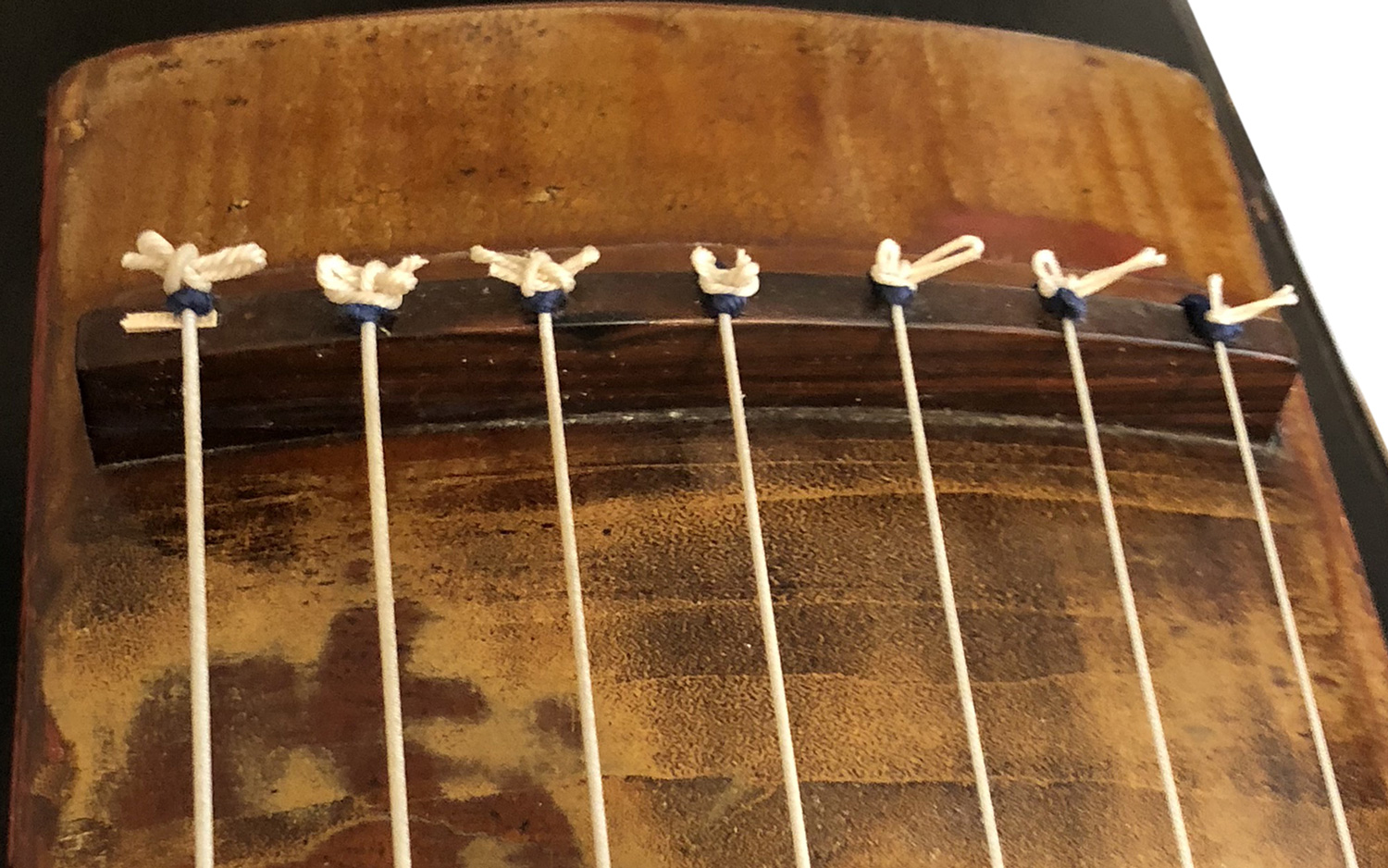 Enlarge the image at right to follow clearly the commentary. The strings from left (first string) to right are:
- The knot is nicely tied but the placement is somewhat back from the string, so that it cannot be tigthened much without re-tying it at the other end; the small piece of wood under the knot was put because otherwise the string was vibrating too closely to the top of the qin, causing a buzzing sound (雜音 zayin)
- Good knot and good placement
- The knot was tied well but is upside down; good placement
- Knot works but looks a bit pinched; good placement
- Knot works but is a bit lopsided; ideally the knot would be closer to the front of the bridge: might be a problem if one wishes to play a piece in raised fifth string tuning (e.g., ruibin)
- Knot is again lopsided and a bit back from the bridge
- Knot placement is fine but it seems as though it could slip through the loop in the tassel.
In fact, if this qin is in tune with the knots placed as in the image, then the only reason to try to change the knot placement would be for the sake of appearance. However, such balancing would require a lot of effort re-tying the strings to the legs.
(Return)
20.
String gauges
String gauge is the thickness/diameter of a string. Here measurements are in centimeters: 1 cm = 0.39 in. (By comparison, for guitar strings in the USA one gauge usually means 1/1000th of an inch [1"= 2.54 cm]. Thus, a 10-gauge string has a diameter of 0.010 inches.
The page on Ancient techniques has further details about string wrapping and gauges, including the following chart (see also length/breakage):
Sample modern silk string gauges (mm)
| thickest | thick | standard | medium | thin | |
| 1st | 1.88 | 1.75 | 1.65 | 1.52 | 1.40 |
| 2nd | 1.78 | 1.60 | 1.50 | 1.38 | 1.27 |
| 3rd | 1.60 | 1.45 | 1.35 | 1.24 | 1.14 |
| 4th | 1.40 | 1.30 | 1.20 | 1.10 | 1.00 |
| 5th | 1.20 | 1.15 | 1.10 | 1.00 | 0.90 |
| 6th | 1.10 | 1.03 | 1.02 | 0.90 | 0.80 |
| 7th | 1.00 | 0.90 | 0.85 | 0.80 | 0.75 |
The above chart was made around 2005, shortly after Taigu strings were introduced. In particular the three middle columns above, here called "thick", "standard" and "medium", correspond quite closely to the three gauges that Wong Shu-Chee made for his Taigu strings; there they were called "加重 jiazhong", "太古 taigu" and "中清 zhongqing" respectively. However, these measurements are not intended as definitive, only as a guideline for the range of string gauge possibilities. Note also that they these measurements were made on new strings: over time they may stretch a bit and become slightly thinner.
Japanese string gauges are shown separately here:
烏羽屋
Tobaya
丸三桥本 Marusan Hashimoto.
Lawrence Kaster's "Real Silk Strings" are sold individually:
Unwrapped: diameters from .62 to 1.30 mm
Wrapped: diameters from 1.20 to 2.0 mm
Details on all strings are prone to change.
(Return)
21.
Qin string longevity: length and breakage
As mentioned above unused silk qin strings may have a length of 250 cm (100"); however, ones made today seem often to have a length closer to 200 cm (6'9") when new. Typical vibrating length of strings on a qin is 110-117 cm (43-46"), however some qin may be several centimeters shorter. About 6 cm (2-3") are used to tie a knot at one end of each string, allowing it to be held by a tassel that goes through the bridge to the sound pegs; at the other end the strings extend about 40 cm (15-16") beyond the nut (where the vibrating part of the string meets the body) before being wound around one of the two legs under the qin. When a string breaks it is usually where it rubs against the bridge. Trimming the broken string and tying a new knot shortens the string about 6 cm. This is why the top three strings, which do not have an outer mesh, might break more than half a dozen times before they are too short to be used. As for the lower 4 strings, which have an outer mesh, with my older sets this mesh on a new string may extend under the lower end of the qin almost all the 38 cm to where it starts to wrap around the foot. This means they may break five or more times before having to be replaced. On the newer sets, however, the mesh often extends only about 8 cm under the qin. This means that, good as they sound, one of these strings can break at most twice before it must be replaced.
(Return)
22.
Mellowness with age
In contrast, strings of gut and other materials are usually considered to be at their best when new.
(Return)
23.
Two years needed to break in strings?
See further under "Breaking in new silk strings".
(Return)
24.
Performing with silk strings
Perhaps my favorite performance was one at N.S.I. in San Diego: it seated 300 people but the sound was just as good at the back of the hall as it was on stage. Here one could close one's eyes and imagine listening personally in a scholar's quiet studio. Unfortunately, it is more common to present the qin in a place where you might be able to see remnants of traditional Chinese culture, but you have to have a vivid imagination to hear the music as it was originally intended. Everywhere there seems to be little effort put into making acoustically superior small recital halls. In their absence one must hope for an amplification system of such high quality that it can capture the rich colors of silk strings (since nylon-metal do not have these colors, this is not such an issue with them - the aesthetic is very much changed).
(Return)
25.
Other causes of strings breaking
Humidity can also make the strings to feel somewhat sticky, though this may especially be the lower, wrapped strings where glue has been added (see
more).
26.
Problems from tuning too high (tight): strings breaking and losing their pitch
As for strings losing their pitch, if I tune the silk strings I use so that with standard tuning the bottom string is about B flat, and if the temperature and humidity are relatively stable, the strings can remain almost completely stable for weeks or longer. However, if I try to maintain their tuning with the bottom string is C, the strings will continue to stretch and so need to be tightened regularly.
27.
Was there ever a standard pitch for guqin tuning?
It is within this context that one must consider the fact that many of the guqin recordings made during Zha Fuxi's
recording project in the 1950s are of instruments that seem to use A=440 Hz as their standard, making C (i.e.,
C=65 Hz) the closest pitch to their open lowest string in standard tuning. In the past the actual pitches of the strings on a qin would have been determined by such factors as qin length, quality of strings and weather, not to mention personal taste. But by the 1950s Western ideas of pitch were already common in Chinese conservatories. The available project notes do not seem to comment on this or on the possibility that for these recordings the instruments were tuned up higher so as to have a brighter sound; there is also the possibility that the recordings were speeded up to give them a higher pitch, but there is no evidence to support this. However, it should be noted in this regard that for quite a number of the recordings in this project (as can be heard on the related 8-CD Guqin Collection) the open first strings are tuned (based on C=65 Hz) to B or B flat, and at least one is tuned down to G sharp (in a
Qiujiang Yebo as played by
Cheng Wujia).
It should also be kept in mind that in the past there would normally have been no problem acquiring silk strings at a reasonable price (at least reasonable to the sort of people who could afford to buy a qin). In this case there would be less fear of strings breaking, as they could easily be replaced. One must also consider the possibility that such tasks as stringing and tuning the instrument might have been the job of a "qin servant" (琴童 qin tong).
28.
Ice Strings (冰絃 bingxian)
Because of their reputation for being smooth and clear as ice (or perhaps white as snow), the term "ice strings" became both popular in poetic imagery and prone to commercial misuse (example). The above references from this site and elsewhere suggest that the term was used in three ways: technically, to refer to strings made in a certain way; poetically, to refer fondly to the qin itself; and commercially. In all cases (even with other instruments), it was essential that "ice strings" be made of silk.
Sun Yü-ch'in told me in 1975 that he had one ice string; TKW says that it is chemicals that make strings either white or translucent.
Starting in 2014 Suxin Silk Strings in Beijing has made silk strings that are probably as smooth as any in the past.
29.
Amplification
30.
Lui Tsun-yuen (呂振原; Mandarin: Lü Zhenyuan) and his nylon strings (recording on BiliBili)
(In 2015 this qin was sold in auction at Sotheby's (here mistakenly called Jiu Xiao Yun Pei.)
31.
Breaking in new silk strings (see also
"Preserving and smoothening silk strings")
With the better quality of strings available from around 1980 until the early 2000s such breaking in was much quicker. Unfortunately some of the more recently available strings are more coarse again, not to mention weaker. As of 2014 Marusan Hashimoto strings were much better and
Suxin even smoother (sometimes too smooth). Other Chinese brands seem to vary considerably in quality.
There is more detailed information on smoothening strings under
"Preserving and smoothening silk strings".
32.
Synthetic materials for strings
33.
Laurence Picken, Folk Musical Instruments of Turkey, p.269.
34.
Poor quality and lack of availability of silk strings
35.
Piezo pickups for guqin
Piezo pickups are discussed
further with the general discussion of amplification under
My Performances.
36.
Scientific measurements of the sonic qualities of silk strings
37.
Instability of pitch
Could this be a version of what the earlier
Taiyin Daquanji called "那 ná"
(nuo yin)?
38.
Scientific tests of guqin sound
The summary of their results includes the statement, "Guqin tones are slightly inharmonic and they exhibit phantom partials." This suggests either that no special effort was made to measure the overtones and their decay, or that the overtones on a nylon/metal stringed qin are not at all remarkable. If, as the paper states, the "inharmonicity [is] caused by string stiffness", this should be stronger on a qin with nylon-metal strings than one with the less rigid silk strings. If my understanding is correct, phantom partials are also more likely with rigid strings, and thus should be less with silk strings.
Whether or not my understanding of this and other observations made in the paper are correct, clearly it would be very interesting to compare the results of their measurements of the rather modern nylon/metal sounds with results from similar measurements made of the traditional silk string sounds. In particular, once similar research has been done on a guqin with silk strings, the results of their nylon-metal string research will be very significant for understanding not just traditional guqin sounds per se, and how they have changed since the Cultural Revolution; it will also help explain how and why the new strings are changing the methods people use when playing the instrument.
Dr. Tse does not take a position on whether silk strings or metal strings are "better"; rather his conclusions include advice on how to mitigate the metalic noise when playing with nylon-metal strings: the severity of the sound is related to a variety of factors such as: the place at which the strings are plucked, the precise tuning used, the quality of the instrument, the brand of strings and the interaction of all these to each other.
These papers both focused on the sound from metal string qins. I have not yet seen similar research done on the sound quality of silk strings.
Constant heat and high humidity also may not been good for the silk strings. However, it has been my experience in humid places such as Hong Kong and Singapore that if the qin is kept away from temperature extremes (for example, by keeping it in its box within a ventilated room, as well as not tuning it too high, breakage is not a major problem.
(Return)
It should be noted that the problem of tuning too high also can also apply to Western instruments. Alex Raykov (mentioned in the text above) tells me that he has had complaints of breakage from people using his silk strings on early Western instruments, but always because they wish to tune the strings too high, usually at least two tones higher than what is known to have been the standard pitch during the period from which they play the music. If people have proper respect for the sources of their music then breakage is rarely a problem.
(Return)
With early Western music there is evidence that allows us to know the specific pitches used on certain instruments (e.g., through the pitches used in early organs); this is how we know that in the past pitch was often not standardized, as well as that there have been periods when pitch gradually became higher. Perhaps with Chinese instruments comparisons of this type can be made by measuring the pitch used by fixed pitch instruments such as flutes. This should be done, though, with instruments that can be said for certain not to have been influenced by Western pitch.
(Return)
As can be seen from the following references, "bingxian" has an ancient history as an appelation not just for qin strings but more generally for smooth and translucent strings of the highest quality.
(Return)
A superior amplification system is essential to bringing out the full range of delicate colors available from a silk string guqin. Once again, because such systems are rarely used, or incorrectly used, in guqin performances, many people have never heard the distinctive possibilities of the silk string sound.
(Return)
Lui Tsun-yuen taught guqin for many years at U.C.L.A., and in the mid 1970s, shortly after I had begun qin studies, I visited him there. At that time Lui was one of a tiny handful of active qin performers and his recordings were among the very few then available. He had a qin named 九霄環佩 Jiu Xiao Yun Pei which he believed to date from the Song dynasty (others believe it more likely dated from the Ming); it was lovely in appearance but had nylon fishing line for strings. He related to me his opinion that the noisiness of the sound of fingers sliding on the strings was a major reason for the qin's lack of popularity, and so he was using strings that were perfectly smooth. Unfortunately it also, to my ears, removed all the color from the music. (At the time some people in China also used or had tried pure nylon strings, but I do not have details of that; it was the end of the Cultural Revolution and the newly-developed metal strings had not yet come into common use.)
(Return)
My teacher Sun Yü-ch'in said silk strings were at their best after a two year breaking in period, then began to deteriorate after five. This, especially the break in time, perhaps applied specifically to the type of strings then available, which were quite coarse. He did not suggest any methods for breaking them in other than by playing them regularly until they become smoother.
(Return)
Since Dupont developed nylon in the 1930s, this material has become common for music strings all over the world. Such synthentic forms include the composite qin strings (复合絃 fuhexian) that since 2007 have been made in Fujian by the Longren company . These strings have often been advertised misleadingly as
"new silk strings" or as
"ice strings", but these are both rather misleading. In some environments they do indeed provide a useful alternative to silk strings, but their sound is actually more like that of modified gut strings.
(Return)
(Return)
To my mind this is a rather specious argument. From my personal experience starting in the mid-1970s one could find silk strings that worked perfectly well once they were broken in. See also the mention above of problems that occurred when trying to improve their quality.
(Return)
Paul Hostetter, a luthier near Santa Clara, California
(webiste), installed piezo pickups for me on a guqin made by Tong Kin-Woon. It can be as loud as the amplification system allows, but it gives a completely clean sound devoid of guqin color. In order to keep some of the original color I have used it together with a small exterior mic placed directly under one of the guqin sound holes.
(Return)
See the page Spectral Analysis of Silk String Qin Sound for more detail on this. This includes information on how this sort of measuring of the sound spectrum within individual notes can be carried out by recording onto a good modern computer and using an appropriate sound spectrum analyzer.
(Return)
This apparent rising and falling of pitch is so subtle that, although measurable scientifically, I am never sure I can actually hear it. It does, though, affect my playing sometimes: when holding a stopped note I may try to emphasize this with a very slight movement of the finger stopping the string. This is also sometimes my interpretation of the vibrato technique known as "fixed vibrato" (定吟 dingyin), described as a vibrato in which you just let your pulse make the sound go minutely up and down while from the outside it looks as though you are not moving your left finger. I have not seen an explanation of dingyin in early handbooks, but the 1722 五知齋琴譜
Wuzhizhai Qinpu [QQJC XIV/424] explains it as follows:
"Fixed vibrato": After the left hand obtains a sound (as the result of a right hand pluck), the blood pulse in the (left) fingertip causes it subtly to rise and fall as you press down, even though from the outside the finger appears motionless. Hence, this is called "fixed vibrato".
(Return)
The research mentioned on this page suggested but did not prove scientifically the differing quality and fading of overtones between qins with silk strings and those with strings made with other materials. Since then at least two further scientific research projects have shed further light on the differences between silk and non-silk strings.
This paper, published in Finland in 2006, analyzed sounds from a nylon-metal string qin; the main aim was apparently to synthesize the guqin sound. In addition to the paper linked here (pdf), there was also an introductory webpage of the same title, including some linked sound samples. The test considered all three components to the string vibrations: transversal (a combination vertically and horizontally at one point of the string), longitudinal (horizontally from one end of the string to another, as with a
slinky), and torsional (if the string twists/rotates). It particularly comments on "inharmonicity" (overtones/partials produced that do not have the theoretically correct relation [e.g., 2/1; 3/2] to the fundamental) and "phantom partials" (very high overtones related to longitudinal vibrations of the strings).
This paper, by Dr. Tse Chun-yan and his student Wong Chun-fung, is the English version of a paper first published in 香江琴緣 in connection with a qin exhibition at the HK Heritage Museum in 2014. According to Dr. Tse
"The topic is on longitudinal vibration as a cause of metallic noise qin strings, an issue which I have been interested in for some years. Recently, a qin student of mine who is an IT expert assisted me to do spectral analysis of the qin sound, and we obtained objective evidence to support my previous speculations on the topic."
(Return)
| 39. Preserving and smoothening silk strings (see also "Breaking in new silk strings") | A fraying string and glue |
 The various techniques I have heard for accomplishing this include:
- Constant play (see further); the hands must be clean.
- Rubbing the strings with a glue or paste similar to that in which the strings were originally boiled.
- Rubbing the strings with a type of wax that melts at or near body temperature and is low in acid; this could be a chemical substance such as paraffin, or perhaps an organic substance such as lanolin.
- Wiping the silk strings with egg white. This eventually might make them very smooth, but some people claim that it may also affect the chemical composition of the strings themselves, specifically the glue, making the strings more likely to break. It has also been suggested that the egg white may also attracts bugs to chew on the strings.
- Rub the strings, particularly the wrapped strings, using a very fine grade of sandpaper. As part of the manufacturing proces Suxin has smoothened its wrapped strings this way and some people have used this method on other strings. However, when I told Wong Shu-Chee that some people were using this method with his Taigu strings he recommended against this on the grounds that it may weaken them. Whether or not this method weakens a string may depend on the amount of glue on the strings: does this rubbing remove only glue or does it also remove some silk?
I have not heard of any pre-modern essays discussing this issue. It should be noted that when applying glue or paste one should put paper or cloth under the strings so that the glue or paste does not stick to the top surface of the qin.
Further regarding the application of extra glue or paste to the strings, there are two focuses for this:
As yet I have not seen historical information concerning the application of additional glue to preserve and strengthen silk strings. In modern times it seems to have originated with Wong Shu-Chee for his modern Taigu strings, and I do not know to what extent this may have become more necessary due to a deterioration in the quality of silk available in modern times. The Taigu strings come with additional glue as have a few later string sets. To my knowledge this glue has usually been made using "baiji" (see below). Also to my knowledge in China such glue has not been sold separately from sets of qin strings, though several people outsiide of China have at times done so. To apply the glue that comes with the strings, add water to the hard glue and rub it with the fingers until it feels sticky (do not close the lid until the glue is very dry again). According to Wong Shu-Chee, the glue should be applied thinly but regularly, as a preventative: once the string starts to fray it cannot be repaired.
In addition to this prepared glue, there are also several types of glue that can be easily made at home.
My own experience with making this has been that the result may be useful but not as good as something made professionally. Two people who have made baiji-based glue include Domenic Eckersly and
LP Kaster (Lawrence Kaster).
Once again, there is no historical information available on string maintenance. Perhaps this was because in the past strings were better made, but perhaps also it was the case that the expense of strings was not an issue. In any case, one should beware of information based on "logic" or anecdotes (including such information that may be given here).
As for smoothening qin strings through playing them, the process of breaking them in can be speeded up by various methods. Originally I would take a piece of silk or cotton cloth, pinch it around a string and run it back and forth many times. With thin cloth you can get quite a bit of heat from the friction so you have to be careful, but this does make them smoother after a while. Another method is first to put some wax (chemical wax of the type that melts at a temperature higher than body temperature) into the cloth, then apply this to the strings; this method can be very effective but it may affect the sound. A third such treatment is to apply raw egg white. This also assists in the smoothing process and may also help to keep the mesh on the lower four strings from unraveling; its long term effect is uncertain (some say it attracts bugs, but I have not noticed this yet).
40.
塘棲 Tangqi district (Wiki; also called Tangxi 塘栖鎮)
41.
Fang Yuting 方裕庭 (1885-1977)
42.
Discouraging the use of silk strings
43.
Availability of Taigu silk strings (太古琴絃 Taigu Qinxian) from 黃樹志 Wong Shu-Chee (see also his articles)
Contact for Wong Shu-Chee himself is taigustring@yahoo.com.hk. In January 2007 he had told me the following about the availability of his strings.
Qin players in China who would like the silk strings (只供應國內琴人) should contact:
Perhaps this latter information is now out of date.
44.
Information in English about sericulture
45.
Information in English about string-making
46.
潘國輝 Pan Guohui
47.
Jinyu Qin Strings (今虞琴絃 Jinyu Qinxian)
(see label)
A student recently bought for me some Jinyu Qinxian strings online. Labeled as "白笈加粗", which literally means "thick with
baiji", these strings have the
thickest gauges I have ever seen. They seem to be of quite good quality. Shortly after getting them I installed a set on a new and rather heavy qin made by 夏林余 Xia Linyu of Yangzhou. As usual, removing the existing nylon metal strings gave the sense of releasing a prisoner from chains; putting on the silk strings was like dressing the same person to meet the sages. Fortunately, although the strings were somewhat coarse (as is common with thick strings) and so will require considerable breaking in, their sound on thie instrument is very melodious.
48.
Tiger Hill Brand Qin Strings (虎丘牌琴絃 Huqiupai Qinxian)
(label;
availability)
49.
Up to date informaiton on silk string situation
50.
Silk strings on early Western musical instruments
Asia
(Return)
The Tangqi district is centered about 20 kilometers north of Hangzhou. One can still read online that, "While silk production in China today is largely mechanized, in the ancient town of Tangqi, just outside the city of Hangzhou -- one of the cradles of silk culture in China -- the tradition of raising silkworms, reeling silk threads, and making silk floss quilt is still alive and well. A local government initiative has helped preserve the old, manual techniques of silk production." (source)
(Return)
Some information about Fang can be found through an internet search in Chinese for "方裕庭" (not so much for "Fang Yuting"). Most of the information here about string making after 1949 comes from 琴絃問題 Qinxian Wenti, an article in Zha Fuxi: Collected Writings about Qin, pp. 384-387. 查阜西 Zha Fuxi, 吳景略 Wu Jinglue and 莊劍丞 Zhuang Jiancheng were all famous qin masters. Fang Yuting, by some accounts, could be said to have been the last traditional maker of silk strings for qins, though see also Pan Guohui.
(Return)
One time in the mid 1990s after I had played at a gathering of the Beijing Qin Society, using silk strings as usual, several young players came up to me, said they really liked the sound, and asked where they could get silk strings. I asked who their teacher was. They said Li Xiangting. I said certainly Li could tell them. They told me he had refused to do so.
(Return)
As of 2014 the situation is that in Hong Kong these strings are still available from gift shops at the Chilin Nunnery
(Wiki;
志蓮淨苑) in the Diamond Hill section of Kowloon. They are said to have Taigu strings in two categories,
"精製 jingzhi" (HK$1,600; one gauge) and "標準 biaozhun" (HK$800; two gauges). I have not yet seen the latter and am not sure whether they are the same as the strings made earlier. Before selling they may try to ascertain that you do in fact play the qin, then they will sell one set of each of the three types of string. These strings can also sometimes be found advertised online, sometimes at very high prices; I do not know how reliable these sources are.
The New Asia Institute of Advanced Chinese Studies
6 Farm Road, To Kwa Wan, Kowloon, Hong Kong (every Saturday)
香港九龍土瓜灣農圃道6號 新亞研究所 (逢星期六有活動)
Contact person: Miss Jade Tse 謝淑瓊
Tel: (852) 9465-8442
Email: jadetse@gmail.com
Tel: (86)139 1776 7235
E-mail: sunsong100@gmail.com
(Return)
Begin with Joseph Needham, Francesca Bray, Hsing-Tsung Huang, Christian Daniels, Nicholas K. Menzies, Science and Civilisation in China, Cambridge University Press, 1984. Note that on the internet historical information about sericulture is often hard to read and/or unreliable, in part due to the popular custom of copying things verbatim without giving sources. Some often-copied tidbits are fairly easy to figure out, such as, "Hoang-ti, directed his wife, Si-ling-chi, to examine the silkworm....", referring to
Huangdi and Leizu; others are more problematic and questionable, such as, "In 877 A.D., the rebel chief Biachu captured Canfu, the center of foreign silk trade, put to death all its inhabitants, destroyed all of the mulberry trees and silkworms of the region....". This latter apparently refers the conquest of Guangzhou that year by the rebel Huang Chao. A massacre, however, is mentioned only in foreign sources, not Chinese; and while there might have been damage to trade, damage to the local sericulture industry would not likely have had a lasting effect.
(Return)
The text from the Yuguzhai Qinpu is translated in Binkley.
(Return)
An online article (see translation) says that Pan Guohui studied silk string making from Fang Yuting (see
above). My contacts with Pan have been mostly through Wang Duo, as above, though see next footnote.
(Return)
Some details about ordering these strings can be found by searching in www.taobao.comm, as mentioned above. As of 2012, as far as I understand, they have three gauges with price per set between 300 and 400 RMB; the labels say they were all made by Pan Guohui in Suzhou. In the sample label linked here the writing is all in standard characters, not simplified ones. On the right side is some comment as to how they were made; the left side concerns how to take care of them.
(Return)
Tiger Hill is a famous spot in Suzhou and these strings, which I first saw there in 2004, are apparently also made there. They also make erhu fiddle strings. In 2012 I found several sets in Beijing; they seem to be of quite good quality, as were sets ordered through the internet around that time.
(Return)
The situation of silk string making in China seems quite complex and my information is not really up to date.
(Return)
This information has been moved here.
(Return)
Information about silk strings in the Islamic World (Central, West and South Asia as well as North Africa) has been moved here.
(Return)


| 51. Silk strings on other Western instruments | A "Chancellor" violin string (expand) |
 This information has been moved here.
(Return)
| 52. Lawrence Kaster's "Real SilkTM" Strings | Unwrapped set (expand) |
 Listen online: in January 2022 I put a set of silk strings by Lawrence P. Kaster
(www.lpkaster.com/) on a guqin made by Tong Kin-Woon. It will take some time for me to give a detailed evaluation, but so far the sound is very good and the strings seem very stable. Linked are two recordings with the Kaster strings together with comparative recordings of the same melody using other strings.
Listen online: in January 2022 I put a set of silk strings by Lawrence P. Kaster
(www.lpkaster.com/) on a guqin made by Tong Kin-Woon. It will take some time for me to give a detailed evaluation, but so far the sound is very good and the strings seem very stable. Linked are two recordings with the Kaster strings together with comparative recordings of the same melody using other strings.
Kaster's "Real Silk" Strings are unique in part because he offers them individually, not just as a set. He has also had expert insider advice on how to make them, including wrapping and the use of traditional glue made with fish gelatin ("fish glue" for short). His own website gives a sense of his variety of interests (including his his interest in silk strings, a page from his web blog). His qin strings are officially sold only through his site on Etsy; the site has a drop down menu to select strings either individually or in sets. For something more specific (e.g., I wanted to specify my gauges) he recommends emailing him directly at lpkaster@lpkaster.com.
The drop-down menu on Etsy lists both wrapped an unwrapped strings in the following gauges:
- Unwrapped: diameters from .62 to 1.30 mm
- Wrapped: diameters from 1.20 to 2.0 mm (compare this chart)
The menu includes the price for a set of seven (which includes an extra 7th string), either regular or thick. However, for the sets the gauges are not specified and the site says that for a whole set only the lower three strings are wrapped. (Today it is more common for the lower four to be wrapped; some modern sources say that "originally" only the lower three were wrapped, but here it is not clear either what is meant by "originally" or what the historical sources are).
Based on comparing Kaster's diameters with those of the "standard" string gauges given above (where the lower four are wrapped), my own set is most comparable to the "standard", as follows (initial test results here):
- 01.60 (wrapped)
- 01.45 (wrapped)
- 01.30 (wrapped)
- 01.20 (unwrapped; my set has an extra one that is wrapped)
- 01.00 (unwrapped)
- 00.90 (unwrapped)
- 00.80 (unwrapped; plus one extra seventh; mine is 00.80)
One can order strings separately through the drop-down menu on his site on Etsy; an extra seventh string comes with a complete set.
Regarding the extra 7th string (and sets in general), because Kaster offers custom strings, he can make a set to fit any standard. However, although these individual gauge variations are unlikely to be significant, the issue of whether the fourth string should be wrapped or not could be more significant (my set has an extra fourth string, with one wrapped and the other not, so that I can make a comparison). One advantage of the middle string being unwrapped is that the most wear and tear on silk strings comes in the area where the wrapped strings are plucked: the mesh eventually becomes shredded, presumably by the fingernails. The fact that in spite of this for "many years" the fourth string has been commonly wrapped suggests that this has something to do with the colours of the sound produced.
The Etsy site has further information and reviews about the strings. Here Kaster himself wrote,
Kaster's strings are made in similar lengths to other silk strings, but as of this writing he is wrapping the lower strings for almost the whole length of the strings. This could have a positive bearing on those strings' longevity).
(Return)
53.
Silk strings from Japan (for China see above)
As in China, most Japanese stringed instruments used to use either silk or gut strings. Today in Japan composite strings have often replaced silk, but good quality silk strings have always continued to be available as well. Strings made for these other instruments, however, have never worked well with guqin. I don't know about the history of silk strings made for guqin in Japan, but for the past few years some Japanese companies have shown an increased interest in making them.
At present there are two main limitations to the usefulness of the Japanese strings:
- Some sets include only twisted strings, not the wrapped ones that help give body to the sound on the lower strings (in traditional Chinese guqin string sets the first to fourth strings are wrapped with a fine mesh.)
- The Japanese strings are four to five times more expensive than the common silk strings made in China
Some people have also pointed to another difference in the Japanese strings: they generally use rice glue instead of the glues with traditional potions as described in ancient Chinese texts (n.b.: more recently they have made strings using fish glue. How this affects the sound and the durability is a question that has not yet been answered definitively.
On the other hand, the Japanese strings today are better in quality than any Chinese strings I have seen recently other than perhaps the even more expensive Suxin strings. The workmanship in making the Japanese strings is extremely high, but some people have said that another reason for the seemingly better durability of the Japanese strings is that air pollution in China has already led to a serious deterioration in the quality of silk there (on the other hand, the silk in Suxin strings, which comes from Sichuan, seems to be of quality at least equal to that of the Japanese strings). In this regard it is interesting to note that as of 2014 a version of the strings made by Marusan Hashimoto (see below) was being sold in China by Wang Peng's Juntian Fang, under its own label.
As of June 2013 there were, to my knowledge, two Japanese companies making strings designed for use on the guqin, Tobaya and Marusan Hashimoto. Details are as follows:
The gauges of the Tobaya strings (in mm) put them between the standard and medium gauges for Chinese silk strings:
The Tobaya strings are very smooth and well-made, but none of them has the traditional mesh wrapping (described above). I do not know if this suggests that in the past qins in Japan often did not have wrapped strings. Related to this would be the question of to what extent qin strings might have in the past been imported from China; as yet I have no information about this.
Because these seem to be the best silk strings currently in production, further details are given about them on a separate page.
For both Tobaya and Marusan Hashimoto making silk strings for guqin seems to be a spinoff from the silk strings they make for traditional Japanese instruments. In China their quality is challenged only by the 素心絲絃 Suxin Sixian discussed further below.
54.
Availability of silk strings for guqin made in China
(see also Japan; USA)
With that in mind, here is a listing of recent successes in obtaining silk strings in China and Hong Kong (see also Japan)
In sum, although it takes some determination and perhaps Chinese language skills, it is possible to find silk strings. Thus the main reason for the difficulty in finding them is the fact that almost all teachers in China use metal strings and thus have a vested interest in them, while overseas organizations such as NAGA for apparently similar reasons decline to make them available for sale (see further comment).
55.
Work on silk strings in Japan
56.
Fang Suxin and silk string research in China
(see also this separate page)
The strings were tested here in 2014 were very good. The fourth version, which I tried out the following year in Beijing, were even smoother. In fact they were so smooth that from my perspective they did not have enough friction to capture sliding sounds properly. On the other hand, I was not really able to test them in a quiet home environment (which would have required me buying a set for almost US$1000), but was told later that year that the strings were then being made with varying degrees of smoothness.
In addition to the further information here, there is more detail on Fang Suxin's strings, "素心絲絃 Suxin Sixian", on their website as well as on their Facebook page.
57.
A new name for the guqin ("old qin") that does not use silk strings?
Or, a new name for the guqin ("old qin") that does use silk strings: silkqin? silkchin?
Return to the top or to the Guqin ToC.
Tobaya (烏羽屋;
website)
Tobaya packaging
 Tobaya, located in the Kamigyō district of Kyoto
(京都市上京区油小路通下立売下る西裏辻町260), apparently traces its origins to 1655, first in dyeing then, since 1849, in string making. They make silk strings for a variety of music instruments. They say they have made qin strings for "a long time"; as of this writing (2013) these strings can be ordered directly from Tobaya; one set is US$232, including international postage. I saw a set when I helped a student put them on his qin.
Tobaya, located in the Kamigyō district of Kyoto
(京都市上京区油小路通下立売下る西裏辻町260), apparently traces its origins to 1655, first in dyeing then, since 1849, in string making. They make silk strings for a variety of music instruments. They say they have made qin strings for "a long time"; as of this writing (2013) these strings can be ordered directly from Tobaya; one set is US$232, including international postage. I saw a set when I helped a student put them on his qin.
Marusan Hashimoto (丸三桥本; website)
(Further details)
 Marusan Hashimoto are located in Kinamoto, Nagahama-shi, Shiga-ken, near Lake Biwa (〒529-0425 滋賀県伊香郡木之本町木之本1049番地); as of October 2013 English language contact was via a Mr. Chen (w.chen@ise-jp.com).
(Return)
(For the misleadingly named
"new silk" or metal/nylon see NAGA)
This section is no longer called "current availability" because the situation changes so often that I cannot keep really up to date. And in fact, judging the quality of a set of silk strings based simply on their brand (or on an online advertisement) is a complicated issue for several basic reasons. These include:
1F, 106-118 Prince Edward Road, Kowloon, Hong Kong (852-2381-2025; by Prince Edward MTR)
They also have an address in Scarborough Ontario, but I don't know if orders can be arranged through them.
Several branches may have them
These are apparently being made by another descendant or relative of Fang Yuting, with advice from Wang Duo. The quality seems rather comparable to that of Huqiu strings.
(Return)
In June 2014 Marusan Hashimoto informed me they have modified their strings, presumably after input from their Chinese distributor.
(Return)
方素心 Fang Suxin left a career in finance several years ago to devote herself to making silk strings for guqin. With technical help from qin maker 宋增霖 Song Zenglin and multi-instrumentalist 王耕 Weng Geng she has produced strings of increasingly high quality. In November 2013 Wang Geng brought a "gamma" set (third version) to New York, where we were able to test them out. (Wang Geng and I also visited Alexander Raykov in Cortland, New York, to hear more about his silk strings for early Western instruments).
(Return)
It is probably futile to argue that the modern metal stringed "guqin", while clearly a qin, should not be called "gu". Also, as mentioned, it is very unlikely that modern players will ever start calling the metal string version a "new qin" (xinqin 新琴). Other attempts at new terms also have problems. Thus, since "steel qin" (鋼琴 gangqin) has already been given to the Western piano, terms like "steel-string qin" (鋼絲琴 gangsi qin) would probably cause more confusion with pianos. Metal-wire qin (鐵絃琴 (tiexian qin) seems equally unlikely. Steel string guqin (鋼絲絃古琴gangsixian guqin) and silk string guqin (絲絃古琴 sixian guqin) are terms that clearly describe two types of guqin.
Thus, instead of finding a new name for the pervasive metal string instruments perhaps one should (at least in English, and in an academic context) concentrate on using a term such as silkqin or silkchin for the old qin and otherwise use a more general term such as seven-string qin (七絃琴 qixianqin): the new strings have taken much of the gu out of those qins.
(Return)
