|
T of C
Home |
My Work |
Hand- books |
Qin as Object |
Qin in Art |
Poetry / Song |
Hear, Watch |
Play Qin |
Analysis | History |
Ideo- logy |
Miscel- lanea |
More Info |
Personal | email me search me |
| XLTQT ToC / Silk Zither Dreams | My recording 聽錄音、看五線譜 with transcription / 首頁 |
|
76. Autumn Thoughts at Dongting
- zhi mode:2 standard tuning 5 6 1 2 3 5 6 but played as 1 2 4 5 6 1 2 see also #77 Zui Yu Chang Wan |
洞庭秋思
1
Dongting Qiu Si Zhao Mengfu's Dongting3 |
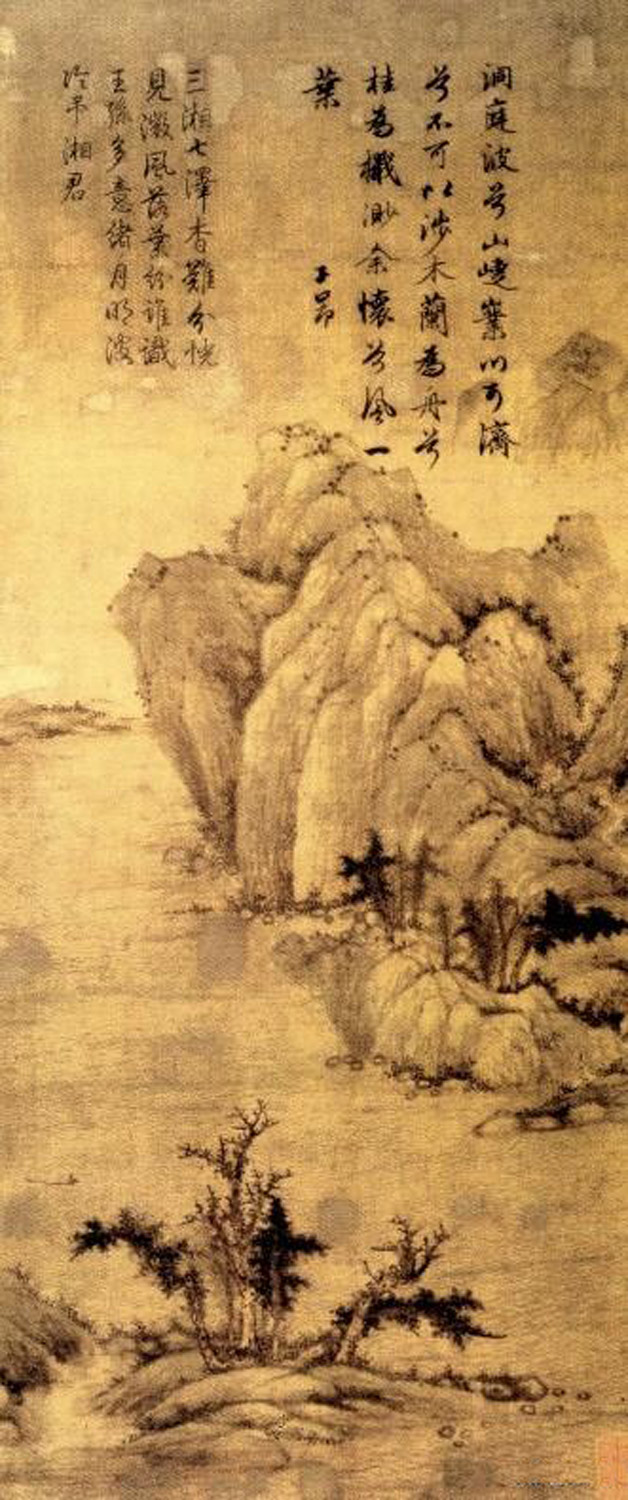
Autumn Thoughts at Dongting is a short melody that can be found in at least 22 handbooks from 1525 to 1890.4 The Dongting of the title is generally considered to be Lake Dongting in Hunan province.5 This is perhaps re-inforced by this melody being called Xiangjiang Yin in two handbooks from the 1550s.6
However, because this earliest version (Xilutang Qintong, 1525) presents it as a prelude to #77, A Drunken Fisherman Sings in the Evening, which has references to the southern part of Lake Taihu and the Song river flowing eastward from there, clearly the reference at one time, and for some players, was to southern Lake Taihu, with its Dongting Grottos. This would be in line with artistic references such as the painting to the right by Zhao Mengfu. There are also noteworthy Dongting teas from these two islands of southern Taihu Lake.7
An examination of the 24 surviving musically related tablatures through 1878 shows that all are musically related, all of them until 1802 were said to be in zhi mode, and all but two (1590 and 1878) are in three sections plus a harmonic coda. The 1525 version is the only one of these used as a prelude. The fourth version, from Qinshu Daquan (1590), has a significant expansion in the form of a fourth section with mostly new material.8 The next version, in Songxianguan Qinpu (1614), also has an added passage at the end of the second section but not the added material of the fourth section. Later versions of this melody seem to follow 1614, or perhaps more precisely Dahuan'ge Qinpu (1673), which changes the tonality.
Regarding this tonal change, the first six surviving versions all follow the common practice of pieces in zhi mode, where the main note is 5 (sol), of often flattening 7 (ti); see for example the third note. (Compare this to the shang mode, in which the main note is 1 and the 3rd is often flatted). The version in Dahuange Qinpu (1673), however, raises these flatted 7s to standard 7s. Most or all later handbooks follow this modality, though the mode is not called "shang" until 1802 and later it is often called zhi again.
Zha Fuxi in the 1950s reconstructed a Dongting Qiu Si in four sections that combines versions from several early handbooks.9 The most important of these early versions seem to be the ones dated 1590, 1614 and 1673; perhaps also 1525, but this is not completely clear. The first of these extends the piece with its added fourth section, the second adds a phrase at the end of Section 2, while the third significantly changes its tonality, as described in the previous paragraph (further comment below).
Most modern recordings, such as those by Ding Chengyun, Wang Huade and Xie Xiaoping, seem largely to follow Zha Fuxi's interpretation.
Of the over 20 handbooks Zha's Guide lists as including this melody, only two late ones are listed as including commentary; they are dated 1705 (Chengyitang Qinpu and 1836 (Wuxue Shanfang Qinpu respectively. The former suggests a northern atmosphere, but it actually refers to a different melody;10 the latter quotes a poem called Dongting Qiusi Shi, which it connects to the Chu region (Hunan).11
As for commentary with the available recordings, one of them tries to make a connection with the Qiu Si said to have been one of the Five Melodies of Cai Yong (Caishi Wunong); another mentions the Erxiang Qinpu,12 so perhaps that is the source of the added passage found in some recordings.
None (see #77. Zui Yu Chang Wan)
00.00 1.
1.
Autumn Thoughts at Dongting (洞庭秋思 Dongting Qiu Si)
2.
Zhi mode (徵調 zhi diao)
As with other zhi mode melodies, the main tonal center being the equivalent note to the zhi (4th) string means some people say the tuning here should be considered as 4 5 7b 1 2 4 5, making the main tonal center 1 and the secondary tonal center 5. However, in this case the pentatonic scale becomes 1 2 3b 5 6 with one of the non-pentatonic notes being 6b, something not found in other modes. (It is important to emphasize that such differing considerations of the mode name do not seem to affect the music itself, only analysis of it.)
For more information on zhi mode see also Shenpin Zhi Yi. For modes in general see Modality in Early Ming Qin Tablature.
Original Preface
Music (聽錄音 Listen to my recording, 看五線譜 see transcription
3 sections, untitled
00.40 2.
01.16 3.
01.51 Closing harmonics
02.08 End
Footnotes (Shorthand references are explained on a
separate page)
17777.56ff have nothing about "autumn thoughts" or the people mentioned here.
(Return)
In some modes using standard tuning the tuning is better considered as 5 6 1 2 3 5 6. Here, with the tuning considered as 1 2 4 5 6 1 2, the main tonal center is 5 (zhi; the open 4th string is also called zhi and the secondary tonal center is 2 (re. One could argue that the music is more diatonic than pentatonics, since the melody includes the non-pentatonic notes 3b, 4, 7b and 7, but the main notes are still the pentatonic ones.
(Return)
| 3. Zhao Mengfu: East Hill of Dongting 趙孟頫﹕洞庭東山圖 | A Korean scroll |
 The Zhao Mengfu painting shown above (link gone is in the collection of the Shanghai Museum, which translates the title as Eastern Hill at the Dongting Area. To some people this may suggest that the painting depicts a scene in the region of Dongting Lake in Hunan. However, at the southern end of Lake Taihu in Jiangsu province are two large islands still called 西、東洞庭 Western and Eastern Dongting; each is covered by a large hill. In this light it is interesting to consider images such as the one at right, from an anonymous Korean painting called
Autumn Moon over Lake Dongting (I have not seen the original Korean title, presumably in Chinese characters) in the Metropolitan Museum; it is said to be one of two the Museum's anonymous 15th century paintings originally part of a complete set of 瀟湘八景
Eight Scenes of the Xiao and Xiang Rivers. This would of course connect it to the Lake Dongting in Hunan.
The Zhao Mengfu painting shown above (link gone is in the collection of the Shanghai Museum, which translates the title as Eastern Hill at the Dongting Area. To some people this may suggest that the painting depicts a scene in the region of Dongting Lake in Hunan. However, at the southern end of Lake Taihu in Jiangsu province are two large islands still called 西、東洞庭 Western and Eastern Dongting; each is covered by a large hill. In this light it is interesting to consider images such as the one at right, from an anonymous Korean painting called
Autumn Moon over Lake Dongting (I have not seen the original Korean title, presumably in Chinese characters) in the Metropolitan Museum; it is said to be one of two the Museum's anonymous 15th century paintings originally part of a complete set of 瀟湘八景
Eight Scenes of the Xiao and Xiang Rivers. This would of course connect it to the Lake Dongting in Hunan.
(Return)
4.
Tracing Dongting Qiu Si
Zha Guide 20/186/-- lists Dongting Qiu Si in 22 handbooks from
1525 to 1890, with Xiangjiang Yin listed separately (23/230/--). Here the two lists are combined to make 24 entries:
- 西麓堂琴統 (1525 and here; III/158); three sections; zhi mode
- 太音傳習 (1553-62; IV/125); 3; zhi; called 湘江吟 Xiangjiang Yin; only comment, "義見下": "significance same as next piece", Yu Ge?
- 太音補遺 (1557; III/370); 3; zhi; same title, melody and comment as previous
- 琴書大全 (1590; V/512); with zhi diao; four sections; expanded
- 松絃館琴譜 (1614; VIII/141); zhi; 3; zhi; added passage at end of section 2, otherwise like 1525
- 徽言祕旨 (1647; X/149); 3; zhi yin; like 1614
- 徽言祕旨訂 (1692; X/xxx); identical to 1647
- 大還閣琴譜 (1673; X/402); 3; "zhi yin" but changes the tonality
- 澄鑒堂琴譜 (1689; XIV/276); 3; zhi yin
- 德音堂琴譜 (1691; XII/565); 3; zhi yin
- 琴譜析微 (1692; XIII/104); 3; zhi yin
- 誠一堂琴譜 (1705; XIII/390); 3; zhi yin; "commentary"?
- 臥雲樓琴譜 (1722; XV/82); 3; zhi yin
- 琴香堂琴譜 (1760; XVII/111); 3; zhi yin
- 自遠堂琴譜 (1802; XVII/402); 3; shang yin
- 二香琴譜 (1833; XXIII/141); 3; shang yin
- 律話 (1833; XXI/432); 3; 仲呂商 zhonglü shang
- 悟雪山房琴譜 (1836; XXII/394); 3; 夷則均宮音 yize jun gong yin
- 一經廬琴學 (1845; XXII/71); 3; gong diao shang yin
- 琴瑟合譜 (1870; XXVI/; 琴府)
- 天聞閣琴譜 (1876; XXV/256); 3; shangyin yudiao; "from 1802"
- 天籟閣琴譜 (1876; XXI/184); 3; zhi yin
- 希韶閣琴譜 (1878; XXVI/167); 4; same tuning as 1836; still related
- 希韶閣琴瑟合譜 (1890; XXVI/452); 3; compare 1878
Based on the changed modality beginning in 1673, 商音 shangyin seems to be the more accurate name for the modality according to the old reckoning based on tonal centers. No examination has been done of how the different names here may reflect differing ideas of modality.
(Return)
5.
Dongting Lake (洞庭湖 Dongting Hu)
Dongting is a large lake in the north of Hunan Province ("Hunan" means "south of the lake"). It is very famous in Chinese poetry, but today its size has shrunk considerably. It is mentioned in connection with such melodies as
Xiao Xiang Shui Yun, but here in Dongting Qiu Si I believe Dongting originally referred to an island in southern lake Taihu.
(Return)
6.
湘江吟 Xiangjiang Yin
Zha Guide 23/230/00 lists this as a separate melody, surviving in two handbooks, dated 1552 and
1557. However, the melody is almost the same as Dongting Qiu Si. The Xiang River flowed into Dongting Lake in Hunan province.
(Return)
7.
洞庭碧螺春 Dongting Biluo Chun
(tea; see
Wiki)
This tea, literally Dongting Green Snail Spring (Tea), should be grown only on 東洞庭山 East Dongting Mountain and 西洞庭山 West Dongting Mountain, the two islands in southern Taihu lake generally known together simply as Dongting.
(Return)
8.
Version in 琴書大全 Qinshu Daquan
The tablature, at V/512-3, has a few errors and omissions.
(Return)
9.
Version by Zha Fuxi
(listen to mp3)
Transcriptions of this version specify that he "合參譜 together-examined different tablatures". This version is available in both recording
(CD list) and transcription (see the modern conservatory Guqin Quji, Level 5, pp. 84/5 [pdf]). Timings for the recording are:
Section 2: 00.51 (added passage at 01.40)
Section 3: 01.52 (from 02.01 to Closing this version is quite different from 1525)
Section 4: 02.29
Closing: 02.52
End: 03.11
Although the main version Zha Fuxi used seems to have been the one in Qinshu Daquan (1590), his own version is somewhat more elaborate. Its four section versions are quite similar to the 1525 version until the beginning of the third phrase of section 3 (of both), after this being very different.
(Return)
10.
Commentary said to be in Chengyitang Qinpu (誠一堂琴譜; 1705)
Zha Guide p. 186 [430] has this as an afterword for Dongting Qiu Si, but the handbook itself has it as an afterword for
Sumen Xiao, which is two pieces earlier (XIII/388).
Northern tones blue expression, like attaining its banners; really there is sound moving the situation of forests and ravines. (Obviously I don't understand that one very well!)
This was presumably an inadvertent clerical error.
(Return)
11.
Dongting Qiu Si in Wuxue Shanfang Qinpu (悟雪山房琴譜; 1836) (XXII/394)
The melody is essentially the same as in other versions, but the tuning is "夷則均 Yize jun (lowered 1st, 3rd and 6th strings). Several other handbooks around this time also use this tuning for Dongting Qiu Si.
The preface here is as follows:
Fang Chaoting's poem Dongting Qiu Si says, "...." (poem not yet translated)
(Return)
Return to the annotated handbook list or to the Guqin ToC.
#160;