|
T of C
Home |
My Work |
Hand- books |
Qin as Object |
Qin in Art |
Poetry / Song |
Hear, Watch |
Play Qin |
Analysis | History |
Ideo- logy |
Miscel- lanea |
More Info |
Personal | email me search me |
| Qin Shi #3 Qin biographies | 首頁 |
|
Yu the Great
- Qin Shi #3 2 |
大禹 1
琴史 #3 夏禹之製 The style of Xia Yu (Yu the Great) 3 |
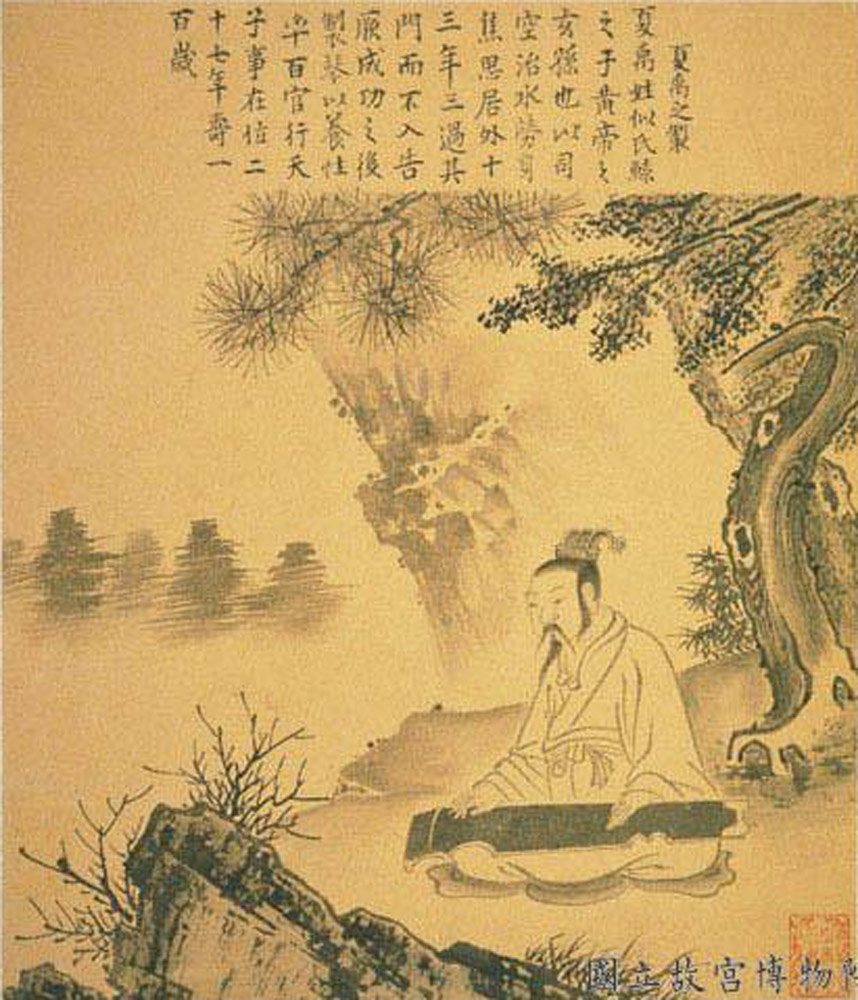 Da Yu (Yu the Great) is also called Xia Yu (Yu of the Xia kingdom); as such he has also been called the first emperor of the Xia dynasty.4 Earlier, as the successor to Shun, Yu had had to take responsibility for saving the country from flooding after his father Gun5 had failed in the task. Flooding was a great problem throughout Chinese history. There were several ancient stories on solving this problem, with story of Yu and the floods being the most famous, and one of China's greatest myths (illustration).6
This Qin Shi biography attributes to Yu a qin composition called Yu's Melody,7 mentioning it in connection with the task of controlling the flood. It does not survive in any handbooks.
The other melody mentioned here, Great Xia (Da Xia8), is said to have been written in response to the flood. There is also no surviving qin melody of this title. However, the melody Yu Hui Tu Shan deals with a great meeting called by Yu after he had solved the problem of the flood.
Another surviving title connected to Yu is Melody of Xiangling (Xiangling Cao). Xiangling, which literally means "overflow the hills", was a city in Henan province. Yuefu Shiji has lyrics with this title (incomplete?).9 The melody Shenren Chang also concerns flooding, but it is connected to Emperor Yao.
One commentary in Yuefu Shiji on Xiangling Cao says an alternate title is Yu Shang Kuaiji (Yu Ascends Mount Kuaiji). However, Song dynasty melody lists include this as a separate melody, with Qin Shu putting it directly after Xiangling Cao. and Seng Juyue doing the same, additing that he did it while "looking for an old cave".10
The original biography in Qin Shi is as follows. 11
Footnotes (Shorthand references are explained on a
separate page)
1.
Yu the Great (大禹 Da Yu)
The main ZWDCD reference is 5485.146 夏禹 Xia Yu (25449.75 禹:夏王號; 5960.795 大禹:夏禹之美稱也), meaning Yu of Xia, referring either to the Xia dynasty or the name of the region called Xia (now anachronistically sometimes considered to refer to all of China.) Anne Birrell, Chinese Mythology, discusses him extensively, translating his name as Reptilian Pawprint
(Return)
2.
The 琴史 Qin Shi entry has 4 lines
(Return)
| 3. Images of Yu the Great (大禹、夏禹) | Da Yu: flood control |
 The image at right, 大禹手持耒耜治水圖 Da Yu grasps a leisi plow to control the waters, is a copy of a stone rubbing commonly found on the internet.
As for the image above, 夏禹之製 The style of Xia Yu (Yu the Great), it comes from a collection called 宋人畫歷代琴式圖. Other early images of qin styles do not seem to include any examples of a Great Yu style qin.
(Return)
4.
夏朝 Xia dynasty
(Wiki)
This "dynasty" was not mentioned in Chinese records prior to the Zhou dynasty, during which time it was identified as the dynasty the Zhou themselves had succeeded. 大禹 Yu the Great was its noble founder; 桀癸 Jie Gui was its evil last emperor. Now it is either considered mythological or said to have ruled during several centuries between about 2200 and 1600 BCE.
桀癸 Jie Gui (夏桀 Jie of Xia, 名桀 given name Gui)
15131 桀 refers to 夏桀 5845.204, which in turn refers to 金石索 Jinshi Suo a Catalog of Bronze Inscriptions (with image), not mentioning the account in Qin Shi (see Grand Scribes Records, Chapter 2, Nienhauser I/several references, but none with the two stories mentioned here). These two stories, mentioned elsewhere on this site, are both said to be relevant to Jie Gui losing the "Mandate of heaven". One (see under Wine Mad) concerns him building a lake filled with wine for which he had retaining dykes made of wine dregs; anyone who criticized him for this would be either executed or banished. The other story (see under King Zhuang of Chu) tells of him loving the se as played by (his concubine) 妹喜 Mei Xi (or Mo Xi) so much that he stopped ruling the country properly and thus was overthrown.
(Return)
5.
Gun 鯀 (Wiki)
It is said that, after hearing a suggestion from a celestial (see
Shenren Chang), Emperor Yao appointed Gun to the task of controlling the floods. He used dykes, and at first this worked. However, eventually they failed and many died in the ensuing floods. As a result Gun committed suicide (or Shun executed him) and the task was turned over to Gun's son Yu.
(Return)
6.
Ancient Chinese flood myths
Birrell, Chinese Mythology, identifies at least four myths related to the flooding. These are as follows:
- "Creatrix flood myth": Nü Gua repairs the sky and builds dams (pp. 69-71)
- "Failed hero flood myth": failed attempts by Gun, father of Da Yu (pp. 79-81 and above)
- "Hero flood myth": successful attempts by Da Yu (pp. 81-13)
- "Marplot flood myth": the marplot (meddler) Gonggong (pp. 97-98)
Gonggong 共工
1484.5 堯時治水之官窮奇也 A person who during the time of
Emperor Yao was in charge of controlling the waters, also called Qiongqi ("one of the four 凶 bad people in the time of Yao"). Birrell quotes various stories, including one from 國語 Guo Yu that she summarizes as saying "his hydraulic work caused cosmic disruption and made the people miserable in their suffering".
(Return)
7.
Yu's Melody
禹操 Yu Cao; 25449.xxx
(Return)
8.
大夏 Da Xia; 5960.924 Music of Yu
(Return)
9.
襄陵操 Xiangling Cao;
35354.49
Although Xiangling Cao is included in Song dynasty melody lists, the only surviving melody with this title is in 1525. But although its afterword quotes from Yuefu Shiji, the lyrics are not paired to any part of the melody.
YFSJ has Xiangliang Cao lyrics in Folio 57, #10 (p. 828). The entry there is as follows.
"also called 'Yu ascends Kuaiji'" (see next footnote)
Rushing water in great quantity caused damage, so vast it surrounded mountains and covered knolls, bringing floods that roiled even the heavens.
《古今樂錄》曰:Gujin Yuelu says,
Yu controlled the flood, ascended Mount Kuaiji, looked around and created this song.
謝希逸《琴論》曰:Xie Zhuang, Qin Lun says,
Xia Yu controlled the waters and so created Xiangling Cao
"Yu Ascends Kuaiji" is what Xia Yu created upon making an imperial tour of the east.
Wūhū, hóng shuǐ yín tiān, xià mín chóu bēi, shàng dì yù zī.
Woohoo! Floods saturate the world,
here below people have sorrow and misery, from above the gods give only vague advice.
三過吾門不入,夫子道衰,嗟嗟,不欲煩下民。
Sān guò wú mén bù rù, fūzǐ dào shuāi, jiējiē bù yù fán xià mín.
Three times they go past my gate without entering, the sage's way is diminished,
Feeling regret, they do not wish to burden the people.
(Later addition from 太平御覽 Taiping Youlan? (mostly repeats):
Fēi yù fá gōng yě, shāng jūn mò zhī fán xià mín.
Not wishing to attack skill,
or harm leaders who dont know how to put burden on people.
嗟乎,天非欲數煩下民。
Jiē hū. Tiān fēi yù shù fán xià mín.
Alas!
Heaven does not want repeatedly to put a heavy burden on the people.
(Tentative early try at translation.)
(Return)
10.
Emperor Yu Ascends Mount Kuaiji (禹上會稽 Yu Shang Kuaiji)
25449.xxx. No tablature survives for this melody. A comment in its entry in the melody list of 僧居月 Seng Juyue, in TKW's edition, says, 禹制,探古穴也 "By Yu; looking for the old cave." (The Shuo Fu edition has 禹制操古穴也 ?). 25449.10 禹穴 Yu Xue says it is the name of caves in two places, one of which is near Shaoxing in Kuaiji. It then quotes Shi Ji, Sima Qian's Preface, saying, 二十而遊江淮。上會稽,探禹穴。 "When I was 20 and traveling in Jiang Huai, I climbed Kuaiji and looked for Yu's cave." (See Watson, Sima Qian, the Grand Historian of China, 1958.)
(Return)
11.
Original text
The original Chinese text is as follows:
(Return)
Return to QSCB,
or to the Guqin ToC.