|
T of C
Home |
My Work |
Hand- books |
Qin as Object |
Qin in Art |
Poetry / Song |
Hear, Watch |
Play Qin |
Analysis | History |
Ideo- logy |
Miscel- lanea |
More Info |
Personal | email me search me |
| CXZC in ToC | lyrics and transcription; 首頁 |
| 09. A Jinling Lament on Antiquity 1 | 金陵弔古 1 |
| Dynastic Rise and Fall in Nanjing; grouped in gong mode:2 1 2 4 5 6 1 2) | Jinling Diao Gu |
| Central section of a long scroll by Qiu Ying (full) 3 |

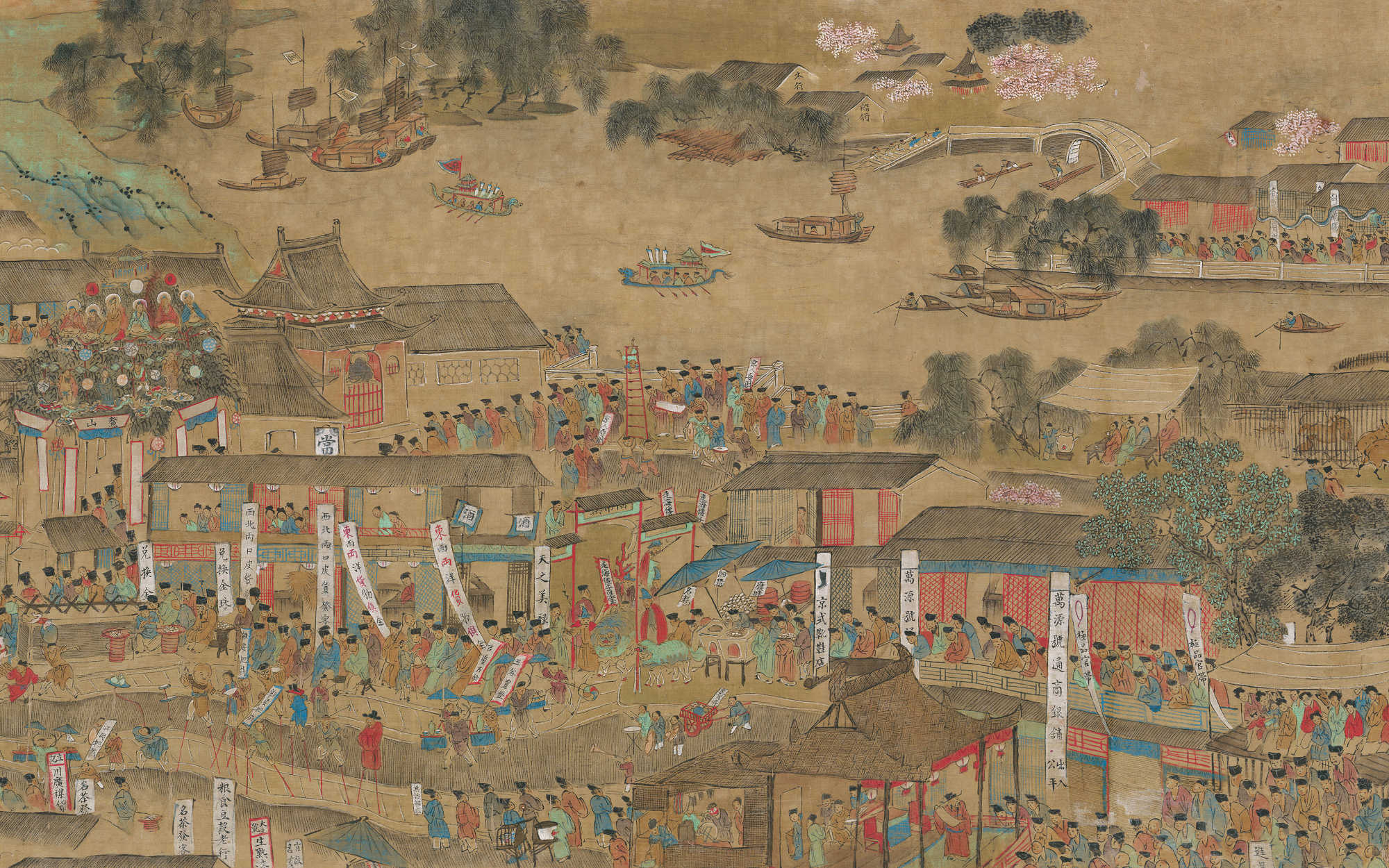 A more explanatory subtitle might be "A guqin song reflecting on the rise and fall of dynasties in ancient Nanjing". The image at right, part of a famous long scroll called "Prosperous Southern Capital", is the perfect counterpoint to this: by highlighting the excitement of the city, which at the time of the painting had again become the capital city it is perfect counterpoint to the melody which, though it speaks of glories and glorious aims, also presents lyrics that remind us of the other side of the coin. As, of course, the Ming literati were so often wont to do.
As for the name Jinling ("Golden Mound"), it was one of the most enduring historical and literary names for what is today Nanjing, especially when viewed through the lens of its ancient dynasties and ruined capitals. Untangling the city’s many names through history is complex and beyond the scope of this website.4 In Yang Biaozheng’s own day the city was officially known as Yingtian Prefecture, while names such as Nanjing (“Southern Capital”), Nandu (“Southern Capital”), and Jinling all remained in use in different contexts.4
This melody, like Mudan Fu was apparently created by Yang Biaozheng himself and included in his Chongxiu Zhenchuan Qinpu, one of a number of handbooks associated with Nanjing (see list).
Reconstructing the melody has begun with looking for melodic as well as poetic/literary structures. A glance at the original lyrics shows, for example, that the lyrics of Sections 1 and 7 are written in lines of 7+7 characters, while the tablature shows that in the first half of each is almost exactly the same, there are many note differences in the second halves. Meanwhile in Section 4 the structure looks as though it should be (7+7) x 4, but the last line seems corrupt. Other sections have short passages that also seem to give an indication of structure.
All this suggests there may be some stylistic and perhaps editorial problems. To start with, the whole of the version in Qinqu Jicheng is printed so faintly that in many places one must consult the facsimile edition (Folio IV/17-24). There are also some clear mistakes in the tablature. Some are impossible to play as written, others are just not clear. As an example, Sections 2, 3 and 8 and part or parts of 9 seem clearly intended to be played in harmonics; all have indications of harmonics ending, but only one, near the end of Section 9, has instructions to begin harmonics. Particularly disconcerting is the fact that in some of the harmonic passages there appear the instructions shang or xia, as though one can slide during a harmonic.
A particular difficulty is the fact that (as with most of this edition of the handbook) the tablature has no punctuation - the punctuation here comes from Zha Fuxi's Guide to Existing Guqin Pieces in Tablature (1958), specifically the Guide to existing qin melodies with lyrics.
One strange aspect with regard to the lyrics here is the use of "的那 dena", literally "of that", syllables that in earlier handbooks such as Zheyin Shizi Qinpu were used almost exclusively to pair with the left hand technique 對起 duiqi but otherwise had no meaning. The use of dena there is discussed, for example, under this Zheyin intro as well as this Cipai and Qin Melodies
In contrast to the usage discussed there, the use here of de na seems generally to be unconnected with the use of left hand techniques such as dui qi (which in any case rarely uses that technique). Here, if de na really has no meaning, does this mean that the lyrics were copied from an earlier melody that had those words, but the person applying those words to the later melody did not know their original purpose and just included them feeling they are an essential part of the song? Here the fact that the preface states that this song is newly made could suggest that more likely that significance of de na was not understood, and so this phrase was used to give an air of antiquity. But here it does seem possibly to be intended to add emphasis to the words that come after. If so, could this have been part of the original reason for this left hand technique being used in the earlier melody?5
All of this is important to understanding the rhythms of the songs. Hopefully, though, perhaps if more songs are successfully reconstructed that issue might become more clear.
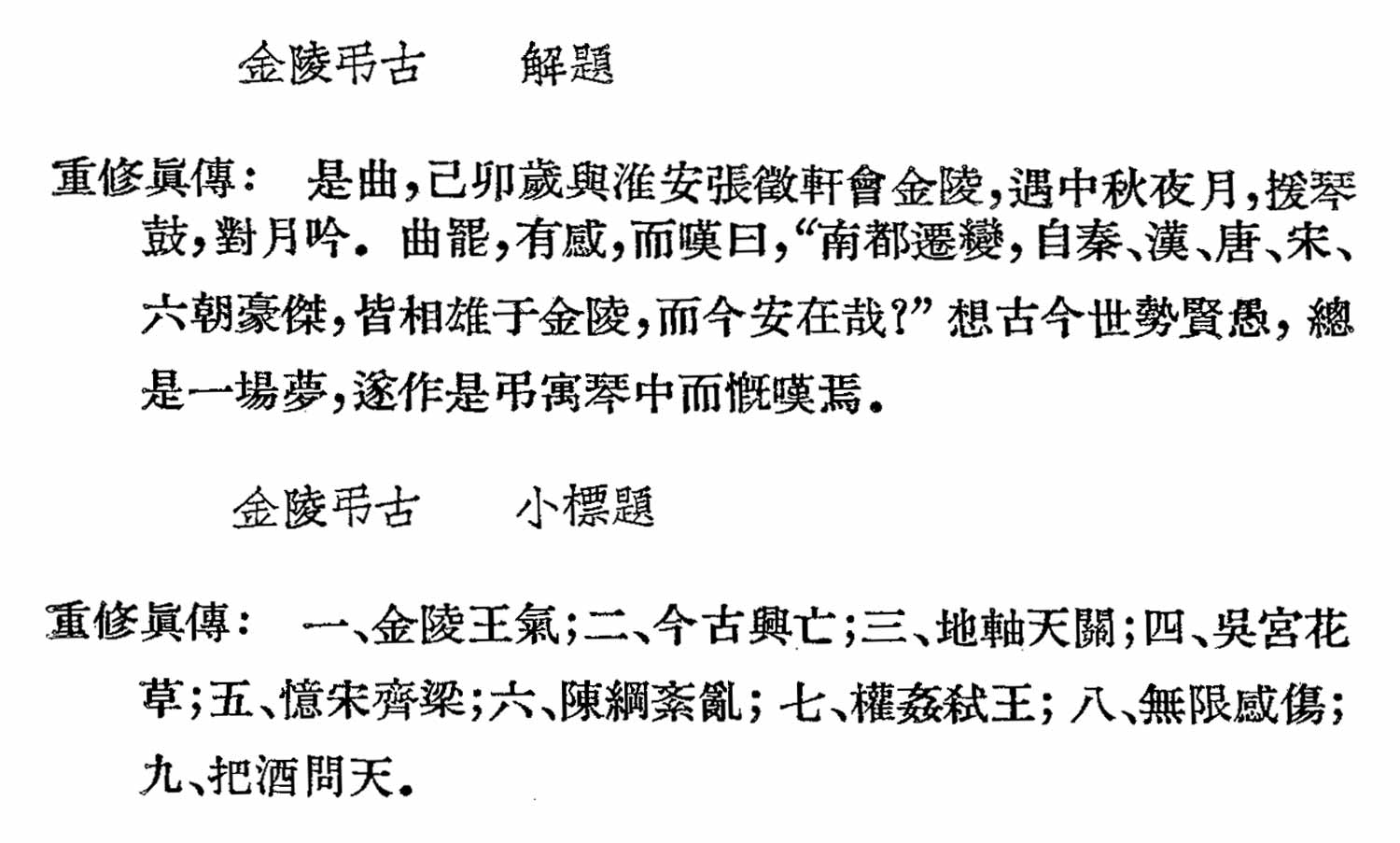
Preface
(IV/317)
The original 1585 preface (not in 1573) says:
This piece was composed in the jimao year (1579, when I met 張徵軒 Zhang Zhengxuan of Huai’an in Jinling. Encountering the moon during Mid-Autumn Night, we took up the qin and played, chanting toward the moon. When the piece was finished, feelings were stirred, and with a sigh it was said: “Since the changes and upheavals of the Southern Capital, from Qin, Han, Tang, Song, and the Six Dynasties onward, heroic men all contended for supremacy in Jinling — but where are they now?”
Reflecting upon the course of the world through past and present, upon wisdom and folly alike, all is but a single dream. Thus this lament was embodied within the qin music, and so gave rise to these sorrowful sighs. And so (these lyrics) have been set to qin music, so that those who greed after fame and pursue profit, upon hearing it, may also be somewhat awakened.
The complete original text of the preface is in the footnote.6
Lyrics, with translation
始皇巡狩馭飛龍,遙瞻王氣在江東。
思今古,論興亡,今古興亡!
玄武湖,鳳凰臺,咫尺之間。
二京初興孫已休,潮聲猶帶舊時愁。
劉裕呵黷武窮兵,道濟呵足智多能。
《後庭花曲》艷的那腔新,景陽宮井又的那誰人。
Virtually same music and lyrics Section 1; the significance of differences in both is not clear: text differences indicated below; tablature differences seem to concern ornaments.
始皇巡狩馭飛龍,遙瞻王氣在江東。
In harmonics as with Section 2, of which it seems to be simply a repeat.
江山也不見消磨,王伯也畢竟如何,如何又如何。
The phrasing here is tentative since the melody is as yet only partially reconstructed. And one might argue that the two sections that are repeated with different titles intend for the player to adapt rhythms and tempi accordingly.
1.
(浩浩歌 Jinling Diao Gu) (QQJC IV/317)
Other titles used here have also included "In Jingling Mourning the Olden Days", and "A Nanjing lament on antiquity in Jinling".
2.
Gong mode (5 6 1 2 3 5 6)
However, that does not seem to be the case in this handbook. In other melodies I have examined, such as Yu Xian Yin, also said to be in gong mode, the first string is 3.
南都繁會圖 The Flourishing Society of the Southern Capital, a scroll once attributed to 仇英 Qiu Ying (1494–1552) (full image .6MB)
At first such a scroll may seem inappropriate to accompany a lament on the city's past, but such contrast was actually quite popular amongst Ming literati: now it is exciting and bustling but look what happens to it - to everything - in the end. This is also reflected in the lyrics themselves, where in sections one and two the same lyrics and melody have positive captions, then at the end they both have negative or questioning ones.
The scroll does mention some things the resonate in the painting, such as the waterways, bridges, palaces and stone walls.
4.
A Nanjing Lament on Jinling in Antiquity?
5.
Usage of 的那 dena
6.
Original text of preface
Translation above.
7.
Original text of lyrics
始皇巡狩馭飛龍,遙瞻王氣在江東。
思今古,論興亡,今古興亡。
玄武湖,鳳凰台,咫尺之間。
二京初興孫已休,潮聲猶帶舊時愁。
- (? Change / to : 吳宮晉代已付流,東流東流那東流。
劉裕呵黷武窮兵,道濟呵足智多能。
《後庭花曲》艷的那腔新,景陽宮井又的那誰人。
始皇巡狩馭飛龍,遙瞻王氣在江東。
思今古,論興亡,今古興亡,無限的那感傷,無限的那慨慷。
江山也不見消磨,王伯也必竟如何,如何又如何。
(Scanned from Guide 25/212/387; also see the full text in these jpg files of the
preface and the section titles and of the complete lyrics).
8.
Addition of 又 you
Music (Lyrics next)
The melody has nine sections as follows:
Here are the original lyrics, with translation:7
The First Emperor on imperial tour rode his flying dragon carriage;
from afar he gazed at the royal aura rising east of the river.
疏鑿秦淮斷地脈,埋金預鎮鍾山中。
He dredged and cut the Qinhuai to sever the earth-veins;
he buried metal there beforehand to suppress Zhong Mountain.
一世傳之萬萬世,當年意氣何豪雄。
“One generation shall transmit it for ten thousand generations” —
how heroic and grand was the spirit of those days!
未幾忽向沙丘崩,鮑魚爛臭聞腥風,椎姦弒主望夷宮。
Yet before long he suddenly dropped dead at Shaqiu;
the stench of rotting salted fish spread in the rank wind (to hide the smell of his corpse).
treacherous ministers murdered (his heirs) at Wangyi Palace.
子嬰子嬰鹿已失,重瞳隆準齊縱橫。
Ziying, Ziying — already the deer (representing power) was lost;
Double-Pupiled Xiang Yu and High-Nosed Liu Bang then together contended across the realm.
盃影龍蛇分漢楚,形勢猶存秦已空。
Amidst wine-cup shadows, dragons and serpents divided Han and Chu;
the strategic configuration still remained, but Qin itself was empty.
(In harmonics; here and later 的那 dena does seem to serve a structural function)
Thinking on past and present, discussing rise and fall: past and present, rise and fall!
無限的那感傷,無限的那慨慷。
Boundless are these feelings of sorrow; boundless too these impassioned sighs.
登峻嶺、渡長江,指白下、望丹陽:圖伯、興王。
Climb (nearby) high ridges, cross the Long Yangzi;
point toward Baixia, gaze toward Danyang; plot hegemony - exalt kingship.
六朝歌舞地,三國戰爭場。
During the Six Dynasties we were a land of song and dance;
during the Three Kingdoms we had fields of battle.
昇州的那蔣州,建業的那建康,唐、宋兮名也無常。
Shengzhou and that Jiangzhou; Jianye and that Jiankang; through Tang and Song, these names had no permanence.
朱雀橋,烏衣巷,王、謝宅,在何方。
There is Vermilion Bird Bridge and Black-Robe Lane, but
the Wang and Xie mansions: where are they now?
空餘烟柳鎖垂楊。
All that remain are misty willows intertwined with drooping poplars.
(Largely concerns Three Kingdoms period
[Wiki])
Xuanwu Lake, Phoenix Terrace — within arm’s reach of one another.
更有那二水三山,虎踞龍蟠,地軸天關。
There also are those "two waters and three mountains",
tiger crouching, dragon coiling — earth’s axis, heaven’s pass.
憶周郎一世之雄,孫仲謀,孫仲謀,
Recall Zhou Yu, hero of his age;
Young Sun Quan, Young Sun Quan —
遺恨的那偏安。
Leaving only the regret of partial security in the south.
(After the Wu of Sun Quan (Wiki) collapsed the capital moved to Luoyang under the Jin
[Wiki] then back to Jiankang, but they too have gone.)
When the Two Capitals first arose, the Sun (rulers) had already gone;
tidal sounds still carries that ancient sorrow.
千尋鐵鎖沉江底,一片降旗出石頭。
Thousand-fathom iron chains sank to the river bottom;
surrender banners emerged from the stone walls.
吳宮的那花草埋幽徑,晉代衣冠成古丘。
Flowers and weeds of the Wu palace bury hidden paths;
Jin dynasty robes and caps became ancient mounds.
吳宮晉代已付流,東流東流那東流。
Wu palaces and the Jin rulers are now completely gone —
yet still the waters flow east, they flow east.
(? The original last line seemed garbled: it actually read,
"吳宮晉代已付 東流的那東流。")
(After Liu Yu [Wiki] came the Southern Dynasties
[Wiki]; its great defender Tan Daoji Wiki] was known as "The Great Wall")
Liu Yu — ah! — exhausted himself in militarism and warfare;
Daoji — ah! — abundant in wisdom and ability.
戎馬宵征,鉦鼓宵鳴。
Warhorses nightly tread the ground; gongs and drums by night resound!
春燕也,春燕也,林木為巢,
Spring swallows, ah! Spring swallows! 'Mongst trees they simply make their nests,
空思憶的那萬里長城。
While we in vain do still recall that ten-thousand-li Great Wall.
蕭道成禪未稱齊,梁武帝麵代犧牲。
Xiao Daocheng accepted(the previous emperor's) abdication before being proclaimed (first emperor of) Qi;
and Emperor Wu of Liang substituted noodles in place of animal sacrifice (at his own) inauguration).
臺城餓,臺城餓,佛不慈悲,
(And yet when trapped) in Taicheng he starved ! In Taicheng he starved!
Buddhism brought no compassion;
到如今遺臭的那千齡。
and down to today this has left a bad stench that has reeked for a thousand years.
(The Chen dynasty [Wiki; 557-589] is here typified by a frivolous song. Note that for the sake of parallel structure in the first line I have changed the original "景陽宮井的那誰人" to "景陽宮井又的那誰人".8
The tune “Flowers in the Rear Court” — how seductive its new melody!
At the Jingyang Palace Well — then who was that person?
張麗華何處風流,江總也詩酒酣淫。
As for Zhang Lihua, where now is her elegance and charm?
Jiang Zong also with poetry and wine loved to indulge.
君不的那君,臣不的那臣,繁華簫管都已總成塵。
The rulers were truly rulers;
the ministers were not truly ministers.
All their flourishing pipes and flutes have altogether turned to dust.
細柳新蒲為誰綠,芳草年年他自春。
The slender willows and fresh cattails - for whom to they grow green?
The fragrant grasses year after year make their own spring.
The First Emperor on imperial tour rode his flying dragon carriage;
from afar he gazed at the royal aura rising east of the (Yangzi) river.
疏鑿秦淮斷地脈,埋金預鎮鍾山中。
He dredged and cut the Qinhuai to sever the earth-veins;
he buried metal there beforehand to suppress Zhong Mountain.
一世傳之萬萬世,當年意氣何豪雄。
“One generation shall transmit it for ten thousand generations” —
how heroic and grand was the spirit of those days!
未幾忽向沙丘崩,鮑魚爛臭聞腥風,(權)姦弒主望夷宮。
Yet before long he suddenly collapsed at Shaqiu;
the stench of rotting salted fish spread upon the rank wind.
treacherous ministers murdered their lord at Wangyi Palace.
子嬰子嬰鹿已失,重瞳隆準齊縱橫。
Ziying, Ziying — already the deer was lost;
Double-Pupiled Xiang Yu and High-Nosed Liu Bang together contended across the realm.
盃影龍蛇分漢楚,形勢猶存(形)已空。
Amidst wine-cup shadows, dragons and serpents divided Han and Chu;
the strategic configuration still remained, but Qin itself was empty.
Rivers and mountains do not appear worn away;
yet kings and hegemon-lords — what became of them in the end?
How? And again, how?
世事也何苦蹉跎,歲月也空虚過。
Why must worldly affairs pass in vain?
Years and months too pass emptily away.
問蒼天生我如何,如何達呵?
I ask the Great Blue Heaven: why was I born thus?
how shall fulfillment be attained?
補堯衣的那山火窮呵,披渭水漁簑笑呵呵。
Patching Yao’s robe while mountain fires exhaust themselves —
wearing a fisherman’s cape by Wei River, laughing “ha-ha-ha!”
小窗點易,半生獨自埋頭的那坐,漫哈哦,漫哈哦。
By the little window annotating the Yi Jing;
half a lifetime spent alone, bent over in sitting.
Aimless laughter — oh! aimless laughter — oh!
拿雲手權袖着,捧日心空負呵。
Cloud-grasping hands remain tucked in sleeves;
a sun-supporting heart lies vainly burdened;
(泛音起)倚天劍常背呵,懸河口緊閉呵。
(Harmonics begin) The heaven-leaning sword is forever carried on the back; the hanging-river mouth stays tightly shut.
乾坤寄傲總輸的那儂,今古興亡(泛音止)一任他。
One who lodges pride within Heaven and Earth always loses in the end —
as for rise and fall through past and present: (Harmonics end) let it all be.
Footnotes (Shorthand references are explained on a
separate page)
In ToC;
Guide 25/212/386 lists this title only in 1585 (QQJC IV/311).
(Return)
Gong is the name of the first string but earlier in the Ming dynasty gong mode melodies generally used the relative tuning 5 6 1 2 3 5 6, and the main tonal center is the open third string (the note 宮 gong) would be the open third string. For more on this see Shenpin Gong Yi and Modality in early Ming qin tablature.
(Return)
Copied from Chinese Wiki, from which a 9 MB image of the complete scroll can be downloaded. The original attribution to Qiu Ying was challenged and now academic consensus suggests it was probably done around the Wanli era (1573–1620), just when this melody was created, or perhaps a bit later. It depicts celebrations during 元宵節 the Lantern Festival following those for the New Year. The above excerpt from the center of the full image shows to the left a giant Aoshan (Ao-Turtle Mountain of Lanters: 鰲山灯=>鼇山灯 Aoshan Ding), representative of the Lantern Festival.To the lower right is a stage showing a performance with women seated separate from the men, while it must be the Qinhuai River in the background.
(Return)
See the Wikipedia Nanjing entry
for a sense of the complexity of this issue.
(Return)
From melodies in Chongxiu Zhenchuan Qinpu that have lyrics from Zheyin Shizi Qinpu I have seen "那" paired to left hand strokes in the earlier handbook but not so used here, but I haven't done a thorough search.
(Return)
The original text is as follows:
(Return)
The original text of the lyrics are as follows: note the 20 occurences of "的那 dena" beginning with Section 2 and one of 有那 in Section 4, and see
comment above:
Shǐ Huáng xún shòu yù fēi lóng, yáo zhān wáng qì zài Jiāng dōng.
疏鑿秦淮斷地脈,埋金豫鎮鍾山中。
Shū záo Qín Huái duàn dì mài, mái jīn yù zhèn Zhōng shān zhōng.
一世傳之萬萬世,當年意氣何豪雄。
Yī shì chuán zhī wàn wàn shì, dāng nián yìqì hé háo xióng.
未幾忽向沙坵崩,
Wèi jǐ hū xiàng Shā Qiū bēng,
鮑魚爛臭聞腥風,椎姦弒主望夷宮。
Bào yú làn chòu wén xīng fēng, zhuī jiān shì zhǔ Wàngyí Gōng.
子嬰子嬰鹿已失,重瞳隆準齊縱橫。
Zǐyīng Zǐyīng lù yǐ shī, Zhòng tóng Lóng zhǔn qí zòng héng.
盃影龍蛇分漢楚,形勢猶存秦已空。
Bēi yǐng lóng shé fēn Hàn Chǔ, xíng shì yóu cún qín yǐ kōng.
Sī jīn gǔ, lùn xīng wáng, jīn gǔ xīng wáng.
無限的那感傷,無限的那慨慷。
Wú xiàn denà gǎn shāng, wú xiàn denà kǎi kāng.
登峻嶺,渡長江;指白下,望丹陽:圖伯、興王。
Dēng jùn lǐng, dù Cháng Jiāng; zhǐ Báixià, wàng Dānyáng, tú Bó Xìng wáng.
六朝歌舞地,三國戰爭場。
Liù Cháo gē wǔ de, Sān Guó zhàn zhēng chǎng.
昇州的那蔣州,建業的那建康,唐宋兮名也無常。
Shēngzhōu denà Jiǎngzhōu, Jiànyè denà Jiànkāng, Táng Sòng xī míng yě wú cháng.
朱雀橋,烏衣巷,王、謝宅,在何方?
Zhūquè Qiáo, Wūyī xiàng, Wáng Xiè zhái, zài hé fāng.
空餘烟柳鎖垂楊。
Kòng yú yān liǔ suǒ chuí yáng.
Xuánwǔ Hú, Fènghuáng Tái, zhǐ chǐ zhī jiān.
更有那二水三山,虎踞龍蟠,地軸天關。
Gèng yǒu nà èr shuǐ sān shān, hǔ jù lóng pán, dì zhóu tiān guān.
憶周郎一世之雄,孫仲謀,孫仲謀,遺恨的那偏安。
Yì Zhōu láng yī shì zhī xióng, Sūn Zhòngmóu, Sūn Zhòngmóu, Yí hèn denà piān ān.
Èr jīng chū xìng sūn yǐ xiū, cháo shēng yóu dài jiù shí chóu.
千尋鐵鎖沉江底,一斤降旗出石頭。
Qiān xún tiě suǒ chén jiāng dǐ, yī jīn jiàng qí chū shí tou.
吳宮的那花草埋幽徑,晉代衣冠成古坵。
Wú gōng denà huā cǎo mái yōu jìng, Jìn dài yī guān chéng gǔ qiū.
吳宮晉代已付 東流的那東流。
Wú gōng Jìn dài yǐ fù dōng liú denà dōng liú.
last line
Wú gōng jìn dài yǐ fù liú, dōng liú dōng liú nà dōng liú: should end with a
搯撮三聲?
This section seems clearly intended to have a ([7+7]x4) structure, suggesting there were editorial problems in the last line.)
Liú Yù hē dú wǔ qióng bīng, dào jì hē zú zhì duō néng.
戎馬宵征,鉦鼓宵鳴。
Róng mǎ xiāo zhēng, zhēng gǔ xiāo míng.
春燕也,春燕也,林木爲巢,
Chūnyàn yě, Chūnyàn yě, lín mù wèi cháo,
空思憶的那萬里長城。
kōng sī yì denà Wànlǐ Chángchéng.
蕭道成禪未稱齊,梁武帝麵麪代犧牲。
Xiāo Dàochéng chán wèi chēng Qí, Liáng Wǔdì miàn dài xī shēng.
臺城餓,臺城餓,佛不慈悲,
Táichéng è, Táichéng è, Fó bù cíbēi,
到如今遺臭的那千齡。
dào rú jīn yí chòu denà qiān líng.
"Hòu tíng huā qū" yàn denà qiāng xīn, Jǐngyáng gōng jǐng yòu denà shéi rén.
張麗華何處風流,江總也詩酒酣淫。
Zhāng Lìhuá hé chù fēng liú, Jiāng Zǒng yě shī jiǔ hān yín.
君不的那君,臣不的那臣,繁華簫管,都已總成塵。
Jūn bù denà jūn, chén bù denà chén, fán huá xiāo guǎn, dōu yǐ zǒng chéng chén.
細柳新蒲為誰綠,芳草年年他自春。
Xì liǔ xīn pú wèi shuí lǜ, fāng cǎo nián nián tā zì chūn.
疏鑿秦淮斷地脈,埋金預鎭鍾山中。
一世傳之萬萬世,當年意氣何豪雄。
未幾忽向沙坵崩,
鮑魚爛臭聞腥風,權姦弒主望夷宮。
子嬰子嬰鹿已失,重瞳隆準齊縱構。
盃影龍蛇分漢楚,形勢猶存形已空。
楚人起舞本為楚,中有楚人為。
登峻嶺,渡長江,指白下,望丹陽,圖伯興王。
六朝歌舞地,三國戰爭場。
昇州的那蔣州,建業的那建康,唐宋兮名也無常。
朱雀橋,烏衣巷,王謝宅,在何方。
空餘烟柳鎖垂楊。
Jiāng shān yě bù jiàn xiāo mó, Wáng Bó yě bì jìng rú hé, rú hé yòu rú hé.
世事也何苦蹉跎,歲月也空虚過。
Shìshì yě hékǔ cuōtuó, suìyuè yě kōngxūguò.
問蒼天生我如何,如何達呵,
Wèn Cāngtiān shēng wǒ rú hé, rú hé dá hē,
補堯衣的那山火窮呵,披渭水漁簑笑呵呵。
Bǔ Yáo yī denà shān huǒ qióng hē, pī Wèi shuǐ yú suō xiào hēhē.
小窗點易,半生獨自埋頭的那坐,漫哈哦,漫哈哦。
Xiǎo chuāng diǎn Yì, bàn shēng dú zì máit óu denà zuò, màn hā ó, màn hā ó.
拿雲手權袖着,捧日心空負呵,倚天劍常背呵,懸河口緊閉呵。
Ná yún shǒu quán xiù zhe, pěng rì xīn kōng fù hē, yǐ tiān jiàn cháng bèi hē, xuán hékǒu jǐn bì hē.
乾坤寄傲總輸的那儂,今古興亡一任他。
Qiánkūn jì ào zǒng shū denà nóng, jīn gǔ xīng wáng yī rèn tā.
(Return)
At first glance it looks as though Section Six is intended to begin with two 7+7 lines, with 的那 dena beiing parallel fillers. If so, however, then the second half of the first line is missing a character. With this in mind, I have changed the original "景陽宮井的那誰人" to "景陽宮井又的那誰人", borrowing “又” from the line "景陽宮井又何人" found in a famous poem called "馬嵬坡 On Mawei Slope" by 鄭畋 Zheng Tian [821/5/ - 883?; Wiki])
(Return)
Return to the Chongxiu Zhenchuan intro,
to the annotated handbook list
or to the Guqin ToC.