|
T of C
Home |
My Work |
Hand- books |
Qin as Object |
Qin in Art |
Poetry / Song |
Hear, Watch |
Play Qin |
Analysis | History |
Ideo- logy |
Miscel- lanea |
More Info |
Personal | email me search me |
| Bio notes Historically Informed Performance Performance Themes Repertoire Publicity photos Qin and Dance Marco Polo | 首頁 |
| Performances
Recent and Upcoming (Comment on performance venues 1) |
表演
My first : with Tong Kin-Woon and Sun Yü-Ch'in, 25 April 1978, the Hong Kong City Hall Theatre 2 |

16 November 2025 (Sunday 14.30): Auditorium,
Sun Yat-Sen Memorial Hall, Taipei
(中正紀念堂演藝廳,仁愛路四段五〇五號)
琴道流芳.琴藝傳承 Performance by former students of
Sun Yuqin in honor of the 110th anniversary of his birth (program poster/cover;
content;
compare 100th)

29 April 2025 (Tuesday 09.00-16.00): C.V. Starr East Asian
Library, UC Berkeley, Berkeley CA
Presentation on qin melody structure in the UCB Guqin Music and Kunqu Forum
(program outline)
19 April 2025 (Saturday 14:00-16:30): Columbia Teachers' College, 525 West 120th St. New York NY; Grace Dodge Hall 179
Screening of "Music Beyond Sound: An American's World of Guqin" with brief performance plus Q&A moderated by Evans Chan
(poster)
March/May 2024: Screenings of "Music Beyond Sound: An American's World of Guqin", Beijing
29 May 2024: morning:"2024短影片創作與跨文化傳播國際學術論壇 2024 International Academic Forum on Short Video Creation and Cross-Cultural Communication"
4 April 2024: 3:30 PM: Solo program at Haidian North Cultural Center, Beijing (北京海淀北部文化中心)
6-8 April 2023,
Bard College Conservatory of Music, Annandale-on-Hudson, NY
26 January 2023, 7 PM, Weehawken Nutrition Center, Weehawken, New Jersey
October-November 2022: Screenings of "Music Beyond Sound: An American's World of Guqin", Hong Kong
25 November 2019: 6:30 PM: Solo program at Haidian North Cultural Center, Beijing (北京海淀北部文化中心)
23 November 2019, 6.30 PM: Solo program at Shijingshan District Library, Lugushe Branch, Beijing (北京石景山區圖書館 [魯谷社分館])
10 November 2019, 6.30 PM: Solo program at Chenxiang Hall, Hangzhou (杭州市清波門荷花池頭1號(河坊街),承香堂二樓;
image;
flyer)
9 November 2019, 6.30 PM: solo program at Jiawushan Hall, Shanghai (上海市普陀區凯旋北路1555弄清水湾花园15号楼101室,甲午山堂)
8 November 2019, 5.30 PM: Film feature at 復旦大學 Fudan University, Shanghai (poster)
31 August 2019, 5.30 PM:
"Music Beyond Sound: An American's World of Guqin", at Broadway Cinema, CityPlaza, Tai Koo Shing, Hong Kong
08 October 2018, 3.00 PM: Peking University, Solo event, a Humanities Lecture "Guqin Recital with Sharing"
07 October 2018, 3.30 PM: Solo guqin event in the Beijing Minsheng Art Museum (near 798)
04 March 2018, 3.45 PM, Tai-Yi Daoism School, Hong Kong: Introducing Guqin through Melodies with a Daoist Theme
15 November 2017, 3.30 PM: Solo guqin event at the Arizona Senior Academy, Tucson
12 November 2017, 1.00 PM: Solo guqin event at MIM (Music Instrument Museum, Phoenix)
7 April 2017, 6 PM: Solo guqin performance at the Phoenix Art Museum
12 Feb 2017: Seminar at United International College, Zhuhai
28-29 May 2016: Lectures and performance in Guangzhou
1 May 2016: 春曲傳情 (Expanded version of the
12 February program)
12 February 2016: Elegant Chinese Melodies of Spring and Love
2-4 January 2016: Performances in the Chengdu China Guqin Festival (2016 成都中國古琴藝術薈)
22 December 2015 (Tuesday 7.00 pm):
Guqin artist John Thompson: meeting and performance in Sài Gòn
6 August 2015 (Thursday 7.00-8.30 pm):
Returning to the Sources
(Poster;
Video)
22 July 2015 (Wednesday 7.30 pm):
Memorial Concert in honor of National Treasure 孫毓芹
Sun Yü-Ch'in
(image)
19 May 2015 (Tuesday 6.30-8.30 pm):
Bridge of Poetry: The Ballad of the Han
9, 16, 23, 30 April 2015 (Thursdays, 3.25-4.25 pm):
Guqin Music Appreciation
5 July, 2 August and 6 September 2014 (Saturdays, 7:30pm) (tickets via Urbtix)
7-9 February 2014; Estonia: Chinese and Western Early Music
1 Feb 2014 (Saturday), 2 PM; Guqin solo; 3.30 Segment of Performing Arts Showcase (.pdf)
27 April 2013 (Friday), 7 PM; Reviving Traditional Chinese Music
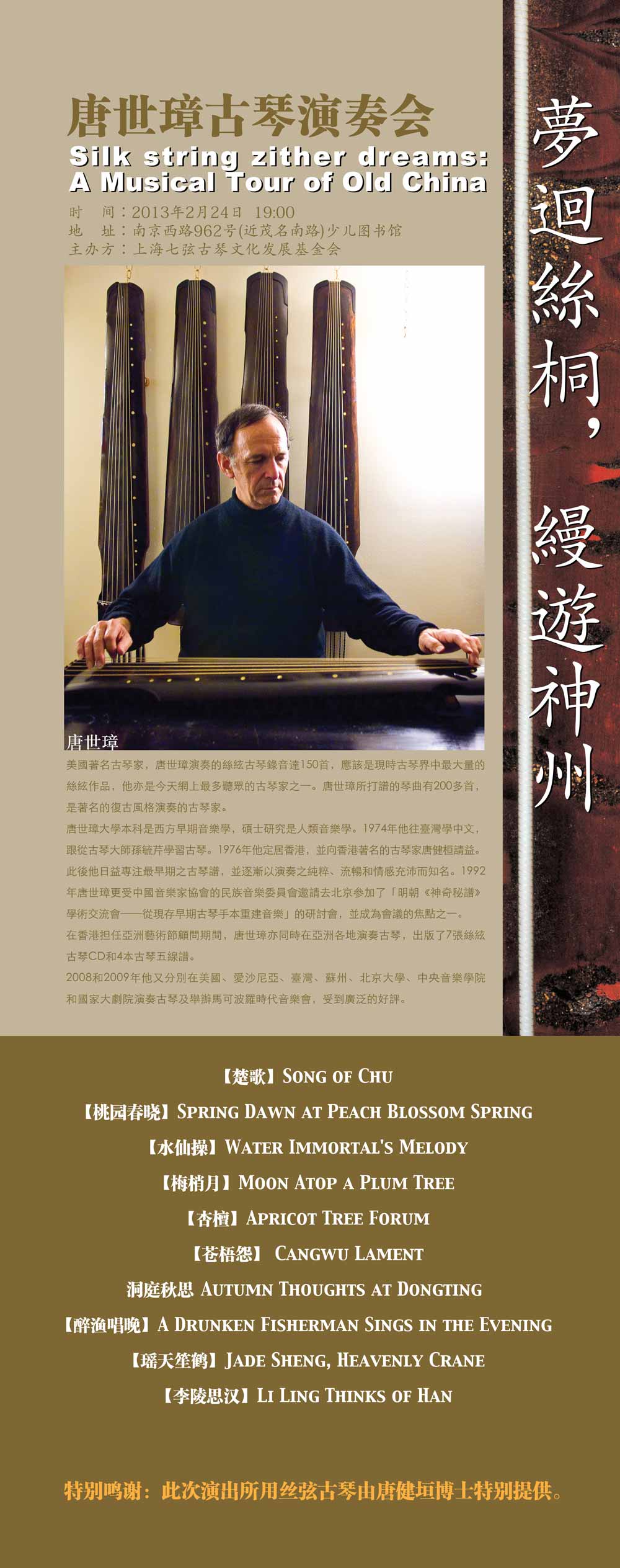
24 February 2013 (Sunday), 7 PM; Shanghai Childrens Library
29 September 2012, 2 PM; The Esplanade, Singapore: Introduction to Guqin
Taiwan performances August-September 2011
8-10 December 2010; Hong Kong: participation in guqin conference
24 - 26 November 2010; Basel, Switzerland: Music from the Time of Marco Polo
(中文)
19 November 2010, Hangzhou, China: solo performance (with others)
20 February 2010, Mumbai, India: Chinese New Year Celebration
(Flyer)
3 to 13 September 2009, Beijing and Ningxia: further performances on the Marco Polo theme
(中文)
2009年7月16日 - 8月6日;琴韻-古琴與中國文化之旅
2009年4月24-25日;臺灣台中朝陽科技大學﹕
2009『古琴、音樂美學與人文精神』國際學術研討會
2008年5月23日;青島,千禧茗茶﹕
古琴茗會·慈善雅集—為地震災區的同胞新福慈善雅集
2008年5月11至17日;北京/杭州﹕馬可•波羅時代音樂(與FA Schola)
February 2008; Estonia:
Music from the Time of Marco Polo, with
FA Schola
December 2007; USA:
Music from the Time of Marco Polo
(馬可波羅時代的音樂), with FA Schola
17 November 2007; Suzhou, China: Performance as a visiting qin master
16 September 2007; Hilton Hotel, Melville, NY:
Awards Ceremony of the Sumi-e Society of America
13 May 2007, 1 PM; Board of Inquiry Room, Ellis Island National Monument, Ellis Island, New York
22 February 2007, 7 PM, Weehawken Nutrition Center,
201 Highwood Ave., Weehawken, New Jersey
16 - 18 February 2007, Parnu, Tartu and Tallinn, Estonia
11 February 2007 (Sunday), Renee Weiler Concert Hall,
Greenwich House Music School, New York City
21 - 23 October 2006, Qionglai and Chengdu, Sichuan province
18 October 2006 (Thursday), Central Conservatory, Beijing
4 December 2005 (Sunday), 8 PM, Beijing Normal University
6 November 2005 (Sunday), 2 PM,
Williams College Museum of Art, Williamstown, MA 4-10 Oct 2005
Tartu Early Music Festival (in
Tartu, Estonia):
2 October 2005 Meeting of the
London Youlan Qin Society, London, England
19 February 2005 Beijing. Solo performance at the
Hua Bao Zhai Gallery
8 February 2005 (Tue) 7.00 PM, Solo l/d and performance at
Casa Asia, Barcelona,
27 October 2004 (Wed) 8.00 PM. Solo performance at
NSI, San Diego;
12 October 2004 (Tue) 7 PM. Performance at The Kitchen, NYC
10 September 2004 Solo performance at the Honolulu Academy of Arts
3 September 2004 8.00 P.M.; Solo performance, Clarion Music Center, San Francisco
14 August 2004 12.00 noon; Solo performance at the
New York Chinese Scholar's Garden, Staten Island
17 July 2004 1.30 PM; Potomoc Community Center, Potomoc, Maryland: A performance organized by the Washington Chinese Literary Society, with three other members of the New York Qin Society
15 April 2004 Solo performance at Rutgers University
12 April 2004 Solo performance at
SUNY, New Paltz
3 April 2004 Performance at the
Terrapin Art Gallery, Chelsea;
13 March 2004 Performance with Chinese poetry reading by translator David Hinton,
12 February 2004 Beijing. Solo performance at the
Hua Bao Zhai Gallery
7 February 2004 Hong Kong City Hall Theatre; a performance organized by ROI Productions; the other performers were qin players Wu Wenguang from Beijing, Tse Chun-yan from Hong Kong, and Hida Tatsushi from Japan, plus the komungo six string zither player Cheong Dae-seog from Korea. (Originally scheduled for April 2003 but postponed due to the SARS epidemic; see poster [174 KB])
7 Nov 2003 NY Metropolitan Art Museum, with Yuan Jung-Ping; the Trefoil Ensemble played early Western music;
25-28 Sep 2003
Tartu Early Music Festival (in
Tartu, Estonia):
26-31 August 2003 Private performances in Beijing
26 July 2003 (Saturday, 3-5 pm); Chinese Scholar's Garden, Staten Island Botanical Garden
12/13 July 2003 (Saturday 8pm; Sunday 7 pm);
Colony Arts Center in Woodstock, NY: Music from the Time of Marco Polo; accompanied China photographs by
Howard Finkelson (see next; no dance).
28/29 June 2003 (Saturday 7.30pm; Sunday 2.30pm);
Kaatsbaan International Dance Center in Tivoli, New York:
22 June 2003 (Sunday, 3-4 pm); Chinese Scholar's Garden, Staten Island Botanical Garden
16 May 2003 Recital at the
Harvard-Yenching Institute
27 March 2003 (9-11 PM); meeting of the Early Medieval China Group at the Association for Asian Studies
Annual Meeting, Hilton Hotel, New York. Melodies with connections to the Six Dynasties period (further detail); with Yuan Jung-Ping
Some performances with other qin players, or of personal significance, include:
23 November 2002 at the China Institute, New York, I took part
in the
New York Qin Society Second Annual Conference. I played
Dunshi Cao, Xing Tan, Feng Qiu Huang and the sung
version of Jiu Kuang.
7 October 2002, at Swarthmore College, with Wu Zhao, a recital and a presentation at a class on Chinese civilization.
7 September 2002, at the City Hall Theatre in Hong Kong, the Qin Recital of the Three Styles. My style was "reconstructed melodies using silk strings"; the other players were Tong Kin-woon (his personal style) and Jiang Kangsheng (a student in the 1950s of Pu Xuezhai and other famous qin masters).
1 June 2002, during my alumni weekend at
Haverford College, I gave a small recital.
28 April 2002, on alumni weekend at the
Asheville School,
my old prep school, I gave the Founder's Day performance. Here is a
letter to the students.
27 February 2001, City Hall Recital Hall, Hong Kong
Qin Recital by Tong and John Thompson
26-30 November 1992, 北京,中國文聯會堂, Hall of the China Federation of Literary and Art Circles
Return to my publications
or to the Guqin ToC
1.
Performance Venues
For guqin one might also add that the most authentic situation would be to have attendees participate by playing themselves, doing calligraphy, painting, or engaging in another such activity (see
"Four Arts" and
"18 Scholars"). Here one might use multi-media methods to re-create such an environment.
For conventional public guqin performance, two aspects of presentation require particular attention.
The essential beauty of the traditional guqin (i.e., one with silk strings) lies in the rich but delicate overtones produced by plucking or hitting the strings (the nylon metal strings so introduced during and commonly used since the Cultural Revolution have their own advantages, particularly in performances, but they do not have this subtle coloring, hence they lead to different styles of play). To capture this the most essential elements are microphones with low internal noise and a large frequency range, and a high quality microphone pre-amp. Under General and Technical Details of my Qin Recordings I discuss issues involved in recording qin. For amplification the issues are much the same except that close miking is probably required. However, a major problem in amplifying qin in this way is often an over-emphasis on the sound of the fingers sliding on the strings. Avoiding this requires considerable skill on the part of the technicians, as well as the right equipment.
Two other amplification alternatives might be considered, contact microphones and piezo electric pickups. These alternatives are particularly important if the qin is to be played together with another instrument.
The above comments concern mainly silk string guqin performed solo. With the modern nylon metal string qin the sound no longer has the traditional qin color, so amplification does not have to take this into consideration. And when played with other instruments the colors of even the silk string guqin tend to be hidden (though at least in recording this example may suggest otherwise). In such cases I am intrigued by the possibility of hooking up a guqin amflified with a piezo pickup to some sort of sound processor. As yet I have no experience with this, but guqin offers intriguing possibilities with such a setup, either alone or in combination with other instruments.
2.
My first performance (another image; House Program)
Return to top.
(9 screenings)
Presentation at Shanghai Normal University on cross cultural aspects of interpreting the melody "Wine Mad"
古琴於飛 Guqin in flight
(report)
Ancient Echoes and New Sounds, Guqin in the 21st Century
(Bulletin)
Outline of my presentation,
A Path to New Music as well as Old
Spring Festival (Chinese Lunar New Year) program for solo
silk-string qin
First "post pandemic" screenings)
Same program as 9 November
Same program as 9 November
“Qin Sharing Program”; same content as 9 November; 唐世璋古琴分亭會:琴谷古琴工作室孤竹君預約
organised by 陸海 Lu Hai (Guzhu Jun;
圖章 seal)
"絃歌不輟:
Playing and Singing without Stopping", a version of "Qin melodies for Confucian learning" (organized by 董岫婷 Dong Xuting;
details;
flyer)
Show the documentary film Music Beyond Sound", then play and talk (host: 復旦藝術教育中心)
Premiere of a two hour doocumentary film about my work, at the 2019 Hong Kong Movie Movie Festival
"Life is Art"
主持人:畢明輝,北京大學藝術學院副教授,理科教學樓108,
"Great Ming Silk String Zither Music", organized by Prof. Bi Minghui
北京民生現代美術館 9号恒通國際創新圓區內
"Return to the Sources"
(details)
A program for the "Hong Kong Sacred Spaces Society"; a few melodies with Confucian themes added for contrast.
"The Guqin, from Ancient China to Outer Space", a narrated performance similar to the one on 12 November at MIM
"Guqin Silk-Stringed Zither Music Associated with Henan Province", a narrated performance connected to the MIM exhibition Ancient Musical Treasures from Central China
Elegant Melodies of Springtime and Love (one hour program); announcement
Topic: Historically Informed Performance of Early Music for the Guqin Silk-String Zither
10am-12 noon, Guqin in its historical and cultural context
2 pm-3.45 pm, Introduction to melodies and their structures
4 pm-5.00 pm, Performance: Early guqin music played from original sources
29 May 7.30 PM (Sunday): solos to open an "elegant gathering" at Liwan Lake Park
(荔灣湖公園; image)
28 May: Nanshan and Dali Libraries (南山圖書館/大瀝圖書館):
translated talks on Historically Informed Qin performance
2 PM; solo program at the Taipei Qin Hall
(臺北琴道館 /
FB), Taiwan
Silk-string guqin music to celebrate the
Lanting Pavilion Gathering
(video excerpt: Section 2)
1 PM (free); solo program at Chatham Square Library, New York
Silk-string guqin music to celebrate Valentine’s Day / the Chinese New Year
(Program;
complements New York Qin Society 13 February program
[q.v.])
2 Jan 10:00 東郊記憶演藝中心 Chengdu Eastern Memory Performance Center
3 Jan 19:30 青羊區教育學院 Qingyang District College of Education
Salon Văn hóa Cà phê thứ Bảy, 19B Phạm Ngọc Thạch, Q.3 Hồ Chí Minh, Vietnam
Guqin solo interspersed with Vietnamese music (Nguyễn Tiến Đạt: xiao end blown flute; Nguyễn Tiến Đạt: di end-blown flute;
Võ Minh Trung: đàn tỳ bà (pipa)
Chinese Cultural Studies Center, 304 Lyndhurst Building, 29 Lindhurst Terrace, Hong Kong
承真樓,擺花街; features the earliest known versions of today's standard guqin melodies
台北市中正紀念堂演藝廳
Chiang Kai-shek Memorial Hall, Taipei, Taiwan
With other former students commemorating the 25th year of his passing (part of a series: 中文);
18 July 2015 (Saturday, 2.30 PM): Returning to the Sources;
my associated event at
琴園藝文空間,
playing the earliest versions of melodies taught by Sun Yü-Ch'in
China Institute, 125 East 65th St., New York, NY (details)
Guqin music complementing a lecture by 汪班 Ben Wang on Han dynasty
Yue Fu poetry
(handout)
A culture course presented by the Confucius Institute for students at Pace University
Great Ming Silk-string Zither Music (大明絲絃琴樂)
Three solo recitals with concluding discussions; Hong Kong City Hall Recital Hall
A Cultural Presentation featuring, in order, music played from early, middle and late Ming dynasty handbooks.
Performances for Chinese New Year with
FA Schola
7 February: Assembly Hall,
Tartu University
Main Building, Tartu
8 February:
Kadriorg Palace, Tallinn
9 February: Rakvere Pangahoone
Interactive workshop and solo performance as part of of the Yale Lunarfest (New Year celebration)
Interview on Culture Matters,
International Channel Shanghai
The 1 hour program is now archived
here
夢迴絲桐 Silk Zither Dreams
(poster)
962 Nanjing West Road (南京西路962號 [近茂名北路 near Maoming Rd])
Presented by You Huang Gu Yun
(幽篁古韵; tel: 021-64374111)
A "Bitesize" narrated performance focusing on melodies with an autumn theme
2011年9月30-十月1日;臺灣台中朝陽科技大學﹕
2011『古琴、音樂美學與人文精神』國際學術研討會
30 August-1 September 2011; 2011 Interdisciplinary, Intercultural International Conference on Guqin, Aesthetics and Humanism
Chaoyang University of Technology, Taichung, Taiwan
(Present paper and perform)
and
1 - 2 September 2011
古琴回家-西方琴人會台灣 Guqin returns home; Westerners perform in Taiwan
Performances in Taipei and Taichung as part of the opening of a guqin center in Taipei, by the 中華古琴學會 Chinese Guqin Association
(台北市齊東街日式宿舍[台北市中正區齊東街53巷11號])
2nd Interdisciplinary, Intercultural International Conference on Guqin, Aesthetics and Humanism
Further performances with FA Schola
Wednesday, Nov. 24, 20.00; Terrassensaal,
Goetheanum;
(2010 CHIME Conference opening)
Friday, Nov 26, 20.30; H95, Kulturraum Concert Hall, Horburgstrasse 95, Basel.
19.30; Zhejiang Concert Hall (浙江音樂廳), Hangzhou
鳳凰和鳴 Fenghuang He Ming, a program featuring two Tang dynasty qins from Yang Shibai in the collection of the Zhejiang Provincial Museum
(來凰 Lai Huang [further] and 彩鳳鳴岐 Cai Feng Ming Qi, both with silk strings; I played Lai Huang: see end of
documentary)
Spring Melodies (guqin solo); follows:
Through Sacred China to Xanadu, an illustrated exploration by Ravi Bhoothalingam
Jnanapravaha, Queens Mansion, G. Talwatkar Marg, Fort
Performances with Fa Schola and early percussionist Janno Mäe as part of the "首屆亞歐文化藝術節
First ASEM Culture and Arts Festival" 2009
(further details)
16 July - 6 August 2009: Teach and perform in China as part of
Way of the Qin 2009
24-25 May 2009; 2009 Interdisciplinary, Intercultural International Conference on Guqin, Aesthetics and Humanism
(.pdf)
Chaoyang University of Technology, Taichung, Taiwan
Present paper and perform
23 May 2008; Qingdao, Qianxi Mingcha Teahouse : Solo performance to benefit earthquake victims
13 - 19 May 2008; Beijing/Hangzhou :
Music from the Time of Marco Polo (with
FA Schola)
五月十五日 May 15 19:30 北京大學南配殿 South Flank Hall, Peking University Library Building
五月十七日 May 17 16:00 國家大劇院
National Center for Performing Arts
五月十九日 May 19 19:30 杭州大劇院 Hangzhou Grand Theatre
(Hangzhou performances cancelled due to mourning period May 19-21 for earthquake victims)
(Festivitas Artium events)
Friday, 8 February 7 P.M. Tallinn University Ceremonial Hall
Monday, 10 December 7.00 PM, Christ Congregation, Princeton, NJ (map)
Wednesday 12 December 7.30 PM, Hilles,
Haverford College, PA
(campus map)
Part of the 怡園琴會 Yiyuan Qin Society's commemoration of the 100th anniversary of the birth of Wu Zhaoji
Qin melodies with themes found in Chinese brush painting
Ancient Chinese silk-string zither music; one of E.I.'s Pacific Asian-American Heritage Month events
Chinese New Year solo qin performance for the
Weehawken Public Library on the
Marco Polo theme
Chinese New Year performances with Fa Schola on the theme
Music from the Time of Marco Polo
Lecture and performance on the Marco Polo theme at the annual meeting of the New York Qin Society
(Event title :
Reflections of Antiquity: Festival of Ancient Music from China: the Qin and the
Konghou)
Performances at the "Cultural Festival for the Guqin and Zhuo Wenjun" (see details).
Performance in connection with the Beijing International Qin Music Week 2006,
dedicated to the memory of Wu Jinglue (October 16th–19th)
Performance organized by the Chinese Cultural Association of the university (see commemorative poem)
Solo event in conjunction with
Masterworks of Chinese Painting, In Pursuit of Mists and Clouds
Music from the Time of Marco Polo,
Evening Melodies for the Silk String Zither, plus other events
Preview of the Tartu Early Music Festival programs
Wang Peng played one melody, Wu Zhao played two
in the Palace of the Baron of Quadras (with help from
Amics del Guqin)
Music from Ming Dynasty Handbooks; co-sponsored by the Center for World Music
24 October 2004 (Sun) 7.00 PM. Narrated performance at
Dizzy's San Diego;
Music for Meditation and Self-Cultivation; complements the above
Part of Necessary Translations, with David Hinton (four other poets also read their translations)
in conjunction with the exhibition
Fantastic Mountains (5 August - 3 October 2004)
Fantastic Mountains (preview of the 10 September program)
Fantastic Mountains (preview of the 10 September program)
for combined classes in Chinese Thought and
Chinese Literature
Joint presentation: Asian Studies Program plus School of Fine and Performing Arts
organized by the Academy of Muse
at the Dactyl Foundation, 64 Grand Street, Manhattan.
(reported on China TV's Meiri Wenhua Guobao).
for the qin program I used a Lu Wang qin
(details) in the Met collection; part of the 9th Conference of RCMI (Research Center on Music Iconography)
Also at the Met: the Audio Guide for Dreams of Yellow Mountain included part of a track from my Shen Qi Mi Pu CD set.
Historically Informed Performance
solo qin performances by members of the New York Qin Society
Silk Stone Moving :
A dance-theater collaboration of East-West fusion combining projected photo-abstracts
by Howard Finkelson, my qin music, and dance by Michael Mao Dance.
(Silk Stone Moving has review, articles, etc.)
solo qin performance with discussion; followed the Curator's Tour of the garden by Judy Whitbeck.
(?)
Shen Qi Mi Pu Academic Seminar, Beijing, marking completion of the reconstruction of all its melodies by John Thompson
Footnotes (Shorthand references are explained on a
separate page)
The ideal place to listen to guqin is in the quiet of someone's home, surrounding by appropriate objects; everything else is a compromise. In this regard there is often a tendency to place a guqin performance in what seems like an appropriate visual location; unfortunately the noise in such places often requires listeners to close their ears and try to imagine the actual sound of the music. With guqin it is much better to close the eyes and open the ears rather than vice versa. It should also be emphasized that if the aim is to re-create the sound appreciated by the literati who gave birth to and nurtured the tradition, then there is no alternative to using
silk strings.
The ideal performance environment is one with such superb acoustics that no amplification is necessary. Here traditional environments for early music, such as churches, often do not work for quiet instruments such as guqin. And as with the gardens or courtyards sometimes favored for guqin performance, acoustics and exterior noise often make appreciation of the actual music difficult. Unfortunately, there seems to be no listing available of small performance halls with excellent acoustics. The best one in which I have performed so far is the auditorium at NSI, San Diego. It seats 300 people, but I found that no amplification was necessary: the sound in the back seats was the same as that in front.
Although the ideal performance space is one that does not require amplification, for most conventional performance spaces the unique colors of the silk string instrument, as well as the desired feeling of intimacy, can only be re-created with the help of high quality electronic amplification, applied knowledgeably. This is especially true if other instruments or voices are added, as these would almost certainly be considerably louder than an un-amplified qin.
(Return)
There was a related article in the South China Morning Post dated 18 April 1978.
(Return)