|
T of C
Home |
My Work |
Hand- books |
Qin as Object |
Qin in Art |
Poetry / Song |
Hear, Watch |
Play Qin |
Analysis | History |
Ideo- logy |
Miscel- lanea |
More Info |
Personal | email me search me |
| CXZC in ToC Nanjing Flowers Peony Pavilion (the opera) | Listen with transcription 首頁 |
|
20. Rhapsody on Peonies
1
Apparent tuning 1 2 4 5 6 1 2,2 but grouped with gong mode melodies.3 |
牡丹賦
1
Mudan Fu |
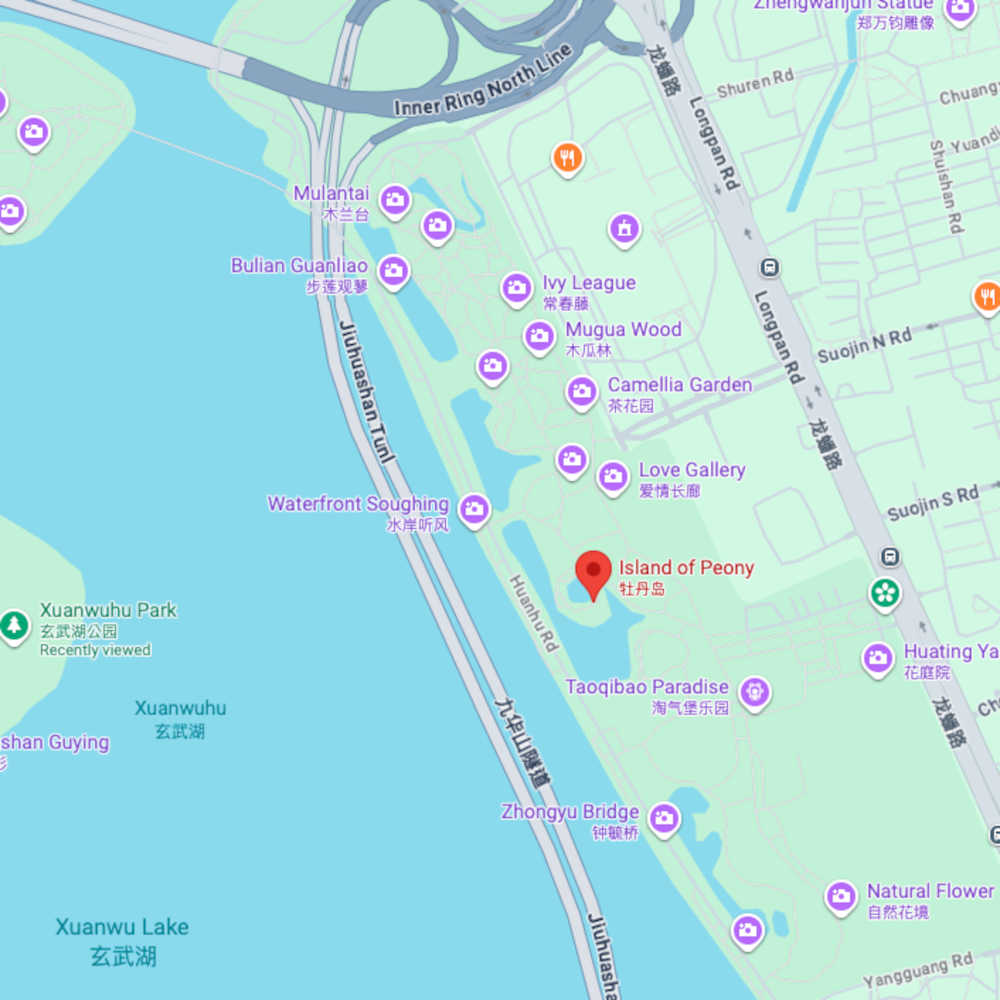
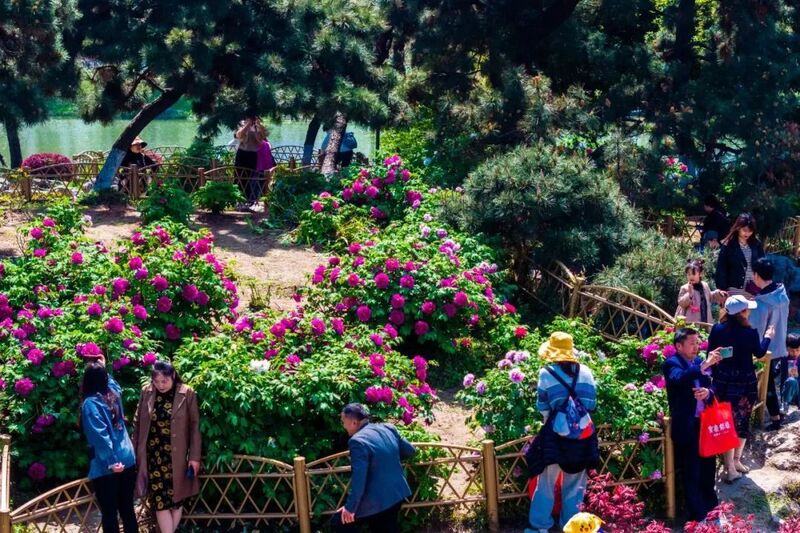
| Visitors at the modern Peony Island in Nanjing (map) 4 |
 According to the introduction below, this rhapsody (fu) commemorates a visit Yang Biaozheng made with friends in spring 1575 to the grounds of the Chief Censorate in Nanjing to see peonies. Inspired by this visit, he then created a qin melody and paired it with lyrics that were either copied from or inspired by a poem he saw inscribed on a wall within the garden. That melody is re-created here based on the original tablature describing in detail how to play the melody that was included in the 1585 collection of tablature for qin melodies as played by Yang Biaozheng.5 As usual, the melody and lyrics are paired according to the traditional pairing method used for virtually all qin songs right up until the modern era.
As can be seen below, the structure of the lyrics is very regular: 14 lines of 7 + 7 each. This is very unlike any standard fu structure. This can be seen in the two peony rhapsodies included in two appendices below. These are:
Why Yang Biaozheng decided to call his qin song a "rhapsody" is not clear, though it does praise peonies in a way that could have been inspired by examples such as Shu's well-known version. Although there is no direct overlap between the structures here and the settings are very different, all three do present similar appreciation for the actual flowers. In Yang's case, perhaps in setting the rhapsodic comments to music he felt it necessary to give it a regular structure.
For the present version Yang arranged the 14 lines of 7+7 characters as a series of couplets. The rhyme scheme is then AABA for the first couplet, CCDC for the second and so forth. This in part helps explain why the music here is very regular. To understand this it would be good to refer to the comments on melodies such as those discussed
here and
here.
There is some further comment on the musical structure
here and also comment on the modal structure
here).
In the third month, spring of the yihai year (1575), I went with friends on an outing to the Chief Censorate to view the peonies. We saw that their mature stems were dark and vigorous, their buds and blossoms opening, more than a 110 of them in all — truly glorious in their appeal. We then climbed to the courtyard terrace, and looking up saw its fu hanging on the wall. It had been inscribed by the censor He Qixian of Baiyue, and it had a coda that said:
Although these are said to be plants handed down from former times, those who admire and enjoy them today do so in just the same way; and now that the fu has been recorded together with a qin melody, this has become a rare and singular moment.”
Original preface
Yang Biaozheng's introduction explains the visit to the peony garden of the Chief Censorate in Nanjing as follows,
「國初種,移自沈萬三家,古幹繁碩,獨異他本,向嘗稱為牡丹道。
每年當花,適值秩滿,盤桓花下,觴詠盡興,漫賦。」
雖謂昔人遺種,至今賞翫而皆同,賦記琴聲,而為一時奇遇矣。
| Music and lyrics (linked next to image below) | Original 1585 tablature: pdf (2 pp.; from facsimile edition) |
As for the actual music, a notable characteristic of the tablature is that nowhere is there any indication of vibrato until just before the very last note, where there is instruction to do a "slow yin", something of a contradiction since yin is defined as a fast vibrato.
As for the structure, according to the understanding I worked out doing my reconstruction, the lyrics for the 14 lines (7 couplete) can be divided into four parts:
Further within that structure is my understanding of the mode. This is discussed in more detail here but in short it has to do with the first half of some couplets tending to end on the relative note sol (5), with the second half ending on do, while other ones end the first half on re and the second half on sol. This understanding led me in my reconstruction to exchange the words and tablature of the sixth line with that of the seventh.
| Rhapsody on Peonies: 五線譜 transcription; timings follow my recording | They bloomed overnight8 |
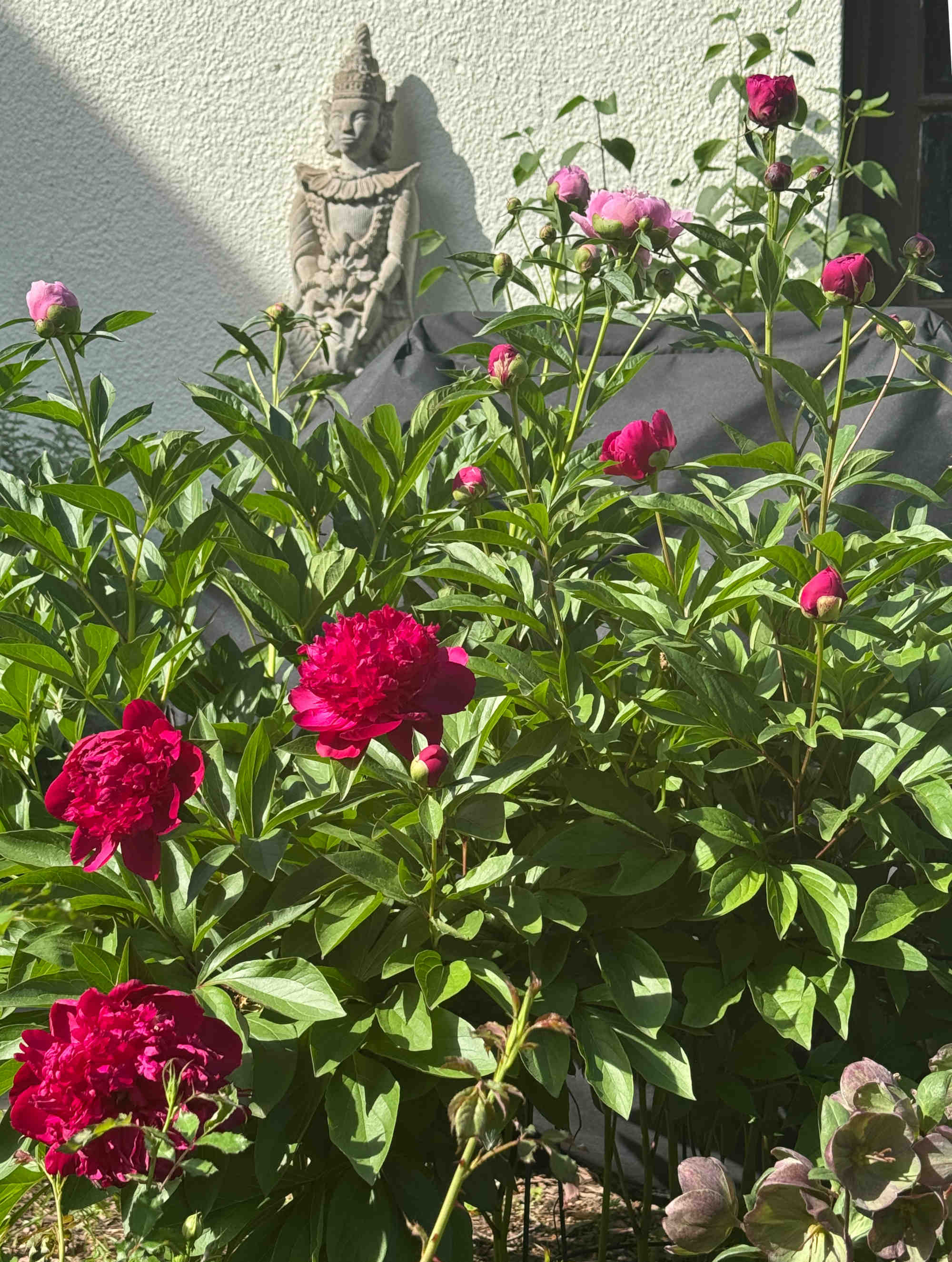 This reconstruction was completed (i.e., I was able to make a recording) on May 16, 2026, just before the blossoming of the peonies in my back yard that evening. But in the morning of May 17th, when I saw the actual blossoms as at right, I felt it most appropriate to redo the recording at a faster pace. The original recording
(listen) is about 30 seconds slower.
This reconstruction was completed (i.e., I was able to make a recording) on May 16, 2026, just before the blossoming of the peonies in my back yard that evening. But in the morning of May 17th, when I saw the actual blossoms as at right, I felt it most appropriate to redo the recording at a faster pace. The original recording
(listen) is about 30 seconds slower.
牡丹賦 Mudan Fu (Rhapsody on Peonies)
from 楊表正,重修真傳琴譜 Yang Biaozheng's Chongxiu Zhenchuan Qinpu, 1585
- 00.01
- 柏林陰陰飛香雨,東風簾幙春如醑。
Bó lín yīn yīn fēi xiāng yǔ, dōng fēng lián mù chūn rú xǔ.
Into the (rows of) cypress trees with their dense shade wafts the fragrance of rain;
an east wind stirs the blinds and curtains as spring enters like a fine raw wine.
當階旗旎見名花,含態含嬌如欲語。
Dāng jiē qí nǐ jiàn míng huā, hán tài hán jiāo rú yù yǔ.
Right at the steps famed flowers appear, fluttering like banners;
full of charm, full of coy beauty, as though about to speak.
秣陵自昔比洛陽,平章宅裏春未央。
Mòlíng zì xī bǐ Luòyáng, píng zhāng zhái lǐ chūn wèi yāng.
Moling (Nanjing) since olden times has compared itself with Luoyang;
and in the Grand Councilor’s mansion, spring never seems to end.
祇今庭中堆繡谷,染就玄湖山水鄉。
Qí jīn tíng zhōng duī xiù gǔ, rǎn jiù Xuán Hú shān shuǐ xiāng.
Only now in this courtyard do the rows and recesses resemble embroidered valleys,
as though dyed into Xuan(wu) Lake's very landscape. - 00.51
丹延有種不足持,檀心倒暈眾未知。
Dān yán yǒu zhǒng bù zú chí, tán xīn dào yūn zhòng wèi zhī.
Crimson varieties are so extensive it is too much to grasp;within the sandalwood hearts are strange suffusions few perceive. 丹延有種 suffusions? 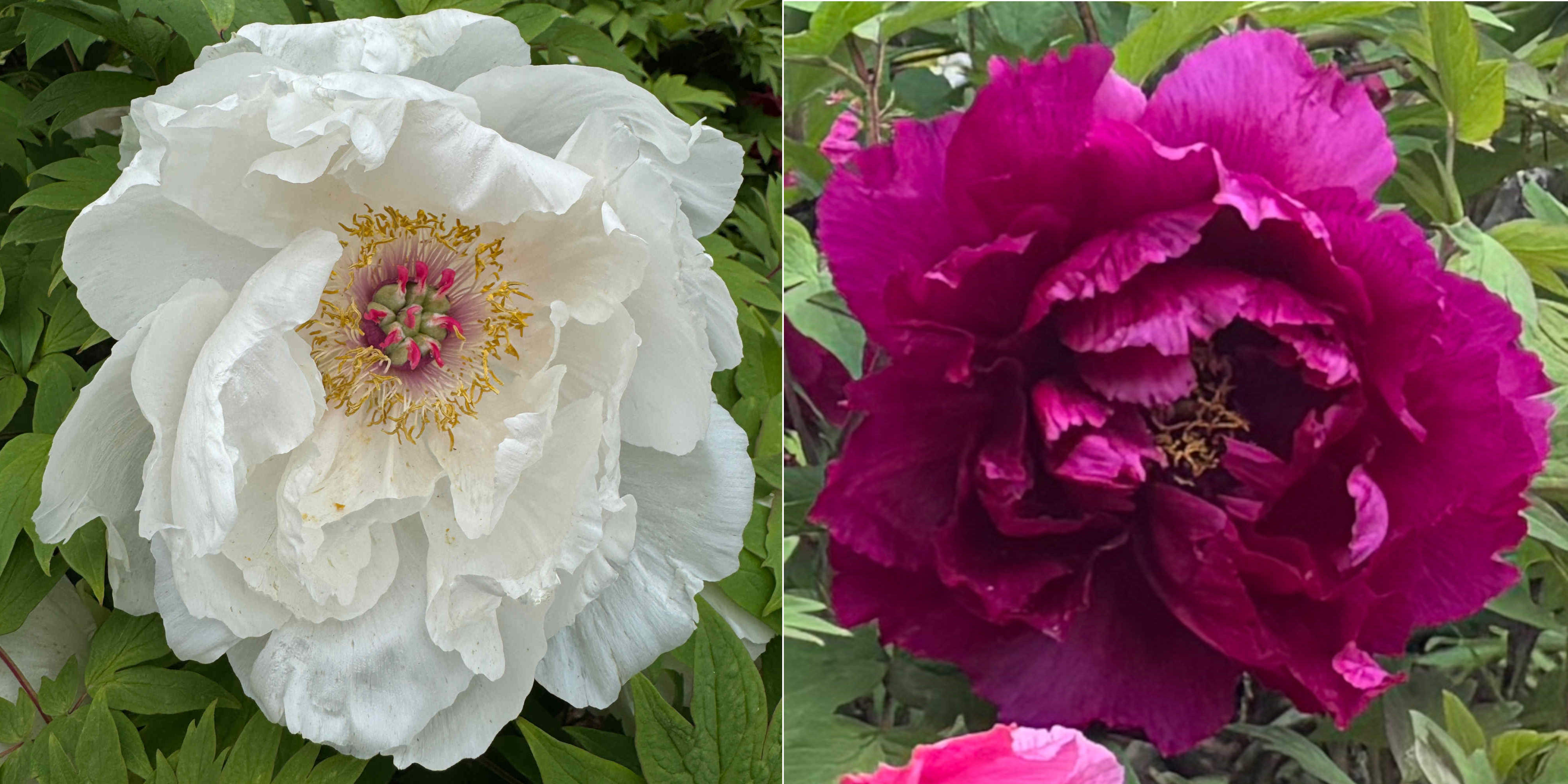 遲日酐來難自持,低昂向背競瑤姿。
(In the original tablature this is the seventh line (comment).)
遲日酐來難自持,低昂向背競瑤姿。
(In the original tablature this is the seventh line (comment).)
Chí rì gān lái nán zì chí, dī áng xiàng bèi jìng yáo zī.
When the lingering sunlight and heady warmth arrive, they can scarcely contain themselves;
tilting high and low, facing and turning away, they compete in jade-like beauty.
輕盈自合湘娥姿,濃艷爭誇六一詞。 (In the original tablature this is the sixth line.)
Qīng yíng zì hé Xiāng É zī, nóng yàn zhēng kuā Liù Yī cí.
Their light grace truly matches the bearing of the Xiang River goddesses;
their rich and vibrant beauty vies in splendor with the verses of Ouyang Xiu.
露容長信初妝罷,風態昭陽乍舞時。
Lù róng Chǎngxìn chū zhuāng bà, fēng tài Zhāoyáng zhà wǔ shí.
Their dewy countenance is (like that of the Beauty of) Changxin having just finished her first toilette;
their graceful manner is (like that of the Beauty of) Zhaoyang whenever she began to dance.
攢[扌族]披蕤動曉寒,餘芬凝弄鬱金團。
Zuān [cù] pī ruí dòng xiǎo hán, yú fēn níng nòng yù jīn tuán.
Clustered together the flower sprays open out as they stir in the chill of dawn;
their lingering fragrance gathers and drifts like clouds of perfume.
豪奢莫論千金價,愛護真如百寶蘭。
Háo shē mò lùn qiān jīn jià, ài hù zhēn rú bǎi bǎo lán.
For luxurious extravagance do not speak in terms of thousands in gold;
cherish and guard them as you would orchids among hundreds of other treasures.- 02.06
欲問花神歲月賒,托根曾向石崇家。
Yù wèn huā shén suì yuè shē, tuō gēn céng xiàng Shí Chóng jiā.
If you wish to ask the spirit of these flowers how many years they have been extended,
it seems their roots were once entrusted to the house of Shi Chong.
可憐金谷當年麗, 添得烏臺此日華。
Kě lián Jīngǔ dāng nián lì, tiān dé Wūtái cǐ rì huá.
How sad to think of his Jin Gu (Golden Valley) and those years of splendor;
yet the additions in Wutai mean now again they flourish.- 03.07
繁華一去不可復,捧日堯心今尚在。
Fán huá yī qù bù kě fù, pěng rì Yáo xīn jīn shàng zài.
(But) once these splendors are gone they cannot be recalled;
yet here today there still remains the moral worth of a heart like that of Yao.
一年一度一對花,當盃莫惜花蘋酹。
Yī nián yī dù yī duì huā, dāng bēi mò xī huā píng lèi.
Every year just once can we come before such blossoms;
so cup in hand do not hold back on the floral libations.03.33 (end)
- 02.06
- 白嶽何其賢 He Qixian of Baiyue (in Anhui; bio/1091xxx; see
in preface).
More specifically He Qixian was from 休寧 Xiuning, near Huangshan, and served as a 南京江西道監察御史 Nanjing Jiangxi Circuit Supervising Censor; 白嶽/白岳 Baiyue (white Peak) was perhaps the name for a peak in the Huangshan range. Elsewhere he is credited with:- 四書人物考序 Preface to a Study of people in the Four Books, dated 嘉靖戊午 (1558). There he praises the book as inspiring people to learn from the ancients how to think and write well.
- A poem 《九疑歌》明朝·何其賢 “Song of Jiuyi”, by He Qixian, Ming dynasty
望仙橋外望靈都,崢嶸萬壽對香爐。
Beyond Wangxian Bridge I gaze toward the numinous capital;
towering Wanshou stands facing Xianglu Peak.
玉琯雲深龍馭杳,桂林秋老月輪孤。
Deep in cloud, the jade pipes are lost and the dragon carriage is gone;
in the aging autumn of the cassia groves, the round moon hangs alone.
日奉五官蒼佩肅,峰回二女翠屏虛。
Day by day the five peaks attend in solemn ranks of dark jade pendants;
as the summits turn, the Two Ladies appear like an empty screen of kingfisher-green.
洞庭不洗娥眉恨,斑竹瀟瀟鳩亂呼。
Dongting’s waters cannot wash away the sorrow of those fair brows;
on the mottled bamboos the wind sighs thinly, while doves cry out in confusion.From the style one might say it supports the idea that He Qixian wrote the text used as lyrics for Mudan Fu.
- 沈萬三 Shen Wansan (bio/1158; Yuan/Ming;
see in preface.)
Shen was a man famous for his great wealth, one of the "gods of wealth" (財神 caishen). Shen Wansan (traditionally ca. 1306–1394, though the dates are uncertain) was a late Yuan – early Ming Jiangnan merchant (both farming and trade), associated above all with the Suzhou–Kunshan–Zhouzhuang region and remembered in later tradition as the archetypal southern millionaire. As such there are quite a few temples commemorating him and his wealth.There is today a residence in Kunshan said to have been his. However, in the note here saying that the peony plants had been transplanted from “Shen Wansan’s house” is probably not identifying a unique horticultural source so much as conferring on the flowers an aura of early-Ming antiquity, elite luxury, and famous Jiangnan wealth.
- 洛陽 Luoyang and Jin Gu
Today Luoyang still has a reputation for the best peonies in China. Jin Gu (Golden Valley), west of Luoyang, was the home of the wealthy Shi Chong, who eventually lost it all. The lyrics seem to suggest some of the flowers here may have come from or be descended from those at Jin Gu. - 洛陽 Luoyang and Jin Gu
Poem glossary:
1.
牡丹賦 Mudan Fu (Rhapsody on Peonies; 1 section)
Regarding the use here of the term 賦 fu in the title, usually translated as rhapsody, it almost always refers to poems that have the same structure as lyrics of an old song. The original melody became lost over time, but they were almost always songs with lines of unequal length. Here, however, the lyrics are in a regular structure: (7+7)x14.
Another qin melody that concerns peonies is Spring in Jin Gu
(金谷春 Jingu Chun; IX/144-7). Some details of that melody and its lyrics are included in Appendix Two below.
2.
Apparent tuning: 1 2 4 5 6 1 2
With Mudan Ting this led to tuning the seven strings to the relative pitches do re fa sol la do re (1 2 4 5 6 1 2) and writing these notes as C D F G A C D.
3.
Mode: gong then zhi?
This (at least the beginning) would be quite in accord with this melody being in gong mode except that the other gong mode pieces I have studied from the Ming dynasty have this note gong played on the equivalent of the open third string, not the open first string.
To be more detailed, the melody is a setting of a poem with the structure ([7+7] x 14), i.e., fourteen lines of two 7-character phrases each. This is organized as follows:
The rhyme scheme genrally follows this: AABA, CCDC...., but there are again some exceptions. Most noteworthy, reversing the sixth and seventh lines brings fewer variations from this structure. In addition, from my understanding this groups the meanings of the lyrics better. And so in my transcription I have reversed lines six and seven, and following this logic has made it much easier for me to memorize the melody.
For more on detail on relevant modes see
Shenpin Zhi Yi as well as
Shenpin Gong Yi and
Modality in early Ming qin tablature.
4.
Visitors at the modern 南京牡丹島 Peony Island in Nanjing
5.
Recreating Yang Biaozheng's qin song
6.
牡丹賦 舒元輿 Rhapsody on the Peony by Shu Yuanyu
(c. 791 - 835; Wiki)
Also see here for a bibliography of other Chinese works on peonies.
7.
Tablature in Qinqu Jicheng
The Ducha Yuan was established early in the Ming dynasty (1368–1644). In 1382 it replaced the old 御史臺 Yushi Tai (also Censorate). Their roles in supervising various judicial matters are discussed in some detail in Kroll. Cypress trees (see line 1) were a characteristic of the censorate compound.
Kroll also says 烏臺 Wutai (Crows' Terrace; see line 12) was a traditional name for the (quarters of?) the Censor-in-chief, and in front of the Censorate quarters there was a large 柏 cyress tree, a conifer that attracted many birds, crows in particular.
Again see Kroll: this was high central government official. The 平章宅 Pingzhangzhai (Grand Councilor's mansion) was probably not connected to the Censorate. Instead it is more likely an allusion to a mansion such as the one in Chang'an of grand councillor 令狐楚 Linghu Chu, famous in Tang poetry for its beautiful peonies.
玄湖 xuanhu 21288.xxx; but 21288.37 玄武湖 Xuanwu Hu.
This most likely refers to Nanjing's well-known 玄武湖 Xuanwu Hu: Xuanwu Lake or Black Warrior Lake. There are examples in Ming poetry where Xuan Hu clearly refers to Xuanwu Lake. This connection is further strengthened by the fact that the old 都察院 censorate in Nanjing may have been close to Xuanwu Lake. The censorate belonged to the judicial quarter associated with 刑部 Ministry of Corrections and its 三法司 Three Office Facilities, and Ming sources place these on the east side of the lake near 太平門 Taiping Gate, where Xuanwu Lake meets 鍾山 Zhongshan (Mountain). In that area there is, in fact, a "Peony Island" (牡丹島) Mudan Dao, part of a lakeside 情侶園 Lovers’ Garden, though it is of modern origin.
In Chinese cosmology, 玄武 xuanwu is one of the "Four Symbols", associated with the north and normally represented as a tortoise entwined with a snake. In that context it is commonly translated “Black Tortoise” or “Black Warrior.”
Changxin was the residence of 竇太后 Empress Dowager Dou during the reign of 漢成帝 Han Emperor Cheng (r. 33-7 BCE); it became the residence of
Ban Jieyu after she lost favor to Zhao Feiyan (next).
Residence built for 趙飛燕 Zhao Feiyan when she became the emperor's favorite; she is noted both as a schemer (along with her sister 班婕妤 Zhao Hede) and as a dancer.
The second character in this line looks like 扌+族 (shǒu+zú: 12887 cù = 促、斂 or written with the 手 underneath; collect, restrain; not 扌+旋 xuan 12886 旋 (whirling).
Within Chinese tradition there are flower deities (花仙、花神) with associated flower festivals (Chinese Wiki), but here it seems more likely this is suggesting the spirit of all the flowers themselves.,
Individual peony species bloom just once a year, for about a week or two in spring. However, different types may bloom at somewhat different times, so there can be overlapping.
Libations, in both Chinese and English, refer specifically to the ritual pouring of an alcoholic liquid on the ground. Of course in common English usage this libation can refer to the "ritual" of pouring alcohol into one's throat, but so far I have not found a Chinese equivalent for such a drinking ritual, the closest perhaps being to 飲「杯中物」, drink “the thing in the cup". The pouring of a non-alcoholic beverage seems to have been called "奠 dian".
Footnotes (Shorthand references are explained on a
separate page)
In Toc;
Guide 26/214/396 lists a Mudan Fu only in 1585 (QQJC IV/344).
(Return)
Because guqin tablature does not give absolute pitch, the first step in reconstructing a melody from tablature is determining the relative tuning of the seven strings. Traditional Chinese music generally did not use absolute pitch (though perhaps attempts were made for ritual purposes) and it was mostly pentatonic, the most common exceptions being the other two notes that from a diatonic scale. Exceptions within the early qin tradition seem to follow certain rules. In effect, what this means is that when I determine the relative pitches of a melody I transcribe them into Western staff notation in a way that avoids accidentals as much as possible.
(Return)
Having determined that the relative qin tuning should be considered as
1 2 4 5 6 1 2, the next task is to determine which are the most important notes: this determines the mode. Here it seems clear that for the first 10 of the 14 lines the primary tonal center is 1 (gong; notated C) and the secondary tonal center is 5 (zhi; notated G). However, for the final 4 lines the primary tonal center is 5 and the secondary center is 2, though the melody actually ends on 1 over 5.
(Return)
Image copied from
www.xhby.net. The park is at the east end of Xuanwu Lake. See further comment above.
(Return)
To do a proper re-creation of Yang's song there must first be a reconstruction
(dapu) from the 1585 tablature that described the original music and its lyrics (see below). The tablature details the right and left hand finger techniques and pairs this to the lyrics following the standard pattern. The tablature prescribes the actual pitches very clearly; as for the note values/rhythms, these are determined by such factors as the nature of the finger strokes and their ornamentation, and patterns discerned within the melody, here especially influenced by the structure and meaning of the lyrics.
(Return)
Shu Yuanyu is also mentioned on this site here in connection with his Chronical of Making a Qin. The original text of his rhapsocy plus a tentative translation are included in Appendix 1 below.
(Return)
The problem was particularly acute on the very last note, where the original was illegible. But even here in the facsimile edition, although it seems quite clear, it contains the very strange added instruction to play the stopped note with "慢吟": slow yin; yin is generally considered a fast vibrato, symbolized by the speed of a cicada's wings. Perhaps this is related to the fact that yin is rarely used in this handbook and as yet I have not seen an occurrence of the slow jerky vibrato, 猱 nao.
(Return)
| 8. The peonies in our backyard | Second day: many more blossoms |
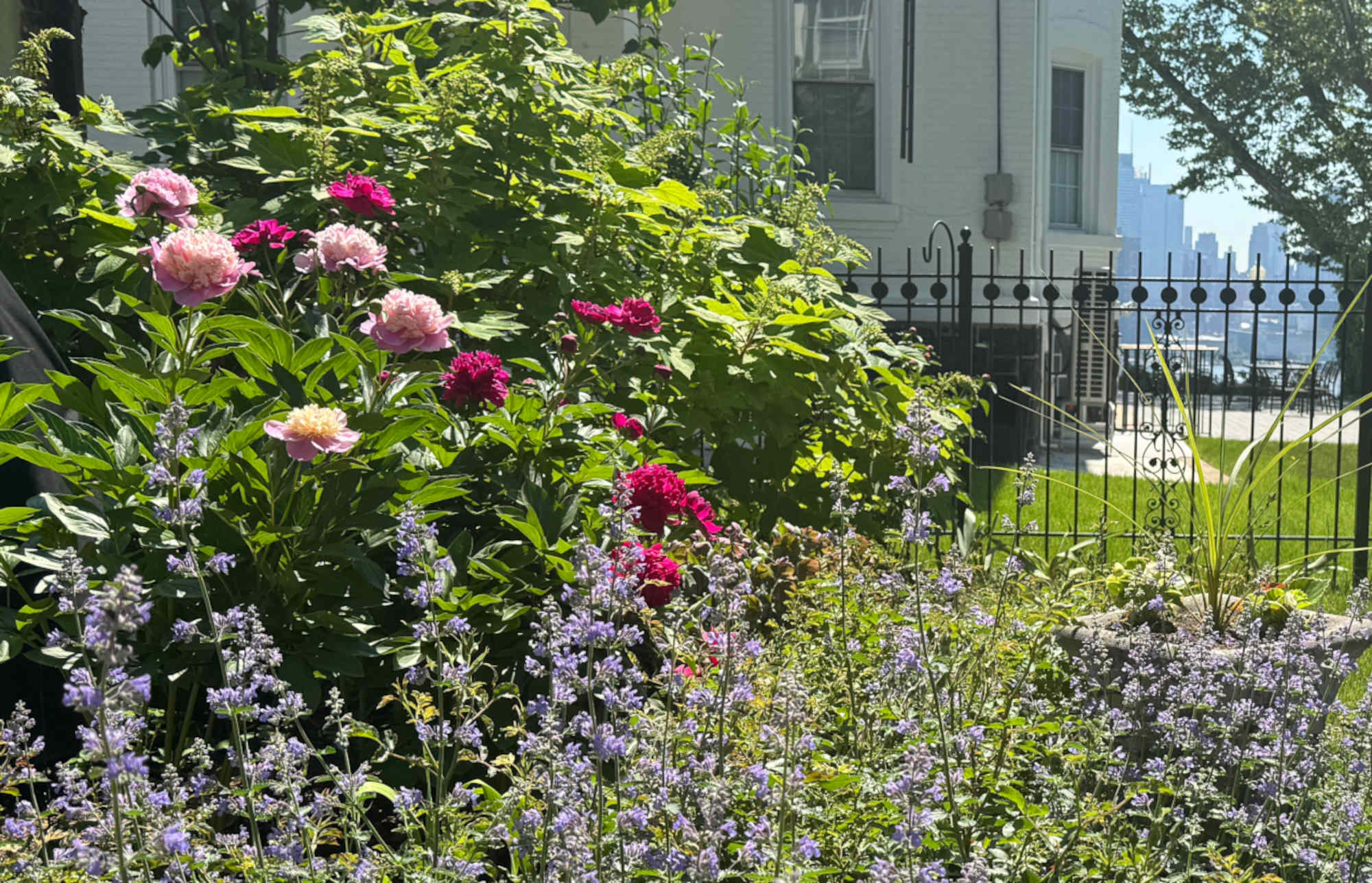 Regarding the two recordings,
slower and
faster
perhaps the faster version is good for when they first bloom, the slower for as they go out and rest until the following year, leaving us to reflect on life's cycle.
Regarding the other image, "丹延有種 suffusions?", those images were of peonies at the lovely Rockefeller State Park Preserve (Taconic Regions), which has an annual
Peony Celbration/
(Return)
Shu Yuanyu's rhapsody begins with an essay before going into verse; the verse is mostly 4-character phrases, but there is also a substantial section of 5-character phrases and in some places mixed phrase lengths; it then has a prose closing. Overall, this is more typical of a fu than is Yang's example (though it should be mentioned that Shu's is not exactly "standard" itself).
This rhapsody is said to be the the earliest important work about peonies. At the time he wrote it he was quite likely living in the capital city, but at that time the Tang dynasty had two capitals, today's Xi'an and today's Luoyang. The latter is particularly famous for its peonies, perhaps dating from the time that the empress Wu Zetian apparently popularized them from her imperial residence in Luoyang.
Several somewhat different versions of Shu's Rhapsody on Peonies can be found online. The one here was copied from
guwendao.net. I have not found any other English translation.
圓玄瑞精,有星而景,有雲而卿。其光下垂,遇物流形。草木得之,發為紅英。英之甚紅,鐘乎牡丹。拔類邁倫,國香欺蘭。我研物情,次第而觀。
暮春氣極,綠苞如珠。清露宵偃。韶光曉驅。動蕩支節,如解凝結,百脈融暢,氣不可遏。兀然盛怒,如將憤洩。淑色披開,照曜酷烈。美膚膩體,萬狀皆絕。赤者如日,白者如月。淡者如赭,殷者如血。向者如迎,背者如訣。坼者如語,含者如咽。俯者如愁,仰者如悅。裊者如舞,側者如跌。亞者如醉,曲者如折。密者如織,疏者如缺。鮮者如濯,慘者如別。
初朧朧而下上,次鱗鱗而重疊。錦衾相覆,繡帳連接。晴籠晝熏,宿露宵浥。
或灼灼騰秀,或亭亭露奇。
或颭然如招,或儼然如思,
或希風如吟,或泫露如悲。
或垂然如縋,或爛然如披。
或迎日擁砌,或照影臨池。
或山雞已馴,或威鳳將飛。
其態萬萬,胡可立辯?不窺天府,孰得而見?
乍遇孫武,來此教戰。教戰謂何?搖搖纖柯。玉欄風滿,流霞成波,歷階重台,萬朵千棵。西子南威,洛神湘娥。或倚或扶,朱顏色酡。角銜紅釭,爭顰翠娥。灼灼夭夭,逶逶迤迤。漢宮三千,艷列星河,我見其少,孰雲其多。弄彩呈妍,壓景駢肩。席發銀燭,爐升絳煙。洞府真人,會於群仙。晶熒往來,金釭列錢。凝睇相看,曾不晤言。未及行雨,先驚旱蓮。公室侯家,列之如麻。咳唾萬金,買此繁華。遑恤終日,一言相誇。列幄庭中,步障開霞。曲廡重梁,松篁交加。如貯深閨,似隔窗紗,彷彿息媯,依稀館娃。我來觀之,如乘仙槎。脈脈不語,遲遲日斜。九衢遊人,駿馬香車。有酒如澠,萬坐笙歌。一醉是競,孰知其他。我案花品,此花第一。脫落群類,獨佔春日。其大盈尺,其香滿室。葉如翠羽,擁抱櫛比。蕊如金屑,妝飾淑質。玫瑰羞死,芍藥自失。夭桃斂跡,穠李慚出。躑躅宵潰,木蘭潛逸。朱槿灰心,紫薇屈膝,皆讓其先,敢懷憤嫉?
煥乎!美乎!后土之產物也。使其花如此而偉乎,何前代寂寞而不聞?今則昌然而大來。曷草木之命,亦有時而塞,亦有時而開?吾欲問汝,曷為而生哉?汝且不言,徒留玩以徘徊。
Translation: Rhapsody on Peonies by Shu Yuanyu
When men of old spoke of flowers, the peony was never included among them. Presumably it had hidden itself away in deep mountains, emerging from obscurity only later. If what is precious and weighty was not aware of it, how could the flower itself ever have found its proper encounter? The native region of the Empress Wu was Xihe. At the Zhongxiang Monastery there grew peonies below it, their blossoms especially extraordinary. The Empress regretted that the imperial garden lacked them, and so ordered them transplanted there. From that time onward, peonies in the capital flourished more and more with each passing month and year. Now, from the palace precincts to official compounds, and outward to the homes of scholars, commoners, and all the rest, they spread everywhere like the flowing of the Four Waterways, with no one knowing where that spreading might end. Every year, in the last month of spring, those who go out to wander and admire them become almost frenzied. This too is one of the great splendors of the capital. In recent times men of letters have written songs and poems to praise their appearance, but none has yet been able to compose a fu on them. I alone have composed one, so as to bring their beauty fully to its utmost.
Someone may say: “You have always prided yourself on the achievements proper to a true man; but now you pour out your feelings over a single flower. Is this not still to have the heart of children and women?” I reply: “Have you alone not seen what sort of man Zhang Jingzhou was? He truly was a man of manly stature. Yet when I look at the beginning of his collected writings, there is a ‘Fu on the Lychee.’ The lychee is indeed a beautiful thing; yet after all it is no more than a single fruit. In what way is that different from the peony? The only question is what intent there is in what one writes of. What harm is there if I write a fu on the peony?” To this such people have no answer, and so I have gone ahead and written it to show them.
The rounded and mysterious essence of auspicious powers—where there is a star, it has radiance; where there are clouds, it has sheen. Its light hangs downward and, upon meeting things, takes on form. When grasses and trees obtain it, it breaks forth as crimson blossoms. And among blossoms, the one whose redness is most fully concentrated is the peony. It rises beyond its kind and surpasses its peers; its national fragrance puts even the orchid to shame. I have studied the dispositions of things, and shall observe them in due order.
When late spring’s breath reaches its height, their green buds are like pearls. Clear dew settles over them by night; fair spring light drives onward at dawn. Their stems and joints sway and stir, as though releasing what had long been congealed. A hundred channels grow fluid and free; their vital energy cannot be held back. Suddenly they seem to blaze forth in full indignation, as though about to vent some long-held force. Their lovely colors open out, shining with fierce brilliance. Beautiful skin, unctuous bodies—their myriad forms are all beyond compare. Those that are red are like the sun; those that are white are like the moon. The pale ones are like rosy light; the deep ones are like blood. Those facing toward one seem to welcome; those turned away seem to take leave. Those split open seem as though speaking; those still closed seem as though swallowing back words. Those drooping seem sorrowful; those raised aloft seem delighted. Those wavering are like dancers; those leaning aside are like falling figures. Those pressed low are like drunkenness; those bent are like something broken. Dense masses are like brocade weaving; sparse ones are like gaps and absences. Fresh ones are as though newly washed; faded ones are as though marked by parting. At first they are dimly half-formed, rising and sinking; next they scale layer upon layer. Like brocade coverlets they lie one upon another; like embroidered curtains they join together. In sunlight they seem enclosed in perfumed warmth through the day; with night dew they are wrapped and enfolded till dawn. Some blaze upward, displaying their beauty; some stand poised and straight, revealing marvels. Some flutter as though beckoning; some stand solemnly as though in thought. Some await the breeze as though chanting; some, touched by dew, seem as though grieving. Some droop as though hanging by a cord; some spill open in radiant disarray. Some face the sun beside the steps; some cast reflections as they lean over the pond. Some are like mountain pheasants already tamed; some like majestic phoenixes just about to fly. Their attitudes are ten thousand upon ten thousand—how could one ever distinguish them one by one? Unless one has glimpsed the treasury of Heaven, how could one ever behold such things?
Suppose Sun Wu were suddenly to come here and drill them for battle—what would that drilling be? Slender branches swaying and swaying. The jade railings are filled with wind; drifting rosy vapors become waves. Across the steps and up the tiered terraces there are ten thousand blossoms on a thousand stems. Xi Shi and Nanwei, the River Luo goddess and the maidens of the Xiang—some leaning, some supporting one another, their vermilion faces flushed with color. They outshine the red lamps at the corners and vie with green-browed beauties in frowning charm. Bright, brilliant, enchanting, winding and trailing on without end. The three thousand women of the Han palace arrayed in gorgeous ranks like stars across the Milky Way—yet what I see here makes them seem few, so who could call them many? Sporting their colors and displaying their loveliness, they press shoulder to shoulder and eclipse all light. Mats are spread, silver candles lit; from the censers rises crimson smoke. It is as though perfected beings from the caverns of immortals were assembled among the host of divinities. Glittering, gleaming, coming and going; golden lamps stand ranked like coins. They gaze fixedly upon one another, yet never exchange a word. Before ever clouds and rain can arrive, they first astonish the drought-stricken lotus.
In the mansions of princes and nobles they are arrayed thick as hemp. Men spend ten thousand in gold with a mere cough or spit, buying this luxuriant splendor. All day long they worry over nothing else, each only speaking of his own display with pride. Canopied tents are set up in the courtyards; silk screens glow like opened clouds. Curved verandas and double beams, pines and bamboo intermingled all around. It is as though they were stored in some deep women’s chamber; as though seen dimly through window gauze. One seems almost to glimpse Xi Gui; one half discerns the beauties of Guanwa Palace. When I come to look at them, it is as though I were riding on an immortal raft. They gaze with deep feeling and say nothing; slowly, slowly the sun slants westward. On the great avenues roam visitors; fine horses and fragrant carriages pass by. Wine flows like the Min River; everywhere are banquets, music, and song. Men compete only in getting drunk—who knows anything beyond that? When I assess the ranks of flowers, this one is first. It has cast off the whole crowd of other kinds and alone occupies the glory of spring. Its bloom may be a full foot across; its fragrance fills the room. Its leaves are like emerald feathers, clustered and embracing one another in serried ranks. Its stamens are like flecks of gold, adorning its lovely substance. Roses die of shame before it; the peony’s cousin, the shaoyao, loses all confidence. Early peaches hide their traces; luxuriant plums are ashamed to emerge. Azaleas melt away in the night; magnolias slip off unseen. The hibiscus loses heart; the crape myrtle bends the knee. All yield precedence to it—who among them would dare still harbor resentment or jealousy?
How splendid! How beautiful! This is one of the things produced by the Earth herself. If its flowers are so marvelous and grand, why was it that in earlier ages they remained obscure and unheard of, whereas now they flourish gloriously and arrive in full abundance? Can it be that even the fate of grasses and trees has its times of blockage and its times of opening? I would ask you: for what reason were you born? But you do not speak. You only leave me lingering here, delighting in you and pacing to and fro.
Spring in Jin Gu (金谷春 Jingu Chun; IX/144-7) is the only other qin melody I have found that concerns peonies. Like the 1585 melody it has lyrics throughout; it might also have been called Rhapsody on Peonies as the style of its lyrics are more like the traditional style of rhapsodies.
This melody was not included in the Zha index because at the time the index was compiled Zhe Fuxi apparently had not seen its handbook, 太音希聲 Taiyin Xisheng (1625; see QQJC IX/140-143, 12 Sections).
The preface and Section 1 of the lyrics to Spring in Jin Gu are as follows (original text copied from
www.douban.com):
太希曰,
金谷春者,余因玩牡丹賦而成操也。時游永灤,訪映垣馮大尹。留飲園亭,當牡丹大放,宛然金谷陽春,對花樂甚,公以所著,牡丹賦示予,乃知花神之麗也,遂勒是操。而姚黃魏紫,爛熳於得心應手之間。雖有桃之綽約,梅之淸瘦。總屬臣種,不得與花王爭春風也。人且以是賦似牡丹余以為牡丹,似是賦耳。
Xisheng says: “Jingu Chun" is a melody I composed after delighting in a Rhapsody on Peonies.
At the time I was traveling in Yongluan (?) and visited Magistrate Feng Yingyuan. I remained there drinking in his garden pavilions, just when the peonies were in magnificent full bloom. It truly resembled the springtime of the Golden Valley. Facing the flowers, our delight was extreme. The magistrate showed me his own composition, the Rhapsody on Peonies, and only then did I realize the beauty of the flower spirit. Thereupon I fashioned this melody.
And there were the Yao Yellow and Wei Purple peonies, blooming in profusion amid moments when inspiration and technique perfectly answered one another. Though there is the delicate grace of the peach blossom and the pure slenderness of the plum blossom, they all belong merely to lesser kinds and cannot contend with the King of Flowers for the spring breeze.
People may say that this fu resembles the peonies; but as for me, I would say rather that the peonies resemble this fu.”
The swirling vital vapors of Great Unity: through them things receive their forms.
The radiant essence of Primal Simplicity: when color meets it, red is formed.
The splendor of red blossoms spreads through the human world;
the beauty of red blossoms is gathered in the peony.
It transmits fragrance through a thousand ages;
it alone possesses the finest beauty of the three spring months.
Brilliantly blazing, it rivals august loveliness: graceful, gentle, delicate, and tender.
The peony’s essence becomes the minister.
The gathered flowers concede that they cannot equal it.
Its colors pile like brocade and contend in beauty.
Its stamens scatter like pearls and vie in fragrance.
Its branches stand tall and lightly rise;
its leaves grow dense and evenly ordered.
Appendix 1
牡丹賦 舒元輿 Rhapsody on the Peony by Shu Yuanyu
(c. 791 - 835; Wiki)
(Return to the footnote)
Appendix 2
金谷春 Spring in Jin Gu
琴曲、歌詞:陳大斌 Qin melody and lyrics by
Chen Dabin
太音希聲 Taiyin Xisheng (1625)
I do not know of anyone having reconsructed that melody. From my preliminary examination there is nothing to suggest "Tai Xi' was influenced in any way by the earlier melody about peonies.
Return to the Chongxiu Zhenchuan intro,
to the annotated handbook list
or to the Guqin ToC.